


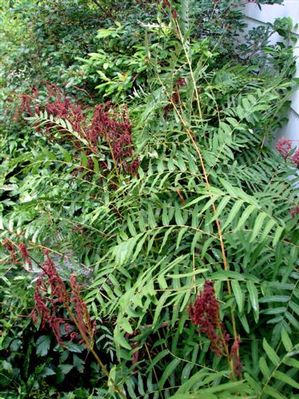

Royal Fern
Osmunda regalis
Pickup currently unavailable at Aiken Nursery
Osmunda regalis, the royal fern, is a plant of stature and quiet nobility, at home where the woods remember water and time moves slowly. The genus Osmunda gives its name to an ancient family, the Osmundaceae, sometimes called the flowering ferns, with a fossil lineage that reaches back past the Jurassic; a royal fern in the garden is a living relic of a far older flora. The natural range runs from Nova Scotia to Florida in North America, and on through Europe, Africa, and Asia, making this one of the most widely distributed ferns on earth. Both the common name and the Latin regalis salute the same quality: among the largest and most robust of all North American herbaceous plants, the royal fern reaches four to six feet where truly content.
The fronds set this fern apart from lacier kin. Coarse and twice-pinnate, they are built of broad, softly rounded leaflets that read more like the foliage of a young locust or ash than the filigree of daintier ferns, and the effect is statuesque rather than delicate. In late spring the plant lifts separate fertile fronds tipped with tassel-like clusters of sporangia, rust-brown and grain-like, and these give the old name flowering fern, though no true flower is involved. Fresh growth is flushed with bronze in spring and turns clear gold before the fronds die back in autumn.
The name Osmunda has gathered folklore over the centuries. One tradition ties the word to Osmund, a Saxon waterman said to have hidden his wife and daughter among the ferns of a river island during Danish raids; another reaches back to the Norse god Osmunder. Gardeners once knew the wiry, fibrous rootstock as osmunda fiber and prized the material as the classic potting medium for orchids. Herbalists valued the astringent rhizome as well: twelfth-century European herbals record its use on wounds and broken bones, and folk healers across Britain, northern Spain, and beyond turned to the plant for fractures, rickets, and aching joints, which earned yet another old name, bone-break fern.
In the garden, royal fern belongs where the ground stays wet: a shaded streambank, a pond or bog margin, a rain garden, or the humus-rich low ground beneath hardwoods. Alan Armitage said of the plant, "Where they are happy, they are some of the biggest, most robust plants around, not just in the fern family, but in all herbaceous plants." Give dappled light, damp feet, and acid soil that smells of leaf mold, and the fern will build slow, long-lived, statuesque clumps that anchor a wet corner for decades. Pair the royal fern with cinnamon and interrupted ferns, sedges, hostas, and Louisiana iris, and let deer pass the bold fronds by.
- Hardiness
- USDA Zones 3–9
- Sun
- Part Shade, Full Shade
- Soil
- Moist, Wet
- Mature size
- Height 3–6 Feet · Spread 3–4 Feet
- Growth rate
- Moderate
- Seasonality
- Deciduous
These statements have not been evaluated by the Food and Drug Administration. This information is shared for traditional and educational interest only and is not intended to diagnose, treat, cure, or prevent any disease. Please consult a qualified healthcare professional before any medicinal use.
- Traditional use only; not established as safe for modern internal use
- Correct identification essential before any use
From rooting to shipping, our top priority is ensuring you receive healthy, thriving plants for your garden’s success.
Because most of our plants are grown from rooted cuttings — alongside seed, air layering, and grafting chosen for each variety — you receive a stronger, true-to-type plant that establishes quickly in your garden.
Raised on organic soil blends and eco-friendly pest management — never harsh chemicals — your plant arrives healthy for your garden, your family, and the pollinators they feed.
Every purchase gives back. We donate to the Aiken Arboretum and support local wildlife conservation, so growing your garden helps protect the wider ecosystem too.

All our plant material is carefully propagated, grown, and nurtured at our humble nursery in Aiken, South Carolina.

Your plant arrives carefully packed and ready to settle in. Unpack them promptly, give them a day or two to acclimate, then plant following the notes we include — that’s all it takes. Clear care guidance comes with every order, so success is the easy part.
What to expect upon delivery
All our plants are sold in 1-gallon sizes, though the height of each plant can vary depending on its growth rate and seasonality, typically ranging from 1/2 to 2.5 feet.
Each plant is carefully packaged with its roots enclosed in a secure plastic bag containing moist soil, forming a compact root ball. To ensure safe transport, the box is padded with recycled newspaper, providing both stability and eco-friendly protection from weather during shipping.
What is your return policy?
Review our full return policy information on our SHIPPING AND RETURNS POLICY page.
What payment methods can I use?
We offer 35 different payment methods including major providers like Mastercard, Visa, PayPal, American Express and Diners as well as many different local payment methods including Klarna, iDEAL, AliPay, Sofort, giropay, and many more.
Can I make changes to my order after it’s been placed?
At Woodlanders, we strive to fulfill orders as quickly as possible. Therefore, we can only accommodate changes to your order within the first 24 hours after it has been placed. These changes include adding or removing products and modifying the delivery address. If you need to make any changes or if there has been a mistake with your order information, please reach out to us promptly via our CONTACT page with your order number for the quickest resolution.
Your satisfaction is our priority, and we appreciate your understanding and cooperation.