




Creeping Jacob's Ladder
Polemonium reptans
Pickup currently unavailable at Aiken Nursery
A spring-blooming native of the eastern woodlands, found from Ontario and Quebec south through the Appalachians and as far west as Minnesota and Oklahoma, growing on rich deciduous forest floors, along streambanks, and at the bases of sandstone canyons. Polemonium reptans is one of those native plants that rewards close attention. The leaves are pinnately compound, with seven to twenty-one paired leaflets running up each stem like the rungs of a ladder, the source of the common name, which gestures all the way back to the biblical Jacob and his dream of a stairway to heaven. The genus name is older still: Polemonium honors King Polemon of Pontus, an ancient Greek ruler with a side interest in herbalism.
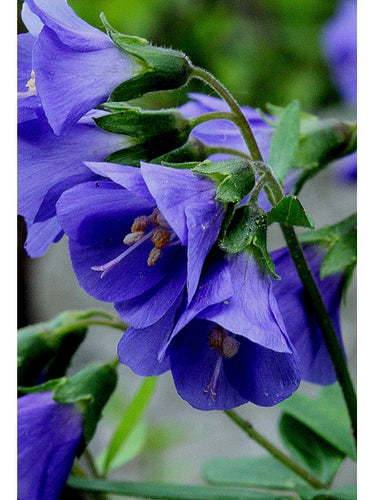
In April and May the foliage is crowned with loose branched clusters of small bell-shaped flowers in pale sky blue to soft lavender, occasionally pink, five-petaled, quietly fragrant, with prominent yellow-tipped stamens. The flowers float just above the leaves on slender stems, so the whole plant reads more like a textural drift than a single specimen. After bloom, the foliage stays green and clean through the summer, unusual among spring ephemerals, most of which disappear entirely by June, which makes Polemonium a more useful design plant than the trillium-and-bluebell crowd it shares a season with.
The plant carries real ecological weight. The species is the sole food source for Andrena polemonii, a specialist native bee that visits no other genus, and a host for the meadow rue borer moth. The early bloom catches pollinators emerging into a season when late frosts can kill the tree blossoms above. In a full list of native woodland perennials, this one is a working part of an eastern forest understory rather than a token piece.
Plant in dappled to part shade in rich, moist, humus-rich soil. Creeping Jacob's ladder spreads slowly by short rhizomes and by self-seeding, building a loose drift over a few seasons rather than colonizing aggressively. Pair with Virginia bluebells (Mertensia virginica), foamflower (Tiarella), wild geranium, trillium, jack-in-the-pulpit, or the smaller native ferns for a layered spring scene. The plant goes dormant under drought stress and returns when conditions cool.
From Spring 2026: welcome to the catalog.
- Hardiness
- USDA Zones 3–8
- Sun
- Part Shade, Full Shade
- Soil
- Moist, Rich, Well-drained
- Mature size
- Height 1–2 Feet · Spread 1–2 Feet
- Growth rate
- Moderate
- Seasonality
- Dies back
- Provenance
- Eastern North America (Ontario and Quebec south through the eastern U.S. to Georgia, west to Minnesota and Oklahoma)
Sky blue to lavender bells, April to May
These statements have not been evaluated by the Food and Drug Administration. This information is shared for traditional and educational interest only and is not intended to diagnose, treat, cure, or prevent any disease. Please consult a qualified healthcare professional before any medicinal use.
- Traditionally diaphoretic and emetic; large doses can induce sweating and vomiting
- Traditional use only, not clinically evaluated
- Consult a professional before use
From rooting to shipping, our top priority is ensuring you receive healthy, thriving plants for your garden’s success.
Because most of our plants are grown from rooted cuttings — alongside seed, air layering, and grafting chosen for each variety — you receive a stronger, true-to-type plant that establishes quickly in your garden.
Raised on organic soil blends and eco-friendly pest management — never harsh chemicals — your plant arrives healthy for your garden, your family, and the pollinators they feed.
Every purchase gives back. We donate to the Aiken Arboretum and support local wildlife conservation, so growing your garden helps protect the wider ecosystem too.

All our plant material is carefully propagated, grown, and nurtured at our humble nursery in Aiken, South Carolina.

Your plant arrives carefully packed and ready to settle in. Unpack them promptly, give them a day or two to acclimate, then plant following the notes we include — that’s all it takes. Clear care guidance comes with every order, so success is the easy part.
What to expect upon delivery
All our plants are sold in 1-gallon sizes, though the height of each plant can vary depending on its growth rate and seasonality, typically ranging from 1/2 to 2.5 feet.
Each plant is carefully packaged with its roots enclosed in a secure plastic bag containing moist soil, forming a compact root ball. To ensure safe transport, the box is padded with recycled newspaper, providing both stability and eco-friendly protection from weather during shipping.
What is your return policy?
Review our full return policy information on our SHIPPING AND RETURNS POLICY page.
What payment methods can I use?
We offer 35 different payment methods including major providers like Mastercard, Visa, PayPal, American Express and Diners as well as many different local payment methods including Klarna, iDEAL, AliPay, Sofort, giropay, and many more.
Can I make changes to my order after it’s been placed?
At Woodlanders, we strive to fulfill orders as quickly as possible. Therefore, we can only accommodate changes to your order within the first 24 hours after it has been placed. These changes include adding or removing products and modifying the delivery address. If you need to make any changes or if there has been a mistake with your order information, please reach out to us promptly via our CONTACT page with your order number for the quickest resolution.
Your satisfaction is our priority, and we appreciate your understanding and cooperation.