




Narrow leaf Mountain Mint
Pycnanthemum tenuifolium
Pickup currently unavailable at Aiken Nursery
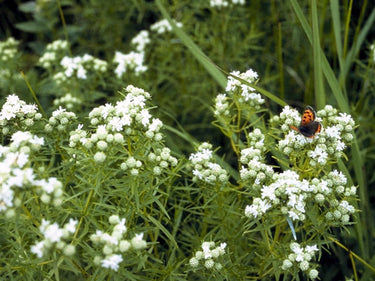
Where blunt mountain mint is all broad silver, Pycnanthemum tenuifolium is the slender cousin, a fine-textured native built from wiry stems and narrow, almost needle-thin leaves. From midsummer into early fall the plant clouds over with flat-topped clusters of tiny white to pale lavender flowers, faintly purple-speckled, and the effect at a distance is a low haze of bloom. What the flowers lack in size they make up in draw: bees, small butterflies, wasps, and beneficial insects work the nectar in numbers that make narrowleaf mountain mint one of the most valuable pollinator plants of the eastern flora.
Narrowleaf mountain mint ranges across much of eastern North America, from New England to the Gulf and west onto the prairies, at home in dry meadows, open woods, old fields, and rocky glades. Tough, adaptable, and quick to form a tidy clump, the plant has become a staple of meadow gardens and pollinator plantings, valued as much for the fine, aromatic foliage as for the bloom. Unlike some of the running mints, this species keeps to a well-behaved clump rather than sprinting through a bed.
The mountain mints carry a deep human history. Members of the genus were once called American wild basil, so common was the use of the aromatic leaves as a seasoning and a tea, and several eastern peoples turned to narrowleaf mountain mint in particular: the Meskwaki kept the plant as a remedy and even as bait for mink traps, while the Potawatomi brewed the leaves into what they considered the finest tonic for reviving someone worn down by exhaustion. The botanical name is plain description: Pycnanthemum, Greek for densely flowered, and tenuifolium, slender-leaved, for those thread-fine leaves.
In the garden, narrowleaf mountain mint is a plant for sunny, informal ground: a meadow, a native or pollinator border, a prairie planting, or the front-to-middle of a mixed bed where the fine texture reads against bolder leaves. Give full sun to part shade and average, well-drained soil, and pair the plant with purple coneflower, black-eyed Susan, little bluestem, and other prairie natives. Set the plant along a path where a brushed leaf releases the clean, minty scent, and leave the seed heads standing to feed birds and self-sow gently. Deer and rabbits pass the aromatic foliage by.
- Hardiness
- USDA Zones 6–9
- Sun
- Full Sun, Part Shade
- Soil
- Well-drained
- Mature size
- Height 2–3 Feet · Spread 2–3 Feet
- Growth rate
- Moderate
- Seasonality
- Dies back, depends on zone
Small white to pale lavender flowers in flat clusters, midsummer to early fall
These statements have not been evaluated by the Food and Drug Administration. This information is shared for traditional and educational interest only and is not intended to diagnose, treat, cure, or prevent any disease. Please consult a qualified healthcare professional before any medicinal use.
- Avoid medicinal use during pregnancy without professional guidance
- Those sensitive to mint-family plants should use caution
From rooting to shipping, our top priority is ensuring you receive healthy, thriving plants for your garden’s success.
Because most of our plants are grown from rooted cuttings — alongside seed, air layering, and grafting chosen for each variety — you receive a stronger, true-to-type plant that establishes quickly in your garden.
Raised on organic soil blends and eco-friendly pest management — never harsh chemicals — your plant arrives healthy for your garden, your family, and the pollinators they feed.
Every purchase gives back. We donate to the Aiken Arboretum and support local wildlife conservation, so growing your garden helps protect the wider ecosystem too.

All our plant material is carefully propagated, grown, and nurtured at our humble nursery in Aiken, South Carolina.

Your plant arrives carefully packed and ready to settle in. Unpack them promptly, give them a day or two to acclimate, then plant following the notes we include — that’s all it takes. Clear care guidance comes with every order, so success is the easy part.
What to expect upon delivery
All our plants are sold in 1-gallon sizes, though the height of each plant can vary depending on its growth rate and seasonality, typically ranging from 1/2 to 2.5 feet.
Each plant is carefully packaged with its roots enclosed in a secure plastic bag containing moist soil, forming a compact root ball. To ensure safe transport, the box is padded with recycled newspaper, providing both stability and eco-friendly protection from weather during shipping.
What is your return policy?
Review our full return policy information on our SHIPPING AND RETURNS POLICY page.
What payment methods can I use?
We offer 35 different payment methods including major providers like Mastercard, Visa, PayPal, American Express and Diners as well as many different local payment methods including Klarna, iDEAL, AliPay, Sofort, giropay, and many more.
Can I make changes to my order after it’s been placed?
At Woodlanders, we strive to fulfill orders as quickly as possible. Therefore, we can only accommodate changes to your order within the first 24 hours after it has been placed. These changes include adding or removing products and modifying the delivery address. If you need to make any changes or if there has been a mistake with your order information, please reach out to us promptly via our CONTACT page with your order number for the quickest resolution.
Your satisfaction is our priority, and we appreciate your understanding and cooperation.