


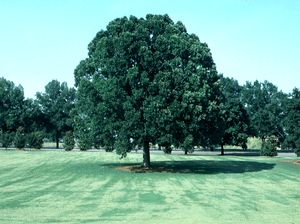

Overcup Oak
Quercus lyrata
Pickup available at Aiken Nursery
Usually ready in 2-4 days
The overcup oak is named for a small piece of botanical theater: an acorn so nearly swallowed by its cup that only the tip shows, sealed up as if against the floodwaters the tree was born to. Quercus lyrata is a creature of the southern bottomlands, the broad floodplains and backswamps from the Mississippi Delta to the Carolina river bottoms, standing through the cycles of flood and drawdown that drown lesser trees.
That patience is the whole of their character. They belong to the white oak group, carry lyre-shaped lobed leaves that give the species the name, and grow slowly into a stout, round-crowned shade tree of sixty to eighty feet.
What the wild bottoms taught them turns out to be exactly what a hard site in town wants: an oak almost indifferent to the soil, taking heavy clay, standing water, compaction, and summer drought with the same composure, which is more than most trees will give you on a parking lot island or a stormwater edge. The heavy acorns float, the way the whole strategy floats, riding the next high water downstream and feeding wood ducks and turkeys along the way.
Plant overcup oak where the ground is difficult and the timeline is long: a bottomland or rain garden, a pond or stream edge, a stormwater basin, or a tough urban site, a parking island, a street verge, a compacted lawn, that would defeat a fussier tree. Give full sun and room for a broad, round crown, pair with bald cypress, swamp tupelo, and other bottomland natives on wet ground, and enjoy one of the most adaptable and underused of the native shade oaks.
- Hardiness
- USDA Zones 5–9
- Sun
- Full Sun
- Soil
- Well-drained, Moist
- Mature size
- Height 60–80 Feet · Spread 30–40 Feet
- Growth rate
- Slow
- Seasonality
- Deciduous
From rooting to shipping, our top priority is ensuring you receive healthy, thriving plants for your garden’s success.
Because most of our plants are grown from rooted cuttings — alongside seed, air layering, and grafting chosen for each variety — you receive a stronger, true-to-type plant that establishes quickly in your garden.
Raised on organic soil blends and eco-friendly pest management — never harsh chemicals — your plant arrives healthy for your garden, your family, and the pollinators they feed.
Every purchase gives back. We donate to the Aiken Arboretum and support local wildlife conservation, so growing your garden helps protect the wider ecosystem too.

All our plant material is carefully propagated, grown, and nurtured at our humble nursery in Aiken, South Carolina.

Your plant arrives carefully packed and ready to settle in. Unpack them promptly, give them a day or two to acclimate, then plant following the notes we include — that’s all it takes. Clear care guidance comes with every order, so success is the easy part.
What to expect upon delivery
All our plants are sold in 1-gallon sizes, though the height of each plant can vary depending on its growth rate and seasonality, typically ranging from 1/2 to 2.5 feet.
Each plant is carefully packaged with its roots enclosed in a secure plastic bag containing moist soil, forming a compact root ball. To ensure safe transport, the box is padded with recycled newspaper, providing both stability and eco-friendly protection from weather during shipping.
What is your return policy?
Review our full return policy information on our SHIPPING AND RETURNS POLICY page.
What payment methods can I use?
We offer 35 different payment methods including major providers like Mastercard, Visa, PayPal, American Express and Diners as well as many different local payment methods including Klarna, iDEAL, AliPay, Sofort, giropay, and many more.
Can I make changes to my order after it’s been placed?
At Woodlanders, we strive to fulfill orders as quickly as possible. Therefore, we can only accommodate changes to your order within the first 24 hours after it has been placed. These changes include adding or removing products and modifying the delivery address. If you need to make any changes or if there has been a mistake with your order information, please reach out to us promptly via our CONTACT page with your order number for the quickest resolution.
Your satisfaction is our priority, and we appreciate your understanding and cooperation.