



Live Oak
Quercus virginiana
Pickup currently unavailable at Aiken Nursery
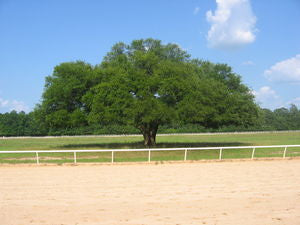
Few trees carry the weight of the South the way the live oak does. Quercus virginiana is the massive, broad-spreading, long-lived evergreen oak of the coastal plain from Virginia to Texas, the tree of avenues and old plantations, of moss-hung branches reaching low and wide over generations of the same ground. Given room and time, a live oak grows far wider than tall, the great limbs sweeping out and often down to rest on the earth, and the whole tree becomes a piece of living architecture. Georgia named the live oak the state tree, and ancient specimens are landmarks across the Deep South.
The two-to-three-inch leaves are small, leathery, and unlobed, dark and glossy above and pale beneath, and the tree holds them nearly year round, dropping and replacing the old foliage in spring so a live oak is never truly bare. Spanish moss drapes the wide branches in the humid coastal air, part of the tree's whole romantic effect, and the deeply furrowed bark and heavy, sinuous limbs give a live oak presence in every season.
No native tree has served harder. Live oak wood is among the densest and strongest of any oak, so strong that the frames of the frigate USS Constitution were built of live oak, earning the ship the name Old Ironsides when British cannonballs seemed to bounce off the hull. The small acorns are unusually sweet for an oak, low enough in tannin that Native peoples of the Southeast gathered and ate them and pressed them for a cooking oil, and the acorns still feed deer, turkey, wood ducks, and squirrels every fall. A mature live oak is a whole ecosystem, hosting a long roll of insects, birds, and epiphytes.
In the garden, plant live oak only where there is room for a very large tree, sixty to eighty feet across or more, as a specimen or avenue tree for a lawn, a park, a campus, or a long drive in the warm coastal South. Give full sun and well-drained soil, allow the low, sweeping limbs the space they want rather than limbing them up too high, and plant for the centuries. Native as far north as southeastern Virginia, live oak can be pushed a little beyond the native range in a sheltered, warm spot.
- Hardiness
- USDA Zones 7–10
- Sun
- Full Sun
- Soil
- Well-drained
- Mature size
- Height 40–50 Feet · Spread 60–100 Feet
- Growth rate
- Slow
- Seasonality
- Evergreen
From rooting to shipping, our top priority is ensuring you receive healthy, thriving plants for your garden’s success.
Because most of our plants are grown from rooted cuttings — alongside seed, air layering, and grafting chosen for each variety — you receive a stronger, true-to-type plant that establishes quickly in your garden.
Raised on organic soil blends and eco-friendly pest management — never harsh chemicals — your plant arrives healthy for your garden, your family, and the pollinators they feed.
Every purchase gives back. We donate to the Aiken Arboretum and support local wildlife conservation, so growing your garden helps protect the wider ecosystem too.

All our plant material is carefully propagated, grown, and nurtured at our humble nursery in Aiken, South Carolina.

Your plant arrives carefully packed and ready to settle in. Unpack them promptly, give them a day or two to acclimate, then plant following the notes we include — that’s all it takes. Clear care guidance comes with every order, so success is the easy part.
What to expect upon delivery
All our plants are sold in 1-gallon sizes, though the height of each plant can vary depending on its growth rate and seasonality, typically ranging from 1/2 to 2.5 feet.
Each plant is carefully packaged with its roots enclosed in a secure plastic bag containing moist soil, forming a compact root ball. To ensure safe transport, the box is padded with recycled newspaper, providing both stability and eco-friendly protection from weather during shipping.
What is your return policy?
Review our full return policy information on our SHIPPING AND RETURNS POLICY page.
What payment methods can I use?
We offer 35 different payment methods including major providers like Mastercard, Visa, PayPal, American Express and Diners as well as many different local payment methods including Klarna, iDEAL, AliPay, Sofort, giropay, and many more.
Can I make changes to my order after it’s been placed?
At Woodlanders, we strive to fulfill orders as quickly as possible. Therefore, we can only accommodate changes to your order within the first 24 hours after it has been placed. These changes include adding or removing products and modifying the delivery address. If you need to make any changes or if there has been a mistake with your order information, please reach out to us promptly via our CONTACT page with your order number for the quickest resolution.
Your satisfaction is our priority, and we appreciate your understanding and cooperation.