


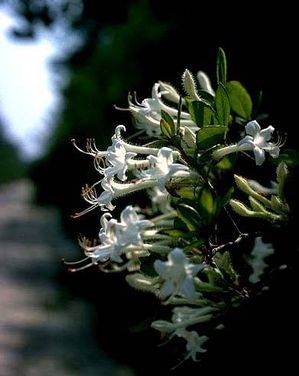

Hammocksweet Azalea
Rhododendron serrulatum
See all 49 Azaleas & Rhododendrons
Pickup currently unavailable at Aiken Nursery
The native deciduous azaleas of the southeastern United States bloom in a long relay, from the pinxters and Piedmont azaleas of March through the flame azaleas of April and May and on into July with the red of Rhododendron prunifolium. And then, once most gardeners have closed the azalea chapter for the year, Rhododendron serrulatum opens. Hammocksweet azalea is the last of the line, flowering in August and September and sometimes later still.
The flowers are white, narrowly tubular, and carried in clusters at the stem tips long after the foliage has expanded, an arrangement easy to overlook in a catalog and impossible to overlook in a garden. On a warm, humid afternoon the fragrance arrives before the eye does, sweet and clean in the manner of honeysuckle but rounder and more complex, and carrying a surprising distance. This is the reason serious collectors of native azaleas count hammocksweet essential; whatever the flowers may lack in spring flash they repay in late-season scent, feeding hummingbirds, native bees, and sphinx moths when little else in the shrub layer is in bloom.
The taxonomy is worth a sentence, since the references do not agree. Some authorities fold Rhododendron serrulatum into R. viscosum as a variety, while others hold the plant apart as a full species. Woodlanders has long argued for the latter, and the argument holds up: the two differ in habit, in flowering time, in native range, and in several botanical details. R. viscosum blooms in June and July, tops out near eight feet, and favors bogs and wet flatwoods, while R. serrulatum blooms in August and September, can rise to ten or fifteen feet, and grows in gallberry thickets, along blackwater streams, and on the slightly raised ground within a wetland that Floridians call a hammock, which is where the common name comes from. The two are close kin, but they are not the same plant, and growing both is the point.
Ranging farther south than any other native deciduous azalea, deep into central Florida where few relatives follow, hammocksweet is the better adapted of the two to the heat and humidity of the Deep South. Grow the shrub at the back of a moist border, along a woodland margin, or beside a pond or rain garden, where the tall, upright, open frame gives structural presence without density and the roots find the steady moisture the plant needs. Site where the August fragrance can be caught along a path or from a seat on a summer evening, and pair with Clethra alnifolia, which overlaps in bloom and shares the taste for moist, acidic soil, for a late-summer fragrance no other pairing quite matches. Every part is poisonous if eaten, as with all azaleas, so grow the plant for scent and not for the table.
- Hardiness
- USDA Zones 6–9
- Sun
- Part Shade
- Soil
- Well-drained, Moist, Acid
- Mature size
- Height 10–15 Feet · Spread 4–6 Feet
- Growth rate
- Moderate
- Seasonality
- Deciduous
White, narrowly tubular, very fragrant, August to September
From rooting to shipping, our top priority is ensuring you receive healthy, thriving plants for your garden’s success.
Because most of our plants are grown from rooted cuttings — alongside seed, air layering, and grafting chosen for each variety — you receive a stronger, true-to-type plant that establishes quickly in your garden.
Raised on organic soil blends and eco-friendly pest management — never harsh chemicals — your plant arrives healthy for your garden, your family, and the pollinators they feed.
Every purchase gives back. We donate to the Aiken Arboretum and support local wildlife conservation, so growing your garden helps protect the wider ecosystem too.

All our plant material is carefully propagated, grown, and nurtured at our humble nursery in Aiken, South Carolina.

Your plant arrives carefully packed and ready to settle in. Unpack them promptly, give them a day or two to acclimate, then plant following the notes we include — that’s all it takes. Clear care guidance comes with every order, so success is the easy part.
What to expect upon delivery
All our plants are sold in 1-gallon sizes, though the height of each plant can vary depending on its growth rate and seasonality, typically ranging from 1/2 to 2.5 feet.
Each plant is carefully packaged with its roots enclosed in a secure plastic bag containing moist soil, forming a compact root ball. To ensure safe transport, the box is padded with recycled newspaper, providing both stability and eco-friendly protection from weather during shipping.
What is your return policy?
Review our full return policy information on our SHIPPING AND RETURNS POLICY page.
What payment methods can I use?
We offer 35 different payment methods including major providers like Mastercard, Visa, PayPal, American Express and Diners as well as many different local payment methods including Klarna, iDEAL, AliPay, Sofort, giropay, and many more.
Can I make changes to my order after it’s been placed?
At Woodlanders, we strive to fulfill orders as quickly as possible. Therefore, we can only accommodate changes to your order within the first 24 hours after it has been placed. These changes include adding or removing products and modifying the delivery address. If you need to make any changes or if there has been a mistake with your order information, please reach out to us promptly via our CONTACT page with your order number for the quickest resolution.
Your satisfaction is our priority, and we appreciate your understanding and cooperation.