


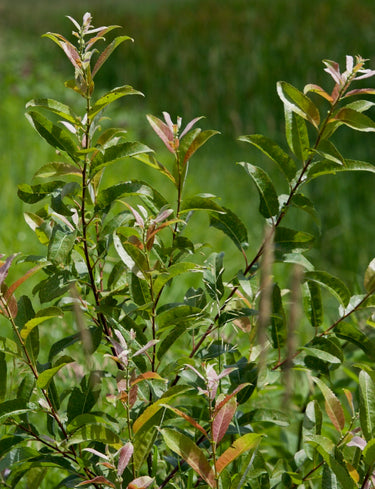


Missouri River Willow
Salix eriocephala
In propagation
Currently growing out 1 Gallon pots. Expected Fall 2026.
Add your name with the notify button below, and we will email you the moment this plant is ready to bring home.
Learn how we grow on The Prop House.
Pickup currently unavailable at Aiken Nursery
Salix eriocephala, the heart-leaved or Missouri River willow, is a graceful native shrub, sometimes a modest multi-stemmed tree, of riverbanks and wet meadows across northern and eastern North America. The plant rises on several trunks clad in coarse gray bark, reaching roughly eight to a dozen feet in the garden and more in wild thickets, and the epithet eriocephala, meaning woolly-headed, points to the soft, silky catkins that give the willow much of its charm.
In early spring, before the leaves, silky catkins open along the bare stems as one of the first stirrings of the season, quiet heralds of pollinator life that feed the earliest bees. The leaves that follow give the plant the name heart-leaved willow, rounded at the base and tapering to a lance-shaped tip, thick in texture and softly hairy beneath, finely toothed along the edge, and shed each fall.
This is a plant of wet places, at home along riverbanks, marshes, wet meadows, and flood-scoured prairies, with a strong root system that stabilizes banks and reads the floodplain's rhythm of ebb and flow. The willow is a useful plant as well as a wild one: the flexible stems have long been cut for basketry, the bark carries the traditional medicinal value of the willow family through its salicylic compounds, and the leaves host the caterpillars of the mourning cloak butterfly, Nymphalis antiopa, while the early catkins feed emerging bees.
In the garden Salix eriocephala earns a place at a pond edge, a streambank, a rain garden, or any damp, sunny spot that needs quick cover and soil holding, and the fast growth suits coppicing and restoration work alike. Give full sun and moist to wet ground, cut back hard when denser growth or fresh stems are wanted, and enjoy a willow that heals, crafts, and anchors in equal measure. For the fuller story, Woodlanders tells it on the nursery blog, The Node. Photographs courtesy of Trees Canadensis, Donald Cameron, and RW Smith.
- Hardiness
- USDA Zones 5–9
- Sun
- Full Sun
- Soil
- Moist, Wet, Sandy, Loam
- Mature size
- Height 8–12 Feet · Spread 8–10 Feet
- Growth rate
- Fast
- Seasonality
- Deciduous
Silky, silvery catkins along the bare stems in early spring, before the leaves, feeding the season's first bees.
These statements have not been evaluated by the Food and Drug Administration. This information is shared for traditional and educational interest only and is not intended to diagnose, treat, cure, or prevent any disease. Please consult a qualified healthcare professional before any medicinal use.
- Not medical advice
- Avoid if allergic to aspirin or salicylates
- Not for children or teens with fever due to Reye's syndrome risk
- Consult a qualified practitioner, especially during pregnancy or with stomach conditions
From rooting to shipping, our top priority is ensuring you receive healthy, thriving plants for your garden’s success.
Because most of our plants are grown from rooted cuttings — alongside seed, air layering, and grafting chosen for each variety — you receive a stronger, true-to-type plant that establishes quickly in your garden.
Raised on organic soil blends and eco-friendly pest management — never harsh chemicals — your plant arrives healthy for your garden, your family, and the pollinators they feed.
Every purchase gives back. We donate to the Aiken Arboretum and support local wildlife conservation, so growing your garden helps protect the wider ecosystem too.

All our plant material is carefully propagated, grown, and nurtured at our humble nursery in Aiken, South Carolina.

Your plant arrives carefully packed and ready to settle in. Unpack them promptly, give them a day or two to acclimate, then plant following the notes we include — that’s all it takes. Clear care guidance comes with every order, so success is the easy part.
What to expect upon delivery
All our plants are sold in 1-gallon sizes, though the height of each plant can vary depending on its growth rate and seasonality, typically ranging from 1/2 to 2.5 feet.
Each plant is carefully packaged with its roots enclosed in a secure plastic bag containing moist soil, forming a compact root ball. To ensure safe transport, the box is padded with recycled newspaper, providing both stability and eco-friendly protection from weather during shipping.
What is your return policy?
Review our full return policy information on our SHIPPING AND RETURNS POLICY page.
What payment methods can I use?
We offer 35 different payment methods including major providers like Mastercard, Visa, PayPal, American Express and Diners as well as many different local payment methods including Klarna, iDEAL, AliPay, Sofort, giropay, and many more.
Can I make changes to my order after it’s been placed?
At Woodlanders, we strive to fulfill orders as quickly as possible. Therefore, we can only accommodate changes to your order within the first 24 hours after it has been placed. These changes include adding or removing products and modifying the delivery address. If you need to make any changes or if there has been a mistake with your order information, please reach out to us promptly via our CONTACT page with your order number for the quickest resolution.
Your satisfaction is our priority, and we appreciate your understanding and cooperation.