



Sassafras
Sassafras albidum
Pickup currently unavailable at Aiken Nursery
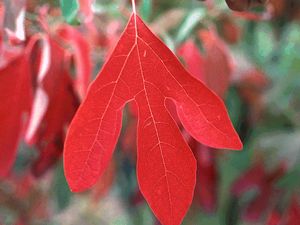
Few native trees announce themselves as cheerfully as Sassafras albidum, whose leaves come in three shapes on the same branch: an unlobed oval, a two-lobed mitten, and a three-lobed silhouette like a splayed hand. A member of the laurel family, Lauraceae, and kin to bay, cinnamon, and spicebush, sassafras carries aromatic oils in every part, so that a snapped twig or crushed leaf releases a warm, root-beer sweetness. The common name traces back through Spanish to the colonial Southeast, where the tree was among the first American plants shipped to Europe as a marketable medicine.
Widespread through the eastern United States, sassafras is one of the region's most ornamental natives and, oddly, one of the least offered for landscape use. The trees reach thirty to sixty feet, forming a rounded, layered crown, and in autumn the foliage turns a riot of clear yellow, orange, and scarlet, often on a single tree. Small yellow flowers open in early spring before the leaves, and where a female tree grows near a male, they ripen into blue-black fruits held on coral-red stalks, quickly stripped by songbirds. Sassafras is also the larval host of the spicebush swallowtail and palamedes swallowtail butterflies, whose caterpillars feed on the leaves.
No native tree has a richer ethnobotanical record. Indigenous peoples of the Southeast treated sassafras as a whole apothecary, using root, bark, and leaf against fevers, coughs, digestive trouble, rheumatism, and wounds, and colonists soon adopted the aromatic root bark as a spring tonic and the flavoring backbone of traditional root beer. The dried, ground leaves become file, the thickening and seasoning still stirred into Louisiana gumbo. The tree's signature oil is rich in safrole, later found to be toxic to the liver in concentration, and in 1960 the United States Food and Drug Administration barred safrole from commercial foods and drugs; the root beers and teas that keep the name today are made safrole-free.
In the garden, give sassafras room to sucker and a naturalistic grove will build itself, splendid at a woodland edge, in a native or wildlife planting, or as a specimen where the fall color can blaze against evergreens. Where a single-trunked tree is wanted, simply remove the suckers as they rise. Plant in well-drained, acid to neutral soil, in sun to part shade, and pair with dogwoods, native azaleas, and other understory companions that share the light. Site the tree where a passerby can crush a leaf and catch the scent, the surest introduction sassafras can give.
- Hardiness
- USDA Zones 4–9
- Sun
- Full Sun, Part Shade
- Soil
- Well-drained, Moist
- Mature size
- Height 30–60 Feet · Spread 25–40 Feet
- Growth rate
- Moderate
- Seasonality
- Deciduous
Small, yellow, weakly fragrant, early spring before the leaves
These statements have not been evaluated by the Food and Drug Administration. This information is shared for traditional and educational interest only and is not intended to diagnose, treat, cure, or prevent any disease. Please consult a qualified healthcare professional before any medicinal use.
- Safrole is toxic to the liver and classified as a carcinogen
- The US FDA banned safrole from foods and drugs in 1960
- Not for internal use; modern teas and root beers are made safrole-free
From rooting to shipping, our top priority is ensuring you receive healthy, thriving plants for your garden’s success.
Because most of our plants are grown from rooted cuttings — alongside seed, air layering, and grafting chosen for each variety — you receive a stronger, true-to-type plant that establishes quickly in your garden.
Raised on organic soil blends and eco-friendly pest management — never harsh chemicals — your plant arrives healthy for your garden, your family, and the pollinators they feed.
Every purchase gives back. We donate to the Aiken Arboretum and support local wildlife conservation, so growing your garden helps protect the wider ecosystem too.

All our plant material is carefully propagated, grown, and nurtured at our humble nursery in Aiken, South Carolina.

Your plant arrives carefully packed and ready to settle in. Unpack them promptly, give them a day or two to acclimate, then plant following the notes we include — that’s all it takes. Clear care guidance comes with every order, so success is the easy part.
What to expect upon delivery
All our plants are sold in 1-gallon sizes, though the height of each plant can vary depending on its growth rate and seasonality, typically ranging from 1/2 to 2.5 feet.
Each plant is carefully packaged with its roots enclosed in a secure plastic bag containing moist soil, forming a compact root ball. To ensure safe transport, the box is padded with recycled newspaper, providing both stability and eco-friendly protection from weather during shipping.
What is your return policy?
Review our full return policy information on our SHIPPING AND RETURNS POLICY page.
What payment methods can I use?
We offer 35 different payment methods including major providers like Mastercard, Visa, PayPal, American Express and Diners as well as many different local payment methods including Klarna, iDEAL, AliPay, Sofort, giropay, and many more.
Can I make changes to my order after it’s been placed?
At Woodlanders, we strive to fulfill orders as quickly as possible. Therefore, we can only accommodate changes to your order within the first 24 hours after it has been placed. These changes include adding or removing products and modifying the delivery address. If you need to make any changes or if there has been a mistake with your order information, please reach out to us promptly via our CONTACT page with your order number for the quickest resolution.
Your satisfaction is our priority, and we appreciate your understanding and cooperation.