


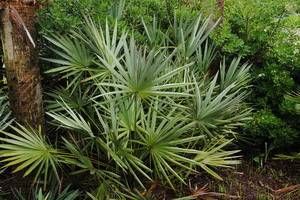

Saw Palmetto
Serenoa repens
Pickup currently unavailable at Aiken Nursery
Saw palmetto is the signature palm of the Deep South, a low, fan-leaved evergreen that carpets the pine flatwoods, scrub, and coastal dunes from the Carolinas through Florida and along the Gulf. The genus honors the American botanist Sereno Watson, and the species name repens, creeping, describes the sprawling habit, while the common name comes from the fierce saw-toothed edges that arm each leaf stalk. Serenoa repens is the only species in the genus, and among the most abundant plants in Florida.
Usually a low, clumping palm with creeping, often underground trunks, saw palmetto can in time turn upward to ten feet or more. Stiff, rounded fans of green to silvery leaves radiate from each crown, and in late spring branched panicles of small, creamy-white, fragrant flowers open among them, drawing so many bees that saw palmetto honey is a prized regional crop. Blue-black drupes ripen behind the flowers. Individual plants are extraordinarily long-lived, and some Florida clones are estimated at many centuries, perhaps thousands of years, old.
Few native plants carry a longer record of use. The Seminole and other Southeastern peoples ate the ripe drupes and turned to the plant as medicine, and by the late nineteenth century the berries had entered European and American herbal practice for urinary and reproductive complaints. Saw palmetto extract remains one of the most widely sold botanical supplements in the world, marketed for prostate health, though large modern reviews have found little or no benefit beyond placebo. The berries also feed black bears, deer, raccoons, and countless birds and insects, making saw palmetto a keystone of the wild communities.
In the garden, saw palmetto is tough, drought-tolerant, salt-tolerant, and fire-adapted, an evergreen anchor for a xeric or native planting, a coastal garden, a wildlife border, or a low, spreading groundcover on dry, sandy ground. Give full sun to light shade and sharp drainage, and expect slow but steady growth into a plant that will outlast the gardener. Site the palm away from paths where the saw-toothed stalks might catch a passerby, and pair with pines, wiregrass, and other natives of the southern sandhills and flatwoods.
- Hardiness
- USDA Zones 8–10
- Sun
- Full Sun, Part Shade
- Soil
- Well-drained, Sandy
- Mature size
- Height 5–10 Feet · Spread 6–8 Feet
- Growth rate
- Slow
- Seasonality
- Evergreen
Creamy-white, fragrant flowers in branched panicles, late spring to summer
These statements have not been evaluated by the Food and Drug Administration. This information is shared for traditional and educational interest only and is not intended to diagnose, treat, cure, or prevent any disease. Please consult a qualified healthcare professional before any medicinal use.
- Large clinical reviews have found little or no benefit for prostate symptoms compared with placebo
- May cause mild digestive upset or headache
- May interact with anticoagulant and hormonal medications
- Not recommended during pregnancy or breastfeeding
From rooting to shipping, our top priority is ensuring you receive healthy, thriving plants for your garden’s success.
Because most of our plants are grown from rooted cuttings — alongside seed, air layering, and grafting chosen for each variety — you receive a stronger, true-to-type plant that establishes quickly in your garden.
Raised on organic soil blends and eco-friendly pest management — never harsh chemicals — your plant arrives healthy for your garden, your family, and the pollinators they feed.
Every purchase gives back. We donate to the Aiken Arboretum and support local wildlife conservation, so growing your garden helps protect the wider ecosystem too.

All our plant material is carefully propagated, grown, and nurtured at our humble nursery in Aiken, South Carolina.

Your plant arrives carefully packed and ready to settle in. Unpack them promptly, give them a day or two to acclimate, then plant following the notes we include — that’s all it takes. Clear care guidance comes with every order, so success is the easy part.
What to expect upon delivery
All our plants are sold in 1-gallon sizes, though the height of each plant can vary depending on its growth rate and seasonality, typically ranging from 1/2 to 2.5 feet.
Each plant is carefully packaged with its roots enclosed in a secure plastic bag containing moist soil, forming a compact root ball. To ensure safe transport, the box is padded with recycled newspaper, providing both stability and eco-friendly protection from weather during shipping.
What is your return policy?
Review our full return policy information on our SHIPPING AND RETURNS POLICY page.
What payment methods can I use?
We offer 35 different payment methods including major providers like Mastercard, Visa, PayPal, American Express and Diners as well as many different local payment methods including Klarna, iDEAL, AliPay, Sofort, giropay, and many more.
Can I make changes to my order after it’s been placed?
At Woodlanders, we strive to fulfill orders as quickly as possible. Therefore, we can only accommodate changes to your order within the first 24 hours after it has been placed. These changes include adding or removing products and modifying the delivery address. If you need to make any changes or if there has been a mistake with your order information, please reach out to us promptly via our CONTACT page with your order number for the quickest resolution.
Your satisfaction is our priority, and we appreciate your understanding and cooperation.