




Wreath Goldenrod
Solidago caesia
Pickup currently unavailable at Aiken Nursery
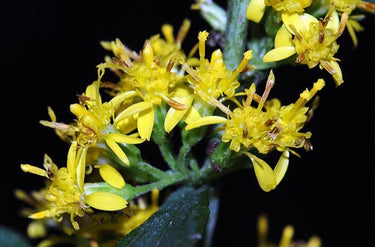
Blue-stemmed goldenrod is the goldenrod for shade. Where most of the clan demand open sun, Solidago caesia threads through the dappled light of the eastern woodland, arching slender, blue-purple stems that carry small, brilliant yellow flowers packed into the leaf axils, so the bloom runs the whole length of each stem like a garland. That habit gives the second common name, wreath goldenrod, and the late-summer to autumn color arrives just as the shade garden begins to fade.
The names carry their own small poetry. The species epithet caesia comes from the Latin for blue-gray, for the waxy bloom on the arching stems, while the genus name Solidago joins the Latin solidus, whole, with ago, to make, a nod to the long healing reputation of the goldenrods, once thought able to make a body whole again. A member of the aster family, Asteraceae, wreath goldenrod belongs to a tribe famous for feeding the late-season garden.
The goldenrods hold a deep place in traditional medicine. European goldenrod, Solidago virgaurea, has long been an official herb for the urinary tract and taken as an anti-inflammatory, and Native peoples turned to American goldenrods for wounds, sore throats, and complaints of the kidneys and joints; the dried flowers of several species were brewed as a fragrant tea. Blue-stemmed goldenrod shares that heritage as one of the woodland members of the genus, valued as much by pollinators as by herbalists, and unfairly blamed, like all goldenrods, for the hay fever actually caused by ragweed blooming at the same season.
In the garden, use blue-stemmed goldenrod to light a shaded or part-shaded border, a woodland edge, or a naturalized planting where the arching golden wands can spill among ferns, asters, and wild ginger. The late nectar draws bees, butterflies, and beneficial insects when little else is flowering, and the blue-purple stems lend a quiet contrast the rest of the year. Give dappled shade and ordinary well-drained soil, and let the clump settle into a graceful, arching presence at the close of the season.
Photos courtesy of James Reveal and RW Smith.
- Hardiness
- USDA Zones 3–8
- Sun
- Part Shade
- Soil
- Well-drained, Moist
- Mature size
- Height 1–3 Feet · Spread 2–3 Feet
- Growth rate
- Moderate
- Seasonality
- Dies back, depends on zone
Brilliant yellow, in the leaf axils along arching stems, late summer to fall
These statements have not been evaluated by the Food and Drug Administration. This information is shared for traditional and educational interest only and is not intended to diagnose, treat, cure, or prevent any disease. Please consult a qualified healthcare professional before any medicinal use.
- May trigger allergy in those sensitive to plants of the aster family
- Not for use with kidney disease except under professional guidance
- A traditional remedy; use only under qualified guidance
From rooting to shipping, our top priority is ensuring you receive healthy, thriving plants for your garden’s success.
Because most of our plants are grown from rooted cuttings — alongside seed, air layering, and grafting chosen for each variety — you receive a stronger, true-to-type plant that establishes quickly in your garden.
Raised on organic soil blends and eco-friendly pest management — never harsh chemicals — your plant arrives healthy for your garden, your family, and the pollinators they feed.
Every purchase gives back. We donate to the Aiken Arboretum and support local wildlife conservation, so growing your garden helps protect the wider ecosystem too.

All our plant material is carefully propagated, grown, and nurtured at our humble nursery in Aiken, South Carolina.

Your plant arrives carefully packed and ready to settle in. Unpack them promptly, give them a day or two to acclimate, then plant following the notes we include — that’s all it takes. Clear care guidance comes with every order, so success is the easy part.
What to expect upon delivery
All our plants are sold in 1-gallon sizes, though the height of each plant can vary depending on its growth rate and seasonality, typically ranging from 1/2 to 2.5 feet.
Each plant is carefully packaged with its roots enclosed in a secure plastic bag containing moist soil, forming a compact root ball. To ensure safe transport, the box is padded with recycled newspaper, providing both stability and eco-friendly protection from weather during shipping.
What is your return policy?
Review our full return policy information on our SHIPPING AND RETURNS POLICY page.
What payment methods can I use?
We offer 35 different payment methods including major providers like Mastercard, Visa, PayPal, American Express and Diners as well as many different local payment methods including Klarna, iDEAL, AliPay, Sofort, giropay, and many more.
Can I make changes to my order after it’s been placed?
At Woodlanders, we strive to fulfill orders as quickly as possible. Therefore, we can only accommodate changes to your order within the first 24 hours after it has been placed. These changes include adding or removing products and modifying the delivery address. If you need to make any changes or if there has been a mistake with your order information, please reach out to us promptly via our CONTACT page with your order number for the quickest resolution.
Your satisfaction is our priority, and we appreciate your understanding and cooperation.