


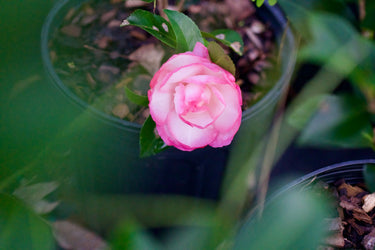


Sasanqua Camellia 'Leslie Ann'
Camellia sasanqua 'Leslie Ann'
In propagation
Currently growing out 1 Gallon pots. Expected season to be announced.
Add your name with the notify button below, and we will email you the moment this plant is ready to bring home.
Learn how we grow on The Prop House.
Pickup currently unavailable at Aiken Nursery
Two Hall of Fame inductions hang on Leslie Ann's lineage, though neither is for a flower. The award stamped on her record, the Ralph Peer Sasanqua Award, carries the name of the man who in 1923 hauled recording equipment south to Atlanta and captured the first commercial sides of country and blues. Ralph Peer pioneered field recording and sits in both the Country Music Hall of Fame and the Blues Hall of Fame, then turned that same restless curatorial instinct on camellias late in life, founding the Los Angeles Camellia Society in 1948 and rising to president of the American Camellia Society by 1957. The man who recorded the Carter Family also decided which sasanquas deserved to be remembered. In 1961, one of them was this one.
She is, despite the species name, an American plant. 'Leslie Ann' began as a chance seedling raised by Ray Davis of Mobile, Alabama, and first bloomed in 1954. Mobile is the right birthplace for her: the city has grown camellias since a single plant arrived from Liverpool in 1838, and more than a century later that obsession was still throwing seedlings worth naming. Davis grew his out, watched the first flowers open, and recognized what most chance seedlings never earn, a reason to keep going.
What he kept is a flower that resists being called simply pink or white. The bloom opens as a tight rosette and unfurls gradually to three and a half or four inches across, white washed with rose and finished at the petal edges in a fine lavender-pink line, around a center of yellow stamens. The edging reads almost like a picotee, drawn rather than brushed. An unusual lasting quality holds each bloom close to two weeks, with a few petals twisting as they age, so an established plant in full October bloom carries a layered, slightly windblown look rather than a flat uniform one.
The habit is the quiet surprise. Where most sasanquas read as dense shrubs, 'Leslie Ann' grows open and upright, and gardeners who know her keep reaching for the same comparison: the Juniper Level Botanic Garden likens the plant to a flowering cherry far more than a camellia. That openness earns a use a stiffer shrub cannot, a narrow profile for a tight space, a candidate for espalier against a warm wall, or simply a specimen given room to throw her branches. She blooms when most of the garden has finished, from mid-fall into early winter, and does it on the year's old wood without fuss.
- Hardiness
- USDA Zones 7–9
- Sun
- Part Shade
- Soil
- Acid, Well-drained
- Mature size
- Height 10–12 Feet · Spread 6–8 Feet
- Growth rate
- Slow
- Seasonality
- Evergreen
From rooting to shipping, our top priority is ensuring you receive healthy, thriving plants for your garden’s success.
Because most of our plants are grown from rooted cuttings — alongside seed, air layering, and grafting chosen for each variety — you receive a stronger, true-to-type plant that establishes quickly in your garden.
Raised on organic soil blends and eco-friendly pest management — never harsh chemicals — your plant arrives healthy for your garden, your family, and the pollinators they feed.
Every purchase gives back. We donate to the Aiken Arboretum and support local wildlife conservation, so growing your garden helps protect the wider ecosystem too.

All our plant material is carefully propagated, grown, and nurtured at our humble nursery in Aiken, South Carolina.

Your plant arrives carefully packed and ready to settle in. Unpack them promptly, give them a day or two to acclimate, then plant following the notes we include — that’s all it takes. Clear care guidance comes with every order, so success is the easy part.
What to expect upon delivery
All our plants are sold in 1-gallon sizes, though the height of each plant can vary depending on its growth rate and seasonality, typically ranging from 1/2 to 2.5 feet.
Each plant is carefully packaged with its roots enclosed in a secure plastic bag containing moist soil, forming a compact root ball. To ensure safe transport, the box is padded with recycled newspaper, providing both stability and eco-friendly protection from weather during shipping.
What is your return policy?
Review our full return policy information on our SHIPPING AND RETURNS POLICY page.
What payment methods can I use?
We offer 35 different payment methods including major providers like Mastercard, Visa, PayPal, American Express and Diners as well as many different local payment methods including Klarna, iDEAL, AliPay, Sofort, giropay, and many more.
Can I make changes to my order after it’s been placed?
At Woodlanders, we strive to fulfill orders as quickly as possible. Therefore, we can only accommodate changes to your order within the first 24 hours after it has been placed. These changes include adding or removing products and modifying the delivery address. If you need to make any changes or if there has been a mistake with your order information, please reach out to us promptly via our CONTACT page with your order number for the quickest resolution.
Your satisfaction is our priority, and we appreciate your understanding and cooperation.