


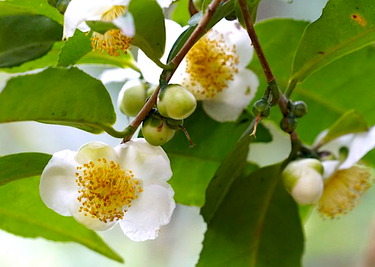


Tea Plant
Camellia sinensis
Pickup available at Aiken Nursery
Usually ready in 2-4 days
This is the tea plant. Not a tea plant but the tea plant. Every cup of green tea, black tea, white tea, oolong, and pu-erh on Earth comes from a single species, Camellia sinensis. The differences in flavor and color come from the timing of the harvest and the way the leaves are handled afterward: green tea from the youngest leaves, briefly steamed; white tea from the unopened buds; black tea from fully oxidized older leaves; oolong from partial oxidation. One plant, many fates.
People have cultivated the species in China for at least three thousand years. The native range is debated, somewhere in the borderlands where southwestern China meets Myanmar, northeast India, and the eastern Himalayas, but humans have moved the plant for so long that a clean point of origin is essentially impossible to recover. Tea began as Buddhist monastic practice, became court refinement, and is now the most-consumed beverage in the world after water. Camellia honors Georg Joseph Kamel, a seventeenth-century Moravian Jesuit who worked as a pharmacist and naturalist in the Philippines and wrote widely about Asian plants, though he never actually saw a tea plant; Linnaeus named the genus for him anyway.
What admirers of the showy japonica and sasanqua camellias do not always realize is that Camellia sinensis is a fine ornamental in its own right. The leaves are smaller, narrower, and more refined than the glossy paddles of the ornamental species, fine-toothed, deep green, with a willow-like texture. Small fragrant white flowers, each with a generous boss of yellow stamens, open from late fall into early winter, often half-tucked under the foliage like a quiet detail. The plant takes well to hedging, shaping, foundation use, container growing, or simply being left alone to round out at four to eight feet. Hardier than the ornamental camellias, the small-leaved Camellia sinensis var. sinensis that Woodlanders grows is reliably hardy through zone 7 and has been pushed into zone 6b with shelter.
For Southerners the plant carries an unexpected regional weight: South Carolina is home to the only commercial tea plantation in the continental United States, the Charleston Tea Garden on Wadmalaw Island, less than two hours from Aiken, growing Camellia sinensis for tea since the 1960s. Plant a few in the garden and you join a small, very Lowcountry tradition. A mature, well-kept plant will produce tea for a hundred years.
For the gardener who wants an ornamental that also does something useful, the collector ready to add the species that started it all, or anyone who has ever wanted to step out the back door, snip a handful of new leaves, and brew a pot.
- Hardiness
- USDA Zones 7–9
- Sun
- Part Shade
- Soil
- Well-drained, Acid, Moist, Mulched
- Mature size
- Height 4–8 Feet · Spread 6–8 Feet
- Growth rate
- Slow
- Seasonality
- Evergreen
These statements have not been evaluated by the Food and Drug Administration. This information is shared for traditional and educational interest only and is not intended to diagnose, treat, cure, or prevent any disease. Please consult a qualified healthcare professional before any medicinal use.
- Contains caffeine
- May reduce iron absorption when taken with meals
- Excess intake may cause insomnia or restlessness
- Consult a healthcare provider if pregnant or taking medication
From rooting to shipping, our top priority is ensuring you receive healthy, thriving plants for your garden’s success.
Because most of our plants are grown from rooted cuttings — alongside seed, air layering, and grafting chosen for each variety — you receive a stronger, true-to-type plant that establishes quickly in your garden.
Raised on organic soil blends and eco-friendly pest management — never harsh chemicals — your plant arrives healthy for your garden, your family, and the pollinators they feed.
Every purchase gives back. We donate to the Aiken Arboretum and support local wildlife conservation, so growing your garden helps protect the wider ecosystem too.

All our plant material is carefully propagated, grown, and nurtured at our humble nursery in Aiken, South Carolina.

Your plant arrives carefully packed and ready to settle in. Unpack them promptly, give them a day or two to acclimate, then plant following the notes we include — that’s all it takes. Clear care guidance comes with every order, so success is the easy part.
What to expect upon delivery
All our plants are sold in 1-gallon sizes, though the height of each plant can vary depending on its growth rate and seasonality, typically ranging from 1/2 to 2.5 feet.
Each plant is carefully packaged with its roots enclosed in a secure plastic bag containing moist soil, forming a compact root ball. To ensure safe transport, the box is padded with recycled newspaper, providing both stability and eco-friendly protection from weather during shipping.
What is your return policy?
Review our full return policy information on our SHIPPING AND RETURNS POLICY page.
What payment methods can I use?
We offer 35 different payment methods including major providers like Mastercard, Visa, PayPal, American Express and Diners as well as many different local payment methods including Klarna, iDEAL, AliPay, Sofort, giropay, and many more.
Can I make changes to my order after it’s been placed?
At Woodlanders, we strive to fulfill orders as quickly as possible. Therefore, we can only accommodate changes to your order within the first 24 hours after it has been placed. These changes include adding or removing products and modifying the delivery address. If you need to make any changes or if there has been a mistake with your order information, please reach out to us promptly via our CONTACT page with your order number for the quickest resolution.
Your satisfaction is our priority, and we appreciate your understanding and cooperation.