




Isu Tree
Distylium myricoides
Pickup currently unavailable at Aiken Nursery
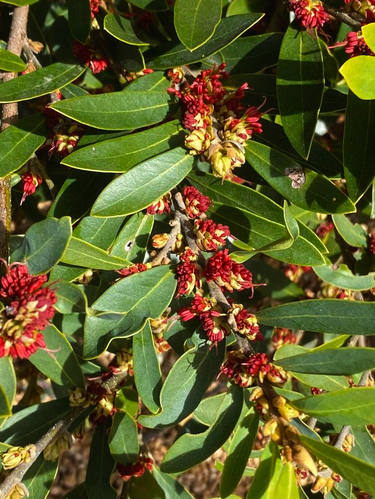
Distylium myricoides is an evergreen member of the witch-hazel family, Hamamelidaceae, and a quiet cousin to the fragrant winter witch-hazels, though the family resemblance hides in the flowers rather than the leaves. The genus name comes from the Greek for "two styles," for the paired styles at the heart of each small bloom, while the species epithet myricoides means "resembling Myrica," the bayberries, a nod to the narrow, leathery foliage.
Native to the cool mountain forests of central and southern China, this is a gracefully arching, layered shrub that grows in time into a small tree, reaching roughly ten to twelve feet with an equal spread. The narrow, oblanceolate leaves are thick and glossy, cast in a distinctive blue-green that has earned the plant the nickname blue-leaf isu tree, and they hold their color through the year. New growth often flushes bronze before settling to that cool, eucalyptus tone.
Come late winter and early spring, the shrub does something unexpected for so restrained a plant: clusters of tiny, petal-less flowers open along the branches in puffs of deep red stamens, an early and welcome source of nectar when little else is blooming. The display is subtle rather than showy, best appreciated up close, but the timing makes Distylium myricoides a favorite of early bees. American gardeners owe the plant to the Arnold Arboretum, which introduced the species from a collection made in China.
In the garden, Distylium myricoides makes a superb evergreen screen, an informal hedge, or a handsome specimen where the arching, tiered branches can be seen. Tough and adaptable, the shrub shrugs off heat, wind, drought, and even brief flooding once established, and deer tend to leave the leathery foliage alone. Pair with camellias, mahonia, and ferns in a woodland border, or use in a row for year-round structure and privacy. Photo credit to Scott A.
- Hardiness
- USDA Zones 7–9
- Sun
- Full Sun, Part Shade
- Soil
- Well-drained, Moist
- Mature size
- Height 6–12 Feet · Spread 6–8 Feet
- Growth rate
- Moderate
- Seasonality
- Evergreen
Small red-stamened flowers, late winter to early spring
From rooting to shipping, our top priority is ensuring you receive healthy, thriving plants for your garden’s success.
Because most of our plants are grown from rooted cuttings — alongside seed, air layering, and grafting chosen for each variety — you receive a stronger, true-to-type plant that establishes quickly in your garden.
Raised on organic soil blends and eco-friendly pest management — never harsh chemicals — your plant arrives healthy for your garden, your family, and the pollinators they feed.
Every purchase gives back. We donate to the Aiken Arboretum and support local wildlife conservation, so growing your garden helps protect the wider ecosystem too.

All our plant material is carefully propagated, grown, and nurtured at our humble nursery in Aiken, South Carolina.

Your plant arrives carefully packed and ready to settle in. Unpack them promptly, give them a day or two to acclimate, then plant following the notes we include — that’s all it takes. Clear care guidance comes with every order, so success is the easy part.
What to expect upon delivery
All our plants are sold in 1-gallon sizes, though the height of each plant can vary depending on its growth rate and seasonality, typically ranging from 1/2 to 2.5 feet.
Each plant is carefully packaged with its roots enclosed in a secure plastic bag containing moist soil, forming a compact root ball. To ensure safe transport, the box is padded with recycled newspaper, providing both stability and eco-friendly protection from weather during shipping.
What is your return policy?
Review our full return policy information on our SHIPPING AND RETURNS POLICY page.
What payment methods can I use?
We offer 35 different payment methods including major providers like Mastercard, Visa, PayPal, American Express and Diners as well as many different local payment methods including Klarna, iDEAL, AliPay, Sofort, giropay, and many more.
Can I make changes to my order after it’s been placed?
At Woodlanders, we strive to fulfill orders as quickly as possible. Therefore, we can only accommodate changes to your order within the first 24 hours after it has been placed. These changes include adding or removing products and modifying the delivery address. If you need to make any changes or if there has been a mistake with your order information, please reach out to us promptly via our CONTACT page with your order number for the quickest resolution.
Your satisfaction is our priority, and we appreciate your understanding and cooperation.