



American Beech
Fagus grandifolia
Pickup currently unavailable at Aiken Nursery
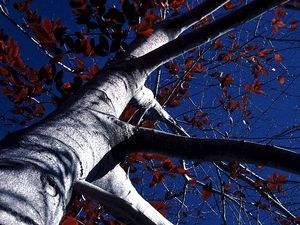
The American beech is one of the great presences of the eastern woods, a large, slow-growing deciduous tree that ranges through rich forests from southern Canada to the Gulf. Toothed oval leaves, several inches long, emerge a clean bright green, turn clear yellow in fall and then a warm russet-brown, and cling to the branches through much of winter, a habit called marcescence that gives the bare woods a soft papery whisper. The trunk is the signature: smooth, silver-gray, and elephantine, so inviting that generations have carved their initials into the living bark, a temptation best resisted since the wounds never truly heal.
The genus name Fagus reaches back through Latin to a Greek root meaning to eat, a nod to the nourishing mast the tree has always offered, while grandifolia simply means large-leaved. The English word beech shares deep linguistic roots with book, for early Germanic peoples are said to have scratched their runes onto tablets of smooth beechwood, so that the tree and the written word grew up together in the northern imagination.
The triangular beechnuts that ripen in fall are sweet and genuinely good to eat, relished by turkey, deer, bear, and squirrel, though so small and fiddly to shell that few people trouble to gather them. Native peoples made far fuller use of the tree. The Iroquois valued leaf and bark as a blood cleanser and an astringent tonic for wet conditions of the lungs, dressed burns and scalds with boiled leaves, and worked beechnut oil with bear grease into a repellent against mosquitoes; the Cherokee chewed the nuts to expel worms, and the Rappahannock steeped a bark tonic to ease the itch of poison ivy.
In the garden the American beech is a tree for the long view and the large property, a magnificent shade and specimen tree that asks for room, fertile ground, and patience. The dense canopy and shallow, greedy roots cast a shade so deep that little will grow beneath, so plan to underplant only at the outer dripline with the toughest woodland companions, autumn fern (Dryopteris erythrosora) or the arching Selaginella braunii, and leave the ground under the crown to fallen leaves. Give moist but well-drained soil and time, and the tree becomes, over decades, the silver-limbed anchor of a woodland. Do not hope to grow much of anything in the dense shade of a mature beech.
- Hardiness
- USDA Zones 4–9
- Sun
- Full Sun, Part Shade
- Soil
- Well-drained, Rich, Loam
- Mature size
- Height 50–70 Feet · Spread 40–60 Feet
- Growth rate
- Slow
- Seasonality
- Deciduous
From rooting to shipping, our top priority is ensuring you receive healthy, thriving plants for your garden’s success.
Because most of our plants are grown from rooted cuttings — alongside seed, air layering, and grafting chosen for each variety — you receive a stronger, true-to-type plant that establishes quickly in your garden.
Raised on organic soil blends and eco-friendly pest management — never harsh chemicals — your plant arrives healthy for your garden, your family, and the pollinators they feed.
Every purchase gives back. We donate to the Aiken Arboretum and support local wildlife conservation, so growing your garden helps protect the wider ecosystem too.

All our plant material is carefully propagated, grown, and nurtured at our humble nursery in Aiken, South Carolina.

Your plant arrives carefully packed and ready to settle in. Unpack them promptly, give them a day or two to acclimate, then plant following the notes we include — that’s all it takes. Clear care guidance comes with every order, so success is the easy part.
What to expect upon delivery
All our plants are sold in 1-gallon sizes, though the height of each plant can vary depending on its growth rate and seasonality, typically ranging from 1/2 to 2.5 feet.
Each plant is carefully packaged with its roots enclosed in a secure plastic bag containing moist soil, forming a compact root ball. To ensure safe transport, the box is padded with recycled newspaper, providing both stability and eco-friendly protection from weather during shipping.
What is your return policy?
Review our full return policy information on our SHIPPING AND RETURNS POLICY page.
What payment methods can I use?
We offer 35 different payment methods including major providers like Mastercard, Visa, PayPal, American Express and Diners as well as many different local payment methods including Klarna, iDEAL, AliPay, Sofort, giropay, and many more.
Can I make changes to my order after it’s been placed?
At Woodlanders, we strive to fulfill orders as quickly as possible. Therefore, we can only accommodate changes to your order within the first 24 hours after it has been placed. These changes include adding or removing products and modifying the delivery address. If you need to make any changes or if there has been a mistake with your order information, please reach out to us promptly via our CONTACT page with your order number for the quickest resolution.
Your satisfaction is our priority, and we appreciate your understanding and cooperation.