


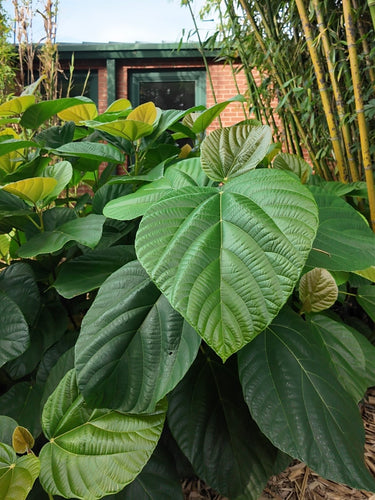


Roxburgh Fig
Ficus roxburghii
In propagation
Currently growing out 1 Gallon pots. Expected Summer 2027.
Add your name with the notify button below, and we will email you the moment this plant is ready to bring home.
Learn how we grow on The Prop House.
Pickup currently unavailable at Aiken Nursery
In the forests of the Himalayan foothills and across monsoon Asia grows a fig of ancient bearing, Ficus roxburghii, known to botanists today as Ficus auriculata and to gardeners as the elephant-ear fig. This is no dainty exotic. In the tropics the plant makes a bold small tree; in the American South, where hard frost cuts back the top, the fig returns from the root each year as a heroic perennial, with a presence as memorable as a live oak draped in Spanish moss.
Here in the Deep South, where the soil runs sandy and red and winter knocks more gently, the elephant-ear fig has found a second home. Joe LeVert of Augusta, Georgia, a true Southern plantsman, first brought the plant to our attention; his thriving, root-hardy specimen, proven through many a Southern winter, became the mother of our current stock, a plant born of grit, heritage, and care.
The leaves are the glory, sometimes stretching fifteen inches or more across, round, glossy, and substantial, rising like lacquered shields to turn any bed into a living tapestry of the tropics. In the warmest gardens the fig also bears in the curious way called cauliflory, the fat, downy fruit erupting directly from the trunk and old wood rather than the twigs. Those figs are genuinely good, eaten fresh or cooked, folded into jams and curries, or sliced green into a Vietnamese salad, and the tree carries deep ethnobotanical weight across the native range, valued for food, folklore, and traditional medicine alike.
Plant the elephant-ear fig where the roots can stretch and where water is not a stranger, in fertile, moisture-retentive soil with shelter from wind and hard frost. Give a warm, protected corner, a shaded wall or a wind-still glen, and the fig repays the kindness with almost prehistoric grandeur, the boldest foliage a Southern garden can hold short of a banana. Root-hardy to about zone 8 with a deep winter mulch, and a superb container subject that can be wheeled under cover farther north.
- Hardiness
- USDA Zones 8–10
- Sun
- Full Sun, Part Shade
- Soil
- Well-drained, Fertile
- Mature size
- Height 15–20 Feet · Spread 15–25 Feet
- Growth rate
- Moderate
- Seasonality
- Dies back, depends on zone
These statements have not been evaluated by the Food and Drug Administration. This information is shared for traditional and educational interest only and is not intended to diagnose, treat, cure, or prevent any disease. Please consult a qualified healthcare professional before any medicinal use.
- Regional traditional use; not intended as medical advice.
- Fig latex can irritate skin.
From rooting to shipping, our top priority is ensuring you receive healthy, thriving plants for your garden’s success.
Because most of our plants are grown from rooted cuttings — alongside seed, air layering, and grafting chosen for each variety — you receive a stronger, true-to-type plant that establishes quickly in your garden.
Raised on organic soil blends and eco-friendly pest management — never harsh chemicals — your plant arrives healthy for your garden, your family, and the pollinators they feed.
Every purchase gives back. We donate to the Aiken Arboretum and support local wildlife conservation, so growing your garden helps protect the wider ecosystem too.

All our plant material is carefully propagated, grown, and nurtured at our humble nursery in Aiken, South Carolina.

Your plant arrives carefully packed and ready to settle in. Unpack them promptly, give them a day or two to acclimate, then plant following the notes we include — that’s all it takes. Clear care guidance comes with every order, so success is the easy part.
What to expect upon delivery
All our plants are sold in 1-gallon sizes, though the height of each plant can vary depending on its growth rate and seasonality, typically ranging from 1/2 to 2.5 feet.
Each plant is carefully packaged with its roots enclosed in a secure plastic bag containing moist soil, forming a compact root ball. To ensure safe transport, the box is padded with recycled newspaper, providing both stability and eco-friendly protection from weather during shipping.
What is your return policy?
Review our full return policy information on our SHIPPING AND RETURNS POLICY page.
What payment methods can I use?
We offer 35 different payment methods including major providers like Mastercard, Visa, PayPal, American Express and Diners as well as many different local payment methods including Klarna, iDEAL, AliPay, Sofort, giropay, and many more.
Can I make changes to my order after it’s been placed?
At Woodlanders, we strive to fulfill orders as quickly as possible. Therefore, we can only accommodate changes to your order within the first 24 hours after it has been placed. These changes include adding or removing products and modifying the delivery address. If you need to make any changes or if there has been a mistake with your order information, please reach out to us promptly via our CONTACT page with your order number for the quickest resolution.
Your satisfaction is our priority, and we appreciate your understanding and cooperation.