


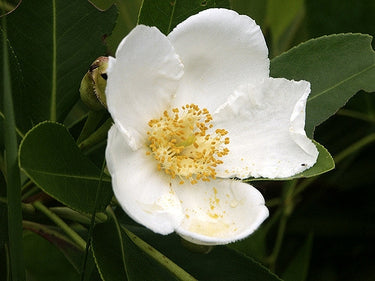


Loblolly Bay
Gordonia lasianthus
In propagation
Currently growing out 1 Gallon pots. Expected Summer 2027.
Add your name with the notify button below, and we will email you the moment this plant is ready to bring home.
Learn how we grow on The Prop House.
Pickup currently unavailable at Aiken Nursery
Read the full plant profile, with design and field notes, on our blog.
There are trees that feel as though they were written into the land's original scripture, and Gordonia lasianthus, the loblolly bay, is one of them: a native evergreen of the Southern coastal plain whose white flowers gleam like prayers unfolding in the heat of high summer.
This noble member of the tea family, Theaceae, shares kinship with the celebrated camellias and with Franklinia alatamaha, that long-lost ghost tree of Georgia's riverbanks. But unlike the mythic cousin, the loblolly bay has remained a quiet and constant presence, thriving in the moist, acidic soils of pinewoods, boggy hollows, and sandy seepage slopes from Virginia to eastern Texas.
Reaching a stately height in the wild, often thirty to sixty feet, the tree grows straight and tall with smooth gray bark and a narrow crown. The evergreen leaves are glossy and lance-shaped, catching light like bayonets, while the flowers, large, pure white, and golden-throated, open in succession from early summer into August. Each bloom lasts but a day, yet the steady procession brings a quiet brilliance to the woodland edge when most other native trees have long finished flowering. Early American botanists exploring the southeastern wilderness admired the tree, and William Bartram praised the grace of the loblolly bay in the wet pine savannas of Florida.
Gordonia can be particular in cultivation, but rewards the careful gardener. The tree prefers moist yet well-drained sandy soils, especially along seeps and natural woodland slopes, and will not abide standing water or heavy, compacted ground, where the plant languishes or perishes. Given the right site, though, the loblolly bay grows straight and tall, flowers faithfully, and offers a taste of the native grandeur of the Southern wilderness.
Photos courtesy of Will Cook and Scott Zona.
- Hardiness
- USDA Zones 7–9
- Sun
- Full Sun, Part Shade
- Soil
- Well-drained, Sandy, Moist
- Mature size
- Height 40–60 Feet · Spread 20–30 Feet
- Growth rate
- Fast
- Seasonality
- Evergreen
White, fragrant, June to September
From rooting to shipping, our top priority is ensuring you receive healthy, thriving plants for your garden’s success.
Because most of our plants are grown from rooted cuttings — alongside seed, air layering, and grafting chosen for each variety — you receive a stronger, true-to-type plant that establishes quickly in your garden.
Raised on organic soil blends and eco-friendly pest management — never harsh chemicals — your plant arrives healthy for your garden, your family, and the pollinators they feed.
Every purchase gives back. We donate to the Aiken Arboretum and support local wildlife conservation, so growing your garden helps protect the wider ecosystem too.

All our plant material is carefully propagated, grown, and nurtured at our humble nursery in Aiken, South Carolina.

Your plant arrives carefully packed and ready to settle in. Unpack them promptly, give them a day or two to acclimate, then plant following the notes we include — that’s all it takes. Clear care guidance comes with every order, so success is the easy part.
What to expect upon delivery
All our plants are sold in 1-gallon sizes, though the height of each plant can vary depending on its growth rate and seasonality, typically ranging from 1/2 to 2.5 feet.
Each plant is carefully packaged with its roots enclosed in a secure plastic bag containing moist soil, forming a compact root ball. To ensure safe transport, the box is padded with recycled newspaper, providing both stability and eco-friendly protection from weather during shipping.
What is your return policy?
Review our full return policy information on our SHIPPING AND RETURNS POLICY page.
What payment methods can I use?
We offer 35 different payment methods including major providers like Mastercard, Visa, PayPal, American Express and Diners as well as many different local payment methods including Klarna, iDEAL, AliPay, Sofort, giropay, and many more.
Can I make changes to my order after it’s been placed?
At Woodlanders, we strive to fulfill orders as quickly as possible. Therefore, we can only accommodate changes to your order within the first 24 hours after it has been placed. These changes include adding or removing products and modifying the delivery address. If you need to make any changes or if there has been a mistake with your order information, please reach out to us promptly via our CONTACT page with your order number for the quickest resolution.
Your satisfaction is our priority, and we appreciate your understanding and cooperation.