


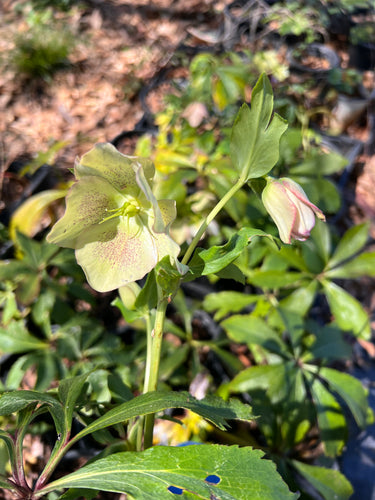


Lenten Rose
Helleborus x hybridus
Pickup currently unavailable at Aiken Nursery
The Lenten rose is not a rose at all, but a member of the buttercup tribe that happens to flower around Lent, in the raw weeks of late winter when the garden is otherwise bare. The blooms are nodding cups a couple of inches across, held just above the foliage in white, cream, pink, plum, and a smoky green, many of them freckled or veined at the throat. What look like petals are in fact sepals, which is the secret of the long show: rather than dropping in days, the flowers hold for weeks and age slowly to green, carrying color from late winter well into spring.
The name is a warning in Greek. Helleborus joins helein, to injure or kill, and bora, food, a blunt acknowledgment that every part of the plant is poisonous. Antiquity knew this well: the writers Theophrastus and Dioscorides described hellebore, and one grim account has the plant used to poison the water supply of the besieged city of Kirrha in the sixth century BC. That same toxicity is a quiet garden virtue now, since deer and rabbits recognize the bitterness and leave the leathery, evergreen, palmate leaves strictly alone. Handsome the year round, the foliage gives structure long after the flowers have faded.
Helleborus x hybridus is not one species but a garden hybrid, a swarm bred from the Lenten rose and related kinds, and the resulting plants are the most forgiving hellebores for the warm-temperate garden. Grown from seed, the offspring vary in color and marking, so each plant is a little different, and the long-lasting sepals make even the simplest a good doer. As Woodlanders notes, other species of hellebore can be had, but this hybrid is perhaps the easiest to grow in southern gardens, and named color forms and selections are offered by various growers.
In the garden, plant the Lenten rose in shade or dappled light in well-drained but moisture-retentive, ideally acid soil, at a woodland edge, along a shaded path, or massed as an evergreen groundcover beneath deciduous trees. The nodding flowers are best appreciated from below, so site the plants on a slope or a raised bed, or beside a walk where the faces can be tipped up by hand. Pair with ferns, epimedium, hardy cyclamen, and early bulbs for a long winter-into-spring picture, and value the drought tolerance that lets a mature clump hold its own in the dry shade under trees. Cut away the tattered old leaves as the buds rise, and let the fresh flowers take the stage.
- Hardiness
- USDA Zones 4–9
- Sun
- Part Shade, Full Shade
- Soil
- Well-drained, Moist
- Mature size
- Height 12–15 Inches · Spread 12–15 Inches
- Growth rate
- Moderate
- Seasonality
- Evergreen
White, pink, plum, or green, often spotted, late winter to spring
From rooting to shipping, our top priority is ensuring you receive healthy, thriving plants for your garden’s success.
Because most of our plants are grown from rooted cuttings — alongside seed, air layering, and grafting chosen for each variety — you receive a stronger, true-to-type plant that establishes quickly in your garden.
Raised on organic soil blends and eco-friendly pest management — never harsh chemicals — your plant arrives healthy for your garden, your family, and the pollinators they feed.
Every purchase gives back. We donate to the Aiken Arboretum and support local wildlife conservation, so growing your garden helps protect the wider ecosystem too.

All our plant material is carefully propagated, grown, and nurtured at our humble nursery in Aiken, South Carolina.

Your plant arrives carefully packed and ready to settle in. Unpack them promptly, give them a day or two to acclimate, then plant following the notes we include — that’s all it takes. Clear care guidance comes with every order, so success is the easy part.
What to expect upon delivery
All our plants are sold in 1-gallon sizes, though the height of each plant can vary depending on its growth rate and seasonality, typically ranging from 1/2 to 2.5 feet.
Each plant is carefully packaged with its roots enclosed in a secure plastic bag containing moist soil, forming a compact root ball. To ensure safe transport, the box is padded with recycled newspaper, providing both stability and eco-friendly protection from weather during shipping.
What is your return policy?
Review our full return policy information on our SHIPPING AND RETURNS POLICY page.
What payment methods can I use?
We offer 35 different payment methods including major providers like Mastercard, Visa, PayPal, American Express and Diners as well as many different local payment methods including Klarna, iDEAL, AliPay, Sofort, giropay, and many more.
Can I make changes to my order after it’s been placed?
At Woodlanders, we strive to fulfill orders as quickly as possible. Therefore, we can only accommodate changes to your order within the first 24 hours after it has been placed. These changes include adding or removing products and modifying the delivery address. If you need to make any changes or if there has been a mistake with your order information, please reach out to us promptly via our CONTACT page with your order number for the quickest resolution.
Your satisfaction is our priority, and we appreciate your understanding and cooperation.