

Beautybush

Kolkwitzia amabilis 'Pink Cloud'

$38.00 Sold out
USDA Zones 4–8 Full Sun and Part Shade Matures 6–8 Feet

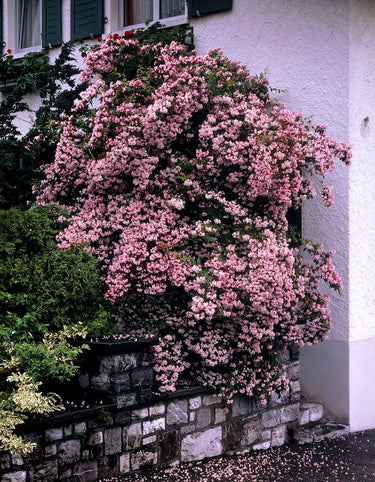
Kolkwitzia amabilis 'Pink Cloud,' the beautybush, vanishes each May under arching branches of soft, yellow-throated pink bells. Ernest Wilson counted the species among his finest, and this is the form to want.

Pickup currently unavailable at Aiken Nursery

Healthy-arrival guarantee Free shipping over $150
Roots wrapped in moist soil and padded for safe transit
Grown and shipped from our nursery in Aiken, SC
Shipping later in the season? Schedule your delivery date in your cart.

Ernest Wilson came across this shrub in the late summer of 1901, up in the mountains above Ichang in western Hubei, and sent the seed home to Veitch in Exeter. Of the two thousand or so Asian plants he introduced to the West, "Chinese" Wilson counted Kolkwitzia amabilis among his finest, which is no small ranking once you consider the company they were keeping. Dirr, in the Manual of Woody Landscape Plants, is content to let the explorer have the last word. The beautybush flowered in England by 1910 and went on to become very nearly the defining garden shrub of America between the wars, then quietly slipped out of fashion. These shrubs turn up far less often now than they ought to.

'Pink Cloud' is the form to want. Selected from a seedling at Wisley in 1946, and still carrying the RHS Award of Garden Merit, they show a deeper, cleaner pink than the wild type on flowers a shade larger. In mid to late spring the arching branches vanish under paired, bell-shaped blooms, soft pink flaring out of burgundy buds, each throat brushed with yellow. The whole shrub becomes a fountain, six to ten feet of arching growth, the branches bowed gently by the weight of all that flower. Older stems exfoliate to a quiet brown, so there is something to hold the eye once the bloom has passed.

Easy in full sun, forgiving of most soils with clay among them, and steady through drought once they have settled. Hardy to zone 4, and the deer tend to walk on by. Prune after flowering rather than before, since next spring's flowers are already set on this year's wood. Give them room and a backdrop of green to spill against, and you will spend every May watching the branches go under beneath the pink.

Will this plant thrive in your zone?

Plant Profile
At a glance
Hardiness
USDA Zones 4–8
Sun
Full Sun, Part Shade
Mature size
Height 6–8 Feet · Spread 6–8 Feet
Growth rate
Moderate
Seasonality
Deciduous
Design Notes

These shrubs have one magnificent act and a long, agreeable intermission, and it pays to plan around both. In bloom they are spectacle, a fountain of pink broad enough to anchor the back of a border or to stand alone on a lawn where the arching form can be read from every side. Give them that room. Crowded in among other shrubs the fountain collapses into a thicket, and the whole reason for growing them is lost.

The rest of the year they settle into a large, well-mannered mass of green, and with age they tend to go bare about the ankles. Both are easily managed. Set something lower in front to dress the base, and let the neighbors carry the season once the flowers have gone. Their old-garden kin, the weigelas and deutzias, make natural company, and a drift of amsonia at their feet will give back the autumn color the shrub itself never offers. The prettiest move, and an old one, is to train a summer clematis up through the branches, so the beautybush flowers in May and the clematis flowers through them in July, and the space earns its keep twice over.

Site them where you walk past in spring, near a path or under a window, somewhere the three weeks of bloom can be spent at close range. The display is brief, and worth arranging the year around.

Flower, Fruit & Foliage

Flower. The flowers come in pairs, as the honeysuckle family insists, opening from buds the color of dark wine into bells of soft, clear pink. 'Pink Cloud' carries that pink deeper, on flowers a shade larger than the wild type. Each throat is washed with yellow and lined in fine white hairs, the mouth flaring into five lobes. They gather in loose clusters along the previous year's wood, and in mid to late spring there are so many of them that the arching branches bend under the weight. A faint sweetness hangs over them on a warm afternoon. The bees work them steadily, and the hummingbirds find them too.

Fruit. The flowers give way to small dry capsules, bristled and faintly feathered, no more than a quarter inch long. They cling through autumn and well into winter, dressing the bare branches in a fine tawny stubble that takes a frost beautifully. Easy to overlook in a catalog, less so on the plant in January.

Foliage. The leaves are opposite and broadly ovate, three inches or so, tapering to a point, dark green and lightly toothed along the edge. Through summer they make a dense, matte backdrop, the kind that flatters whatever is flowering in front of them. In fall they turn yellow, though no one has ever planted the shrub on that account.

Care

Read our full care guide

Light. Give them full sun. They will live in light shade, but the flowering thins in proportion, so sun is the price of the spring display.

Soil. Undemanding. Average garden soil suits them, clay included, as long as the ground drains. Slightly acidic to neutral is ideal, though they are not fussy about it.

Water. Water regularly through the first season while the roots take hold. After that they carry dry spells well and ask for little, though a deep soak in a long drought is always welcome.

Hardiness. Reliably hardy to zone 4 and easy through zone 8, which covers all of the Southeast and most of the country besides.

Pruning. This is the one thing worth getting right. 'Pink Cloud' flowers on old wood, on growth made the year before, so prune as soon as the blooms fade and not later. Cut in late winter and you cut off spring. To keep an older plant from going leggy and bare-kneed, take out a few of the oldest stems at the base each year once flowering has finished. They take the renewal in stride, and will forgive a hard cut when one is overdue.

Habit and placement. Plan for six to ten feet, near enough as wide as tall, with an arching fountain of a form and a tendency to sucker at the margins. Give them room to spill rather than something to fight, and set a backdrop of green behind them so the pink has somewhere to read against.

Here’s a closer look at how we produce our plants

From rooting to shipping, our top priority is ensuring you receive healthy, thriving plants for your garden’s success.

Woodlanders Growing Process

Because most of our plants are grown from rooted cuttings — alongside seed, air layering, and grafting chosen for each variety — you receive a stronger, true-to-type plant that establishes quickly in your garden.

Sustainable Growing Practices

Raised on organic soil blends and eco-friendly pest management — never harsh chemicals — your plant arrives healthy for your garden, your family, and the pollinators they feed.

Supporting Local Biodiversity

Every purchase gives back. We donate to the Aiken Arboretum and support local wildlife conservation, so growing your garden helps protect the wider ecosystem too.

At Woodlanders, we are committed to quality.
Grown in Aiken, South Carolina
At Woodlanders, we are committed to quality.

All our plant material is carefully propagated, grown, and nurtured at our humble nursery in Aiken, South Carolina.

Learn more about Woodlanders
Healthy plants, ready to thrive
Success, made simple
Healthy plants, ready to thrive

Your plant arrives carefully packed and ready to settle in. Unpack them promptly, give them a day or two to acclimate, then plant following the notes we include — that’s all it takes. Clear care guidance comes with every order, so success is the easy part.

Read the care guide
Frequently Asked Questions
What to expect upon delivery

All our plants are sold in 1-gallon sizes, though the height of each plant can vary depending on its growth rate and seasonality, typically ranging from 1/2 to 2.5 feet.

Each plant is carefully packaged with its roots enclosed in a secure plastic bag containing moist soil, forming a compact root ball. To ensure safe transport, the box is padded with recycled newspaper, providing both stability and eco-friendly protection from weather during shipping.

What is your return policy?

Review our full return policy information on our SHIPPING AND RETURNS POLICY page.

What payment methods can I use?

We offer 35 different payment methods including major providers like Mastercard, Visa, PayPal, American Express and Diners as well as many different local payment methods including Klarna, iDEAL, AliPay, Sofort, giropay, and many more.

Can I make changes to my order after it’s been placed?

At Woodlanders, we strive to fulfill orders as quickly as possible. Therefore, we can only accommodate changes to your order within the first 24 hours after it has been placed. These changes include adding or removing products and modifying the delivery address. If you need to make any changes or if there has been a mistake with your order information, please reach out to us promptly via our CONTACT page with your order number for the quickest resolution.

Your satisfaction is our priority, and we appreciate your understanding and cooperation.