


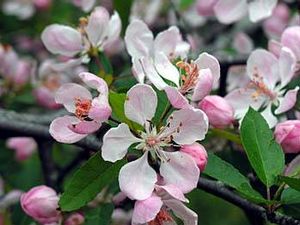

Southern Crabapple
Malus angustifolia
Pickup currently unavailable at Aiken Nursery
Crabapples in almost infinite variety are popular ornamentals in the North, and most of them sulk in zones 8 and 9. Malus angustifolia is the one that belongs here. The southern crabapple grows wild along fencerows, old field edges, and creek bottoms from Virginia to Florida and west to Mississippi, and for two weeks in late March or April the tree covers every twig in deep pink buds that open to blush-pink flowers so fragrant that William Bartram, riding through the Carolina backcountry in the 1770s, wrote of being led to groves of them by the scent alone. Few flowering trees anywhere smell as good, and none that are native to the lower South.
The name is plain Latin: angustifolia, narrow-leaved, for the slender, glossy, blunt-toothed leaves that set this species apart from the broader-leaved sweet crabapple of the Midwest. William Aiton published the name at Kew in 1789 from plants already growing in English gardens, where the southern crab had arrived decades earlier as one of the first American trees shipped east. The fruit follows in late summer, round yellow-green crabs about an inch across, hard and mouth-puckeringly sour fresh, which is exactly why they were prized. Southern households made the crabs into jelly, cider, and vinegar, and in the fall the fruit litters the ground for deer, foxes, turkeys, and grouse. The Cherokee used the bark in washes and the fruit in preserves, and the wood, hard and close-grained, went into tool handles.
In the garden expect a small rounded tree of fifteen to twenty-five feet, often multi-trunked, with spreading, somewhat thorny branches and a tendency to sucker into a loose thicket if allowed. The tree takes sun or light shade and nearly any soil short of standing water, including the thin sand and heavy clay that defeat the northern cultivars. Like all crabs the southern crabapple can host cedar-apple rust where red cedars grow near, which spots the leaves in a wet year without doing the tree any lasting harm. Prune after flowering to shape, or leave alone for the wildlife and the wild look.
Site the southern crabapple where the April scent will find a window or a porch, at the sunny edge of a woodland garden, or along a property line where the thicket can earn a living as cover. Underplant with Phlox divaricata and Amsonia that bloom in the same weeks, or let the tree stand alone in a meadow. This is the crabapple the South was given, and still the best one for the South.
- Hardiness
- USDA Zones 6–9
- Sun
- Full Sun, Part Shade
- Soil
- Well-drained, Moist
- Mature size
- Height 15–25 Feet · Spread 15–25 Feet
- Growth rate
- Medium
- Seasonality
- Deciduous
Deep pink buds opening blush pink, fragrant, late March to April
From rooting to shipping, our top priority is ensuring you receive healthy, thriving plants for your garden’s success.
Because most of our plants are grown from rooted cuttings — alongside seed, air layering, and grafting chosen for each variety — you receive a stronger, true-to-type plant that establishes quickly in your garden.
Raised on organic soil blends and eco-friendly pest management — never harsh chemicals — your plant arrives healthy for your garden, your family, and the pollinators they feed.
Every purchase gives back. We donate to the Aiken Arboretum and support local wildlife conservation, so growing your garden helps protect the wider ecosystem too.

All our plant material is carefully propagated, grown, and nurtured at our humble nursery in Aiken, South Carolina.

Your plant arrives carefully packed and ready to settle in. Unpack them promptly, give them a day or two to acclimate, then plant following the notes we include — that’s all it takes. Clear care guidance comes with every order, so success is the easy part.
What to expect upon delivery
All our plants are sold in 1-gallon sizes, though the height of each plant can vary depending on its growth rate and seasonality, typically ranging from 1/2 to 2.5 feet.
Each plant is carefully packaged with its roots enclosed in a secure plastic bag containing moist soil, forming a compact root ball. To ensure safe transport, the box is padded with recycled newspaper, providing both stability and eco-friendly protection from weather during shipping.
What is your return policy?
Review our full return policy information on our SHIPPING AND RETURNS POLICY page.
What payment methods can I use?
We offer 35 different payment methods including major providers like Mastercard, Visa, PayPal, American Express and Diners as well as many different local payment methods including Klarna, iDEAL, AliPay, Sofort, giropay, and many more.
Can I make changes to my order after it’s been placed?
At Woodlanders, we strive to fulfill orders as quickly as possible. Therefore, we can only accommodate changes to your order within the first 24 hours after it has been placed. These changes include adding or removing products and modifying the delivery address. If you need to make any changes or if there has been a mistake with your order information, please reach out to us promptly via our CONTACT page with your order number for the quickest resolution.
Your satisfaction is our priority, and we appreciate your understanding and cooperation.