


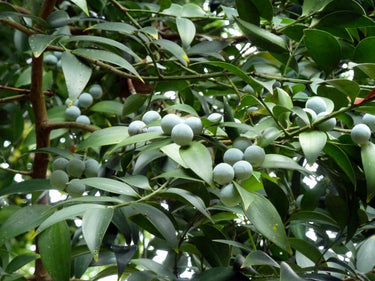

Broadleaf Podocarpus
Nageia nagi
Pickup currently unavailable at Aiken Nursery
There is something almost meditative about Nageia nagi. Named from the Japanese word nagi, meaning both calm and to mow down one's troubles, this ancient conifer carries a quiet gravitas few trees can match. At the Nyakuoji Shrine in Kyoto a sacred nagi tree has stood for centuries, believed to cut through hardship and leave peace in its wake, and sprigs of nagi have long passed between lovers as a token of steadfast devotion, the leaves too tough and resilient to tear easily, a metaphor that has endured for a thousand years.
What makes Nageia nagi so compelling to collectors and plantspeople is how thoroughly the tree defies expectation. This is a conifer, a relative of the podocarps, and yet nothing about the foliage announces as much. The leaves are oddly monocot-like, broad and glossy with parallel veins and no midrib, more reminiscent of a tropical Dracaena than anything in the pine family. That botanical strangeness is part of the charm, and the reason the tree stops knowledgeable gardeners cold.
Native to China and Japan, the nagi has been cultivated for centuries in gardens, on temple grounds, and as a subject for bonsai, a measure of both adaptability and the deep aesthetic regard the tree commands in East Asian horticulture. In Western gardens the species remains genuinely uncommon, which makes finding a plant all the more satisfying.
In the garden the nagi makes a slow, dense, columnar to pyramidal evergreen, handsome as a specimen, a screen, or a courtyard tree where the unusual glossy foliage and the green-to-reddish stems can be read at close range. The cut branches last remarkably well and are prized in floral work. Give full sun to part shade and well-drained soil, shelter from hard freezes at the cold edge of the range, and the patience a slow, long-lived tree deserves; on a female plant, small plum-bloomed fruit ripen blue to black in fall.
- Hardiness
- USDA Zones 8–10
- Sun
- Full Sun, Part Shade
- Soil
- Well-drained
- Mature size
- Height 30–60 Feet · Spread 15–20 Feet
- Growth rate
- Slow
- Seasonality
- Evergreen
From rooting to shipping, our top priority is ensuring you receive healthy, thriving plants for your garden’s success.
Because most of our plants are grown from rooted cuttings — alongside seed, air layering, and grafting chosen for each variety — you receive a stronger, true-to-type plant that establishes quickly in your garden.
Raised on organic soil blends and eco-friendly pest management — never harsh chemicals — your plant arrives healthy for your garden, your family, and the pollinators they feed.
Every purchase gives back. We donate to the Aiken Arboretum and support local wildlife conservation, so growing your garden helps protect the wider ecosystem too.

All our plant material is carefully propagated, grown, and nurtured at our humble nursery in Aiken, South Carolina.

Your plant arrives carefully packed and ready to settle in. Unpack them promptly, give them a day or two to acclimate, then plant following the notes we include — that’s all it takes. Clear care guidance comes with every order, so success is the easy part.
What to expect upon delivery
All our plants are sold in 1-gallon sizes, though the height of each plant can vary depending on its growth rate and seasonality, typically ranging from 1/2 to 2.5 feet.
Each plant is carefully packaged with its roots enclosed in a secure plastic bag containing moist soil, forming a compact root ball. To ensure safe transport, the box is padded with recycled newspaper, providing both stability and eco-friendly protection from weather during shipping.
What is your return policy?
Review our full return policy information on our SHIPPING AND RETURNS POLICY page.
What payment methods can I use?
We offer 35 different payment methods including major providers like Mastercard, Visa, PayPal, American Express and Diners as well as many different local payment methods including Klarna, iDEAL, AliPay, Sofort, giropay, and many more.
Can I make changes to my order after it’s been placed?
At Woodlanders, we strive to fulfill orders as quickly as possible. Therefore, we can only accommodate changes to your order within the first 24 hours after it has been placed. These changes include adding or removing products and modifying the delivery address. If you need to make any changes or if there has been a mistake with your order information, please reach out to us promptly via our CONTACT page with your order number for the quickest resolution.
Your satisfaction is our priority, and we appreciate your understanding and cooperation.