


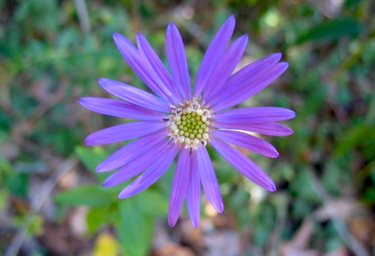


Georgia Aster
Symphyotrichum georgianum
Pickup available at Aiken Nursery
Usually ready in 2-4 days
In the open oak-hickory woodlands and fire-maintained savannas that once covered the upland South, Georgia aster was a fixture, a late-season native sending up violet-blue flowers in October and November at the precise moment when almost everything else had finished. That landscape is largely gone now, and the aster went with most of it.
What remains are scattered populations in Georgia, Alabama, the Carolinas, and a handful of other Piedmont sites, stands that persist not because the plant is particularly fragile, but because Georgia aster requires something modern land management rarely provides: disturbance, and fire specifically. The species evolved in ecosystems shaped by regular burning, where the suppression of woody growth kept the canopy open and the light reaching the ground. Take away the fire, and the shrubs move in; take away the shrubs, and the aster comes back. The plant itself is not the problem.
This makes Symphyotrichum georgianum a genuinely interesting garden subject, not just botanically significant but ecologically legible in a way few native perennials manage. In cultivation the aster spreads steadily by underground rhizomes, forming colonies that expand politely over time rather than aggressively. The October flowers are a vivid violet-blue, borne in loose branching clusters on stems that reach three to four feet, late enough in the season to overlap with goldenrods and ornamental grasses, early enough to escape the first frosts across most of the native range. Bees and late-season butterflies find the flowers reliably, sometimes in considerable numbers.
Growing Georgia aster is, in a quiet way, a conservation act. The garden populations that exist in cultivation, including the Woodlanders stock, represent a meaningful fraction of what remains of this species in any accessible form. A rare plant worth knowing, and worth growing.
- Hardiness
- USDA Zones 6–9
- Sun
- Full Sun
- Soil
- Well-drained, Acid
- Mature size
- Height 2–4 Feet · Spread 2–3 Feet
- Growth rate
- Moderate
- Seasonality
- Dies back, depends on zone
Deep violet-blue, 1.5 to 2 inches, October to November
From rooting to shipping, our top priority is ensuring you receive healthy, thriving plants for your garden’s success.
Because most of our plants are grown from rooted cuttings — alongside seed, air layering, and grafting chosen for each variety — you receive a stronger, true-to-type plant that establishes quickly in your garden.
Raised on organic soil blends and eco-friendly pest management — never harsh chemicals — your plant arrives healthy for your garden, your family, and the pollinators they feed.
Every purchase gives back. We donate to the Aiken Arboretum and support local wildlife conservation, so growing your garden helps protect the wider ecosystem too.

All our plant material is carefully propagated, grown, and nurtured at our humble nursery in Aiken, South Carolina.

Your plant arrives carefully packed and ready to settle in. Unpack them promptly, give them a day or two to acclimate, then plant following the notes we include — that’s all it takes. Clear care guidance comes with every order, so success is the easy part.
What to expect upon delivery
All our plants are sold in 1-gallon sizes, though the height of each plant can vary depending on its growth rate and seasonality, typically ranging from 1/2 to 2.5 feet.
Each plant is carefully packaged with its roots enclosed in a secure plastic bag containing moist soil, forming a compact root ball. To ensure safe transport, the box is padded with recycled newspaper, providing both stability and eco-friendly protection from weather during shipping.
What is your return policy?
Review our full return policy information on our SHIPPING AND RETURNS POLICY page.
What payment methods can I use?
We offer 35 different payment methods including major providers like Mastercard, Visa, PayPal, American Express and Diners as well as many different local payment methods including Klarna, iDEAL, AliPay, Sofort, giropay, and many more.
Can I make changes to my order after it’s been placed?
At Woodlanders, we strive to fulfill orders as quickly as possible. Therefore, we can only accommodate changes to your order within the first 24 hours after it has been placed. These changes include adding or removing products and modifying the delivery address. If you need to make any changes or if there has been a mistake with your order information, please reach out to us promptly via our CONTACT page with your order number for the quickest resolution.
Your satisfaction is our priority, and we appreciate your understanding and cooperation.