


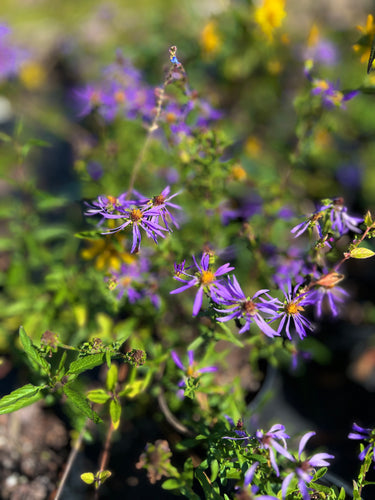


Large-flowered Aster
Symphyotrichum grandiflorum
In propagation
Currently growing out 1 Gallon pots. Expected Spring 2027.
Add your name with the notify button below, and we will email you the moment this plant is ready to bring home.
Learn how we grow on The Prop House.
Pickup currently unavailable at Aiken Nursery
A native aster with a regional accent. Most of the asters Americans plant are wide-ranging species that turn up from Maine to Texas and read essentially the same wherever they grow. Symphyotrichum grandiflorum is more particular, with a native range small and specific: the Atlantic Coastal Plain of Virginia and the Carolinas, plus the Piedmont of the Carolinas, and little more. A few hundred miles of sandy roadsides, dry pine-oak woods, abandoned fields, and forest edges from the Tidewater into the rolling country west of the fall line. For a gardener in the Carolinas or Georgia, this is one of the few asters that is genuinely here, a piece of the actual Atlantic Coastal Plain flora rather than a borrowed prairie species filling in for a missing native.
The flower is the show. Heads an inch and a quarter to an inch and a half across, large for a wild aster, hence the species name grandiflorum, with twenty to thirty narrow ray florets in a deep, saturated violet-purple around a tight golden disk. The color carries enough blue to read cool and enough red to read warm, the kind of saturated violet that catches autumn light beautifully. The flowers open at a useful time, October into November, when most of the other asters have already finished and the garden is otherwise leaning toward seed heads, late grasses, and the first frost. Among native asters, grandiflorum is one of the latest to bloom and the largest-flowered, two genuine differentiators the more common species cannot match.
The plants stand one to three feet tall on stiff, hairy, upright stems, with narrow, lance-shaped leaves and lower clasping foliage. Not a soft, billowy, fall-flowering aster, but an upright, structural one, more architectural than romantic. Dry, sandy soils suit the plant well, and poor conditions that defeat showier perennials are taken in stride, which is part of why grandiflorum has persisted along Coastal Plain roadsides where the native communities have largely disappeared. A long list of late-season insects works the flowers, including specialist Andrena bees that depend on Symphyotrichum and a few related genera for their pollen; without late asters, these bees lose their season.
For the gardener building a late-fall pollinator garden, anyone planting the actual flora of the Carolinas rather than a generic native mix, or the late-season designer wanting a structural, drought-tough, deep-purple punctuation when most other asters are spent, grandiflorum earns a place.
- Hardiness
- USDA Zones 6–8
- Sun
- Full Sun, Part Shade
- Soil
- Well-drained
- Mature size
- Height 1–3 Feet · Spread 1–2 Feet
- Growth rate
- Moderate
- Seasonality
- Dies back, depends on zone
Deep violet-purple, 1.25 to 1.5 inches, October to November
From rooting to shipping, our top priority is ensuring you receive healthy, thriving plants for your garden’s success.
Because most of our plants are grown from rooted cuttings — alongside seed, air layering, and grafting chosen for each variety — you receive a stronger, true-to-type plant that establishes quickly in your garden.
Raised on organic soil blends and eco-friendly pest management — never harsh chemicals — your plant arrives healthy for your garden, your family, and the pollinators they feed.
Every purchase gives back. We donate to the Aiken Arboretum and support local wildlife conservation, so growing your garden helps protect the wider ecosystem too.

All our plant material is carefully propagated, grown, and nurtured at our humble nursery in Aiken, South Carolina.

Your plant arrives carefully packed and ready to settle in. Unpack them promptly, give them a day or two to acclimate, then plant following the notes we include — that’s all it takes. Clear care guidance comes with every order, so success is the easy part.
What to expect upon delivery
All our plants are sold in 1-gallon sizes, though the height of each plant can vary depending on its growth rate and seasonality, typically ranging from 1/2 to 2.5 feet.
Each plant is carefully packaged with its roots enclosed in a secure plastic bag containing moist soil, forming a compact root ball. To ensure safe transport, the box is padded with recycled newspaper, providing both stability and eco-friendly protection from weather during shipping.
What is your return policy?
Review our full return policy information on our SHIPPING AND RETURNS POLICY page.
What payment methods can I use?
We offer 35 different payment methods including major providers like Mastercard, Visa, PayPal, American Express and Diners as well as many different local payment methods including Klarna, iDEAL, AliPay, Sofort, giropay, and many more.
Can I make changes to my order after it’s been placed?
At Woodlanders, we strive to fulfill orders as quickly as possible. Therefore, we can only accommodate changes to your order within the first 24 hours after it has been placed. These changes include adding or removing products and modifying the delivery address. If you need to make any changes or if there has been a mistake with your order information, please reach out to us promptly via our CONTACT page with your order number for the quickest resolution.
Your satisfaction is our priority, and we appreciate your understanding and cooperation.