




Marmaladequat
Sunquat Tree
Pickup available at Aiken Nursery
Usually ready in 2-4 days
The Sunquat began as an accident in a Beeville, Texas dooryard in the early 1940s, when a man named Leslie Cude noticed a seedling carrying fruit that looked like a small lemon and behaved like a kumquat. Walter Swingle, the great citrus authority of the day, took one look and guessed a cross of Meyer lemon and kumquat, which is where the name Lemonquat comes from and how it entered the collections as Citrus limon × Fortunella. The trouble is that the curators who have kept the tree at Riverside ever since have come to doubt him. The fruit, they think, points to a mandarin somewhere in the parentage rather than a lemon, which would make the plant a mandarinquat wearing the wrong label. Nobody has settled the question. The plant has gone out as Sunquat, Lemonquat, Lemondrop, and Marmaladequat, four names for one tree, each a different theory and not one of them proven. Asking a citrus to hold still long enough to be classified rather misunderstands the family.
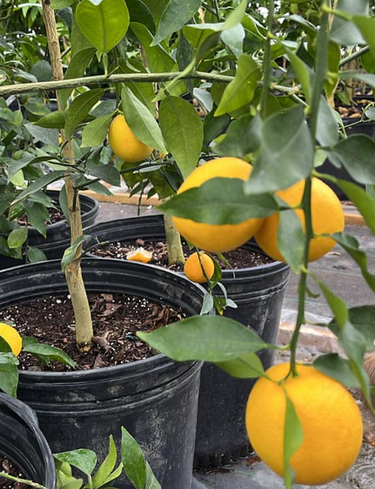
What is not in dispute is the fruit, which comes round to faintly pear-shaped, an inch and a half to three inches across, about the size of a hen's egg, ripening from green to a clear orange-yellow. The peel is thin, soft, and sweet, the flesh sharply acidic beneath, and the whole thing is built to be eaten in hand, skin and all, the way you would a kumquat that had grown up. Picked early the fruit is all bright sourness. Left on the branch into late winter the fruit sweetens, and by March the balance tips toward something you can eat without flinching. Whatever you do not eat goes into marmalade, honest enough that one of the names is built around it.
They were selected, in the first place, for gardeners whose lemons kept freezing, and that is still the practical case for growing one. They carry enough kumquat in them to take cold that would scorch a true lemon, into the mid-teens once established and dormant, while still handing you a usable acid fruit. They stay compact, six to ten feet in open ground and a good deal less in a pot, which is where most people north of the citrus belt will want the tree: out on the terrace through summer, carried to shelter before the first hard freeze. Give the tree full sun and a container that drains, a clay pot for preference, since the roots resent sitting wet. They are self-fertile, so a single plant fruits alone, and they bloom more than once a year, which means the scent comes back when you have stopped expecting it.
A lemon for people who cannot grow lemons, wearing three spare names and answering to none of them. Few plants reward a cold porch, or an argument, quite so well.
- Hardiness
- USDA Zones 8–10
- Sun
- Full Sun
- Soil
- Well-drained
- Mature size
- Height 6–10 Feet · Spread 4–5 Feet
- Growth rate
- Moderate
- Seasonality
- Evergreen
Fragrant white citrus blossoms, blooming more than once a year
From rooting to shipping, our top priority is ensuring you receive healthy, thriving plants for your garden’s success.
Because most of our plants are grown from rooted cuttings — alongside seed, air layering, and grafting chosen for each variety — you receive a stronger, true-to-type plant that establishes quickly in your garden.
Raised on organic soil blends and eco-friendly pest management — never harsh chemicals — your plant arrives healthy for your garden, your family, and the pollinators they feed.
Every purchase gives back. We donate to the Aiken Arboretum and support local wildlife conservation, so growing your garden helps protect the wider ecosystem too.

All our plant material is carefully propagated, grown, and nurtured at our humble nursery in Aiken, South Carolina.

Your plant arrives carefully packed and ready to settle in. Unpack them promptly, give them a day or two to acclimate, then plant following the notes we include — that’s all it takes. Clear care guidance comes with every order, so success is the easy part.
What to expect upon delivery
All our plants are sold in 1-gallon sizes, though the height of each plant can vary depending on its growth rate and seasonality, typically ranging from 1/2 to 2.5 feet.
Each plant is carefully packaged with its roots enclosed in a secure plastic bag containing moist soil, forming a compact root ball. To ensure safe transport, the box is padded with recycled newspaper, providing both stability and eco-friendly protection from weather during shipping.
What is your return policy?
Review our full return policy information on our SHIPPING AND RETURNS POLICY page.
What payment methods can I use?
We offer 35 different payment methods including major providers like Mastercard, Visa, PayPal, American Express and Diners as well as many different local payment methods including Klarna, iDEAL, AliPay, Sofort, giropay, and many more.
Can I make changes to my order after it’s been placed?
At Woodlanders, we strive to fulfill orders as quickly as possible. Therefore, we can only accommodate changes to your order within the first 24 hours after it has been placed. These changes include adding or removing products and modifying the delivery address. If you need to make any changes or if there has been a mistake with your order information, please reach out to us promptly via our CONTACT page with your order number for the quickest resolution.
Your satisfaction is our priority, and we appreciate your understanding and cooperation.