


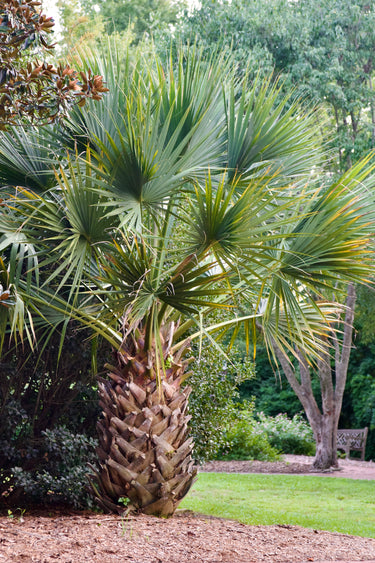

Birmingham Palmetto
Sabal birmingham
In propagation
Currently germinating seeds. Expected season to be announced.
Add your name with the notify button below, and we will email you the moment this plant is ready to bring home.
Learn how we grow on The Prop House.
Pickup currently unavailable at Aiken Nursery
Sabal 'Birmingham' is one of the hardiest fan palms an American gardener can grow, and the palm owes its survival to Woodlanders. Well-established specimens come through USDA Zone 7, deep into country where an ordinary cabbage palm needs coddling and near-perfect siting just to limp along. Broad, costapalmate, deep green fronds rise on a stout, slowly building trunk, giving the unmistakable palm silhouette hundreds of miles north of where the family usually stops.
The story begins in Birmingham, Alabama, with a Miss Eva Alexander, who raised a single palmetto from seed she had bought from California and grew the plant on for some forty years. Whatever the seed's true identity, the palm she nurtured proved astonishingly tough, surviving freeze after freeze below ten degrees Fahrenheit and at least one plunge below zero, temperatures that should have killed any palmetto outright. When Miss Alexander died in 1976, the remarkable palm was donated to the Birmingham Botanical Gardens.
The original tree declined at the Botanical Gardens and was gone by the early 1980s, and the whole singular lineage might have died with it. That the palm survives at all is down to Bob McCartney of Woodlanders, who recognized what was at stake, collected seed from the original tree before it was lost, and raised the seedlings on at the nursery in Aiken, South Carolina. Woodlanders first distributed the palm to gardeners, and virtually every Sabal 'Birmingham' growing in America today traces back to that rescue and that propagation work. This is, in the fullest sense, a Woodlanders introduction.
The exact parentage remains an open question. Sabal 'Birmingham' was once guessed to be a cross involving Sabal mexicana, though the very slow growth and hard-won cold hardiness point more convincingly to a hybrid of Sabal palmetto and Sabal minor, both of which grow wild in Alabama. The palmettos are woven through the human history of the Southeast, long furnishing thatch, basketry fiber, and, from some kinds, the edible heart, and the fan silhouette remains an emblem of the coastal South.
Patience is the price of admission. Even a well-settled plant grows slowly, a twenty-year specimen standing perhaps nine feet tall and fifteen wide, with decades more before the palm approaches the great heights the species can eventually reach. That deliberate pace is a virtue in a smaller garden, where the palm gives lasting structure without threatening to outgrow the space. Site 'Birmingham' as a specimen in full sun to part shade in well-drained soil, where the fronds can be read against sky or a plain wall, and grow a cold-hardy palm with a genuine piece of nursery history behind it.
- Hardiness
- USDA Zones 7–10
- Sun
- Full Sun, Part Shade
- Soil
- Well-drained
- Mature size
- Height 10–30 Feet · Spread 6–15 Feet
- Growth rate
- Slow
- Seasonality
- Evergreen
Creamy white flowers on branched inflorescences held among the fronds in summer, followed by small dark fruit.
From rooting to shipping, our top priority is ensuring you receive healthy, thriving plants for your garden’s success.
Because most of our plants are grown from rooted cuttings — alongside seed, air layering, and grafting chosen for each variety — you receive a stronger, true-to-type plant that establishes quickly in your garden.
Raised on organic soil blends and eco-friendly pest management — never harsh chemicals — your plant arrives healthy for your garden, your family, and the pollinators they feed.
Every purchase gives back. We donate to the Aiken Arboretum and support local wildlife conservation, so growing your garden helps protect the wider ecosystem too.

All our plant material is carefully propagated, grown, and nurtured at our humble nursery in Aiken, South Carolina.

Your plant arrives carefully packed and ready to settle in. Unpack them promptly, give them a day or two to acclimate, then plant following the notes we include — that’s all it takes. Clear care guidance comes with every order, so success is the easy part.
What to expect upon delivery
All our plants are sold in 1-gallon sizes, though the height of each plant can vary depending on its growth rate and seasonality, typically ranging from 1/2 to 2.5 feet.
Each plant is carefully packaged with its roots enclosed in a secure plastic bag containing moist soil, forming a compact root ball. To ensure safe transport, the box is padded with recycled newspaper, providing both stability and eco-friendly protection from weather during shipping.
What is your return policy?
Review our full return policy information on our SHIPPING AND RETURNS POLICY page.
What payment methods can I use?
We offer 35 different payment methods including major providers like Mastercard, Visa, PayPal, American Express and Diners as well as many different local payment methods including Klarna, iDEAL, AliPay, Sofort, giropay, and many more.
Can I make changes to my order after it’s been placed?
At Woodlanders, we strive to fulfill orders as quickly as possible. Therefore, we can only accommodate changes to your order within the first 24 hours after it has been placed. These changes include adding or removing products and modifying the delivery address. If you need to make any changes or if there has been a mistake with your order information, please reach out to us promptly via our CONTACT page with your order number for the quickest resolution.
Your satisfaction is our priority, and we appreciate your understanding and cooperation.