


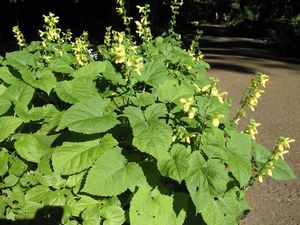

Japanese Yellow Sage
Salvia koyamae
Pickup currently unavailable at Aiken Nursery
Here is a salvia that wants what salvias are not supposed to want. Most of the genus comes from sunbaked Mediterranean hillsides, dry Mexican mountains, and dusty California chaparral, so that the very word Salvia is shorthand for full sun, gravelly soil, and a watering regime closer to neglect than care. Salvia koyamae, endemic to the cool wooded slopes of Honshu in Japan, breaks every rule, asking instead for shade, moist humus-rich woodland duff, and the cool morning light that filters through a deciduous canopy. This is, in short, the salvia to grow where hostas would otherwise go.
The Japanese name, Shinano-akigiri, names both the plant's home and season: Shinano is the old name for the mountainous Nagano region where the species was first collected, and akigiri reads loosely as autumn paulownia, aki for autumn and kiri for the way the broad, arrow-shaped leaves echo the foliage of the paulownia tree. The species was formally described by Tomitaro Makino, the self-taught botanist often called the father of Japanese plant science, and named in honor of his colleague Mitsuo Koyama, the same man remembered in Picea koyamae, a small overlapping circle of late-Meiji Japanese botany.
The leaves are the first thing to catch the eye. Large for a salvia, six inches long and nearly as wide, softly hairy, arrow-to-heart-shaped, fresh green and lightly fragrant when bruised, they build a loose, low, almost groundcover-like clump that fills space generously through the season. From August into October slender spikes lift just above the foliage carrying the second surprise, pale butter-yellow tubular flowers, two-lipped and translucent, in a color almost no other salvia produces. Yellow is rare in the genus at all, and a yellow shade salvia is a small horticultural unicorn.
Pair the plant with hostas, hellebores, hakone grass, tiarella, heuchera, Iris cristata, the smaller ferns, and the spring ephemerals such as trillium, mertensia, and bloodroot that go dormant just as Salvia koyamae hits full stride. Genuinely rare even in the wild of its native Honshu, and uncommon enough in the Western trade to feel like a real find in a catalog, this is the salvia for the gardener whose sunny sage patch is full and whose shade beds want something no one else is growing.
- Hardiness
- USDA Zones 6–10
- Sun
- Part Shade, Full Shade
- Soil
- Moist
- Mature size
- Height 1–2 Feet · Spread 2–3 Feet
- Growth rate
- Fast
- Seasonality
- Dies back, depends on zone
Pale butter-yellow, tubular, two-lipped flowers on slender spikes from August into October, a rare color for a salvia and a fall hummingbird draw.
From rooting to shipping, our top priority is ensuring you receive healthy, thriving plants for your garden’s success.
Because most of our plants are grown from rooted cuttings — alongside seed, air layering, and grafting chosen for each variety — you receive a stronger, true-to-type plant that establishes quickly in your garden.
Raised on organic soil blends and eco-friendly pest management — never harsh chemicals — your plant arrives healthy for your garden, your family, and the pollinators they feed.
Every purchase gives back. We donate to the Aiken Arboretum and support local wildlife conservation, so growing your garden helps protect the wider ecosystem too.

All our plant material is carefully propagated, grown, and nurtured at our humble nursery in Aiken, South Carolina.

Your plant arrives carefully packed and ready to settle in. Unpack them promptly, give them a day or two to acclimate, then plant following the notes we include — that’s all it takes. Clear care guidance comes with every order, so success is the easy part.
What to expect upon delivery
All our plants are sold in 1-gallon sizes, though the height of each plant can vary depending on its growth rate and seasonality, typically ranging from 1/2 to 2.5 feet.
Each plant is carefully packaged with its roots enclosed in a secure plastic bag containing moist soil, forming a compact root ball. To ensure safe transport, the box is padded with recycled newspaper, providing both stability and eco-friendly protection from weather during shipping.
What is your return policy?
Review our full return policy information on our SHIPPING AND RETURNS POLICY page.
What payment methods can I use?
We offer 35 different payment methods including major providers like Mastercard, Visa, PayPal, American Express and Diners as well as many different local payment methods including Klarna, iDEAL, AliPay, Sofort, giropay, and many more.
Can I make changes to my order after it’s been placed?
At Woodlanders, we strive to fulfill orders as quickly as possible. Therefore, we can only accommodate changes to your order within the first 24 hours after it has been placed. These changes include adding or removing products and modifying the delivery address. If you need to make any changes or if there has been a mistake with your order information, please reach out to us promptly via our CONTACT page with your order number for the quickest resolution.
Your satisfaction is our priority, and we appreciate your understanding and cooperation.