


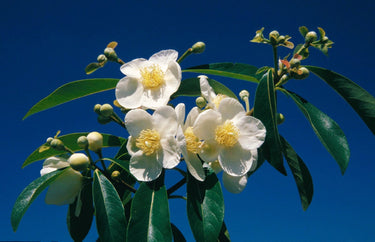


Schima-Franklinia Hybrid
Schima x Franklinia (×Schimlinia floribunda)
Pickup currently unavailable at Aiken Nursery
×Schimlinia floribunda is one of the rarest woody plants a gardener can grow: a deliberate intergeneric hybrid between two members of the tea family, Theaceae, uniting the fabled Franklinia alatamaha with the Asian evergreen Schima argentea. The cross marries the ornamental drama and hardiness of Franklinia with the vigor, adaptability, and evergreen constitution of Schima, and the result carries large, camellia-like white flowers, glossy foliage, and an upright, well-furnished frame. The hybrid formula name honors both parents at once, Schima and Franklinia folded into a single word.
The hybrid was raised by Dr. Thomas Ranney and colleagues at North Carolina State University's Mountain Horticultural Crops Research Station, from deliberate cross-pollinations made in 1999 and 2000 and repeated in 2002. The hybrid was formally described as ×Schimlinia floribunda in 2003, and the 2002 seedlings first flowered in 2004. The aim was frankly practical: to combine the desirable traits of a nearly impossible garden plant, Franklinia, with the easier temperament of a related genus, and so to carry rare Theaceae genetics into gardens that Franklinia alone would defeat.
Half of that heritage is pure legend. Franklinia alatamaha, named by the botanist explorers John and William Bartram for their friend Benjamin Franklin, was found growing along Georgia's Altamaha River in 1765 and never reliably seen in the wild after the early nineteenth century. Every Franklin tree alive today descends from seed the Bartrams carried home to Philadelphia, which makes the parent one of horticulture's great rescues from extinction. Schima, the other parent, brings the broad evergreen leaves and lasting constitution of the warm-temperate Asian forests, a lineage as tough as Franklinia is delicate.
In the garden, grow ×Schimlinia floribunda as a specimen or a large flowering shrub where the late show can be appreciated up close, for the fragrant white blooms open from late summer into fall when little else in the border is flowering. The glossy, deep-veined leaves hold much of the year, thinning somewhat at the cold edge of the range, so treat the plant as evergreen in the warm South and semi-evergreen where winters bite. High heat and humidity tolerance make ×Schimlinia a natural for southeastern gardens; give a sheltered, part-shaded to sunny site, rich well-drained soil, and the company of camellias, tea olives, and other broadleaf evergreens that share the taste. To grow this hybrid is to keep a living piece of botanical history, and one of the newest chapters in it.
Photo courtesy of Trees and Shrubs Online and Ruth Happel.
- Hardiness
- USDA Zones 7–9
- Sun
- Full Sun, Part Shade
- Soil
- Well-drained, Moist
- Mature size
- Height 10–20 Feet · Spread 5–10 Feet
- Growth rate
- Moderate
- Seasonality
- Semi-Evergreen
Large, fragrant, white, camellia-like, late summer to fall
From rooting to shipping, our top priority is ensuring you receive healthy, thriving plants for your garden’s success.
Because most of our plants are grown from rooted cuttings — alongside seed, air layering, and grafting chosen for each variety — you receive a stronger, true-to-type plant that establishes quickly in your garden.
Raised on organic soil blends and eco-friendly pest management — never harsh chemicals — your plant arrives healthy for your garden, your family, and the pollinators they feed.
Every purchase gives back. We donate to the Aiken Arboretum and support local wildlife conservation, so growing your garden helps protect the wider ecosystem too.

All our plant material is carefully propagated, grown, and nurtured at our humble nursery in Aiken, South Carolina.

Your plant arrives carefully packed and ready to settle in. Unpack them promptly, give them a day or two to acclimate, then plant following the notes we include — that’s all it takes. Clear care guidance comes with every order, so success is the easy part.
What to expect upon delivery
All our plants are sold in 1-gallon sizes, though the height of each plant can vary depending on its growth rate and seasonality, typically ranging from 1/2 to 2.5 feet.
Each plant is carefully packaged with its roots enclosed in a secure plastic bag containing moist soil, forming a compact root ball. To ensure safe transport, the box is padded with recycled newspaper, providing both stability and eco-friendly protection from weather during shipping.
What is your return policy?
Review our full return policy information on our SHIPPING AND RETURNS POLICY page.
What payment methods can I use?
We offer 35 different payment methods including major providers like Mastercard, Visa, PayPal, American Express and Diners as well as many different local payment methods including Klarna, iDEAL, AliPay, Sofort, giropay, and many more.
Can I make changes to my order after it’s been placed?
At Woodlanders, we strive to fulfill orders as quickly as possible. Therefore, we can only accommodate changes to your order within the first 24 hours after it has been placed. These changes include adding or removing products and modifying the delivery address. If you need to make any changes or if there has been a mistake with your order information, please reach out to us promptly via our CONTACT page with your order number for the quickest resolution.
Your satisfaction is our priority, and we appreciate your understanding and cooperation.