


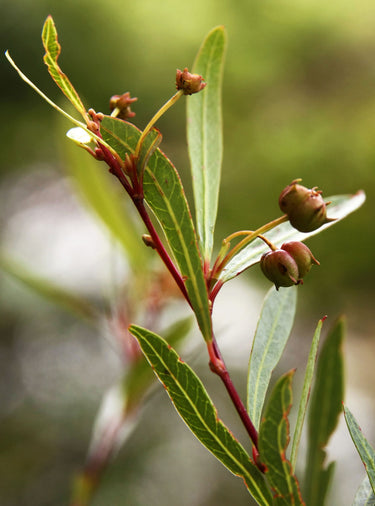


Sarandi
Sebastiania schottiana
Pickup available at Aiken Nursery
Usually ready in 2-4 days
Some plants arrive with a pedigree, and some arrive with a person. This one came to us from Ken Wurdack, a botanist at the Smithsonian's National Museum of Natural History, and his work centers on the systematics and evolution of the spurge family, Euphorbiaceae. He's the sort of botanist who describes entirely new genera in the tribe Hippomaneae, which happens to be the exact tribe Sebastiania sits in. So this is a spurge handed over by a man who names spurges for a living, which is about the best reference a euphorb could ask for.
At home they're called sarandi. Across southern Brazil they line the margins of rivers and lagoons, ranging south to Uruguay and northeastern Argentina, a riverbank shrub built for water that rises and falls and sometimes closes overhead entirely. The leaves are narrow and willow-fine, carried along slender branches that lean with a current rather than break against it. Older names like angustifolia and hippophaifolia all circle the same idea: something thin, soft, and quietly elegant. The flowers and fruit are modest, the way the spurge family usually is when it isn't busy being a poinsettia.
We'll be straight with you. There is very little written about this plant. What exists is mostly herbarium sheets and Brazilian field records, almost nothing in the way of garden experience, and certainly no one telling us how a sarandi spends a South Carolina summer. Our own stock is still small, young plants finding their feet, so for the moment most of what we can offer you is the imagining: a fine green veil leaning over water, a pond margin softened, a low hedge that moves when the wind does. Whether they'll take to a Carolina pond or sulk through our winters, we honestly don't yet know.
Which is the whole appeal. A plant with a real story, a serious provenance, and a nearly blank page where the growing notes ought to be. Someone gets to write the first chapter. It might as well be you.
- Hardiness
- USDA Zones 8–10
- Sun
- Full Sun
- Soil
- Wet
- Mature size
- Height 6–16 Feet · Spread 4–10 Feet
- Growth rate
- Fast
- Seasonality
- Deciduous
From rooting to shipping, our top priority is ensuring you receive healthy, thriving plants for your garden’s success.
Because most of our plants are grown from rooted cuttings — alongside seed, air layering, and grafting chosen for each variety — you receive a stronger, true-to-type plant that establishes quickly in your garden.
Raised on organic soil blends and eco-friendly pest management — never harsh chemicals — your plant arrives healthy for your garden, your family, and the pollinators they feed.
Every purchase gives back. We donate to the Aiken Arboretum and support local wildlife conservation, so growing your garden helps protect the wider ecosystem too.

All our plant material is carefully propagated, grown, and nurtured at our humble nursery in Aiken, South Carolina.

Your plant arrives carefully packed and ready to settle in. Unpack them promptly, give them a day or two to acclimate, then plant following the notes we include — that’s all it takes. Clear care guidance comes with every order, so success is the easy part.
What to expect upon delivery
All our plants are sold in 1-gallon sizes, though the height of each plant can vary depending on its growth rate and seasonality, typically ranging from 1/2 to 2.5 feet.
Each plant is carefully packaged with its roots enclosed in a secure plastic bag containing moist soil, forming a compact root ball. To ensure safe transport, the box is padded with recycled newspaper, providing both stability and eco-friendly protection from weather during shipping.
What is your return policy?
Review our full return policy information on our SHIPPING AND RETURNS POLICY page.
What payment methods can I use?
We offer 35 different payment methods including major providers like Mastercard, Visa, PayPal, American Express and Diners as well as many different local payment methods including Klarna, iDEAL, AliPay, Sofort, giropay, and many more.
Can I make changes to my order after it’s been placed?
At Woodlanders, we strive to fulfill orders as quickly as possible. Therefore, we can only accommodate changes to your order within the first 24 hours after it has been placed. These changes include adding or removing products and modifying the delivery address. If you need to make any changes or if there has been a mistake with your order information, please reach out to us promptly via our CONTACT page with your order number for the quickest resolution.
Your satisfaction is our priority, and we appreciate your understanding and cooperation.