


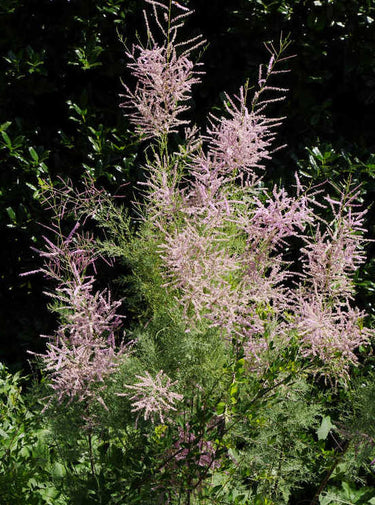

Salt Cedar
Tamarix ramosissima ‘Rubra’
Pickup currently unavailable at Aiken Nursery
Imagine a shrub that looks like a conifer caught in an airy, pink-flowering daydream. Tamarix ramosissima, often called tamarisk or saltcedar, is a deciduous shrub or small tree with fine, scale-like leaves that read as cedar from ten feet away, yet drop in winter. That contradiction is the charm: conifer-like texture on a plant that is no conifer at all.
'Rubra' is grown for rosy-pink, plume-like panicles that dress the branch tips in late spring, often carrying on into early summer. The bloom effect is soft, hazy, and surprisingly luminous, like pink smoke caught in the branches and drawn as a veil through silver-green foliage. Backlit by late afternoon sun, the flowering sprays glow with a translucent quality.
Native across a broad band of Eurasia, from southeastern Europe through western and central Asia, the tamarisks evolved where water comes and goes, soils turn alkaline or salty, winds are constant, and summers punish. That heritage explains a legendary toughness: few ornamental shrubs match tamarisk for tolerance of salinity, drought, wind, and lean, difficult ground, which is why the plant became a staple of coastal exposures and hard, dry sites.
That same resilience carries a serious caveat. Away from the garden, tamarisk is one of the most aggressive woody invaders of the American West, crowding out native vegetation, drawing down water tables, and salting the soil along rivers and washes.
Important legal and ecological note
Tamarix ramosissima is regulated as a noxious weed in a number of areas because of that invasive behavior, including under North Dakota law, where distribution and sale are prohibited and landowners are required to control or eradicate the plant. Please check local regulations before purchasing or planting, especially in western states and anywhere near waterways.
Photo courtesy of the JC Raulston Arboretum.
- Hardiness
- USDA Zones 3–8
- Sun
- Full Sun
- Soil
- Well-drained
- Mature size
- Height 15–20 Feet · Spread 15–20 Feet
- Growth rate
- Fast
- Seasonality
- Deciduous
Rosy-pink, plume-like panicles, late spring into early summer
From rooting to shipping, our top priority is ensuring you receive healthy, thriving plants for your garden’s success.
Because most of our plants are grown from rooted cuttings — alongside seed, air layering, and grafting chosen for each variety — you receive a stronger, true-to-type plant that establishes quickly in your garden.
Raised on organic soil blends and eco-friendly pest management — never harsh chemicals — your plant arrives healthy for your garden, your family, and the pollinators they feed.
Every purchase gives back. We donate to the Aiken Arboretum and support local wildlife conservation, so growing your garden helps protect the wider ecosystem too.

All our plant material is carefully propagated, grown, and nurtured at our humble nursery in Aiken, South Carolina.

Your plant arrives carefully packed and ready to settle in. Unpack them promptly, give them a day or two to acclimate, then plant following the notes we include — that’s all it takes. Clear care guidance comes with every order, so success is the easy part.
What to expect upon delivery
All our plants are sold in 1-gallon sizes, though the height of each plant can vary depending on its growth rate and seasonality, typically ranging from 1/2 to 2.5 feet.
Each plant is carefully packaged with its roots enclosed in a secure plastic bag containing moist soil, forming a compact root ball. To ensure safe transport, the box is padded with recycled newspaper, providing both stability and eco-friendly protection from weather during shipping.
What is your return policy?
Review our full return policy information on our SHIPPING AND RETURNS POLICY page.
What payment methods can I use?
We offer 35 different payment methods including major providers like Mastercard, Visa, PayPal, American Express and Diners as well as many different local payment methods including Klarna, iDEAL, AliPay, Sofort, giropay, and many more.
Can I make changes to my order after it’s been placed?
At Woodlanders, we strive to fulfill orders as quickly as possible. Therefore, we can only accommodate changes to your order within the first 24 hours after it has been placed. These changes include adding or removing products and modifying the delivery address. If you need to make any changes or if there has been a mistake with your order information, please reach out to us promptly via our CONTACT page with your order number for the quickest resolution.
Your satisfaction is our priority, and we appreciate your understanding and cooperation.