


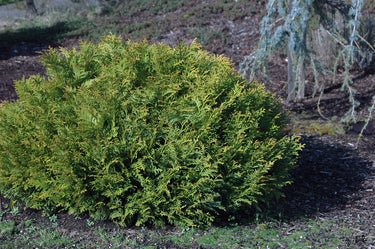


Dwarf Hiba Cedar
Thujopsis dolabrata 'Nana'
In propagation
Currently growing out 1 Gallon pots. Expected Spring 2027.
Add your name with the notify button below, and we will email you the moment this plant is ready to bring home.
Learn how we grow on The Prop House.
Pickup currently unavailable at Aiken Nursery
A dwarf form of one of Japan's legendary Five Sacred Trees of Kiso, the goboku no kinbatsu, a select group of conifers protected by feudal law for centuries, reserved for imperial residences and temple construction, where commoners caught poaching the wood faced execution. The species, Thujopsis dolabrata, is endemic to Japan and known there as asunaro, a name that translates beautifully and a little wistfully as tomorrow it will become hinoki, a nod to the tree's resemblance to the more revered hinoki cypress, forever almost but not quite the more famous tree. Thujopsis is the sole species in the entire genus.
'Nana' is the dwarf form, a Japanese garden selection old enough that no one is sure exactly when it arose, though Veitch and Sons Nursery in England introduced the plant to the Western trade in the early 1860s, placing it in the same wave of Japanese garden cultivars that arrived as Meiji-era Japan opened to the West. The plant grows as a flat-topped, bun-shaped mound, and slowly: real growth measures in inches a year, not feet, a foot tall and three feet wide after a decade being typical, and four to six feet across after twenty years and more the upper end.
The visual signature is the foliage. Each leaf is a thick, hatchet-shaped scale, the epithet dolabrata coming from the Latin dolabra, a hatchet, arranged in flat overlapping sprays that look from above like miniature glossy ferns or, depending on the eye, antler velvet, hence a cluster of English common names that include elkhorn cedar, staghorn cedar, and dwarf hiba cedar. Turn a spray over and the real surprise appears: the underside of every leaf is marked with a vivid silvery-white stomatal band, painted on like a brushstroke. In sunlight the contrast between glossy emerald above and silver below is the kind of detail that makes a visitor bend down for a closer look. In winter the foliage often takes on bronze or russet tones, especially in colder zones, before settling back to deep green in spring.
Best in part shade in the Southeast, though full sun is fine in cooler climates; in zones 7 and 8 a little afternoon shelter keeps the foliage from looking thin by late summer. Handsome in a Japanese garden, beside a stone basin or lantern, in the foreground of a woodland border, or in a large container, where the measured pace and slow architecture earn more attention than a faster plant could.
A plant for the gardener who has stopped buying for instant impact and started buying for what they want to be looking at in twenty years.
Additional photo courtesy of Oregon State University.
- Hardiness
- USDA Zones 7–8
- Sun
- Part Shade, Full Shade
- Soil
- Moist, Well-drained
- Mature size
- Height 3–4 Feet · Spread 3–4 Feet
- Growth rate
- Slow
- Seasonality
- Evergreen
From rooting to shipping, our top priority is ensuring you receive healthy, thriving plants for your garden’s success.
Because most of our plants are grown from rooted cuttings — alongside seed, air layering, and grafting chosen for each variety — you receive a stronger, true-to-type plant that establishes quickly in your garden.
Raised on organic soil blends and eco-friendly pest management — never harsh chemicals — your plant arrives healthy for your garden, your family, and the pollinators they feed.
Every purchase gives back. We donate to the Aiken Arboretum and support local wildlife conservation, so growing your garden helps protect the wider ecosystem too.

All our plant material is carefully propagated, grown, and nurtured at our humble nursery in Aiken, South Carolina.

Your plant arrives carefully packed and ready to settle in. Unpack them promptly, give them a day or two to acclimate, then plant following the notes we include — that’s all it takes. Clear care guidance comes with every order, so success is the easy part.
What to expect upon delivery
All our plants are sold in 1-gallon sizes, though the height of each plant can vary depending on its growth rate and seasonality, typically ranging from 1/2 to 2.5 feet.
Each plant is carefully packaged with its roots enclosed in a secure plastic bag containing moist soil, forming a compact root ball. To ensure safe transport, the box is padded with recycled newspaper, providing both stability and eco-friendly protection from weather during shipping.
What is your return policy?
Review our full return policy information on our SHIPPING AND RETURNS POLICY page.
What payment methods can I use?
We offer 35 different payment methods including major providers like Mastercard, Visa, PayPal, American Express and Diners as well as many different local payment methods including Klarna, iDEAL, AliPay, Sofort, giropay, and many more.
Can I make changes to my order after it’s been placed?
At Woodlanders, we strive to fulfill orders as quickly as possible. Therefore, we can only accommodate changes to your order within the first 24 hours after it has been placed. These changes include adding or removing products and modifying the delivery address. If you need to make any changes or if there has been a mistake with your order information, please reach out to us promptly via our CONTACT page with your order number for the quickest resolution.
Your satisfaction is our priority, and we appreciate your understanding and cooperation.