



Creeping Blueberry 'Bloodstone'
Vaccinium crassifolium ‘Bloodstone’
In propagation
Currently growing out 1 Gallon pots. Expected Summer 2027.
Add your name with the notify button below, and we will email you the moment this plant is ready to bring home.
Learn how we grow on The Prop House.
Pickup currently unavailable at Aiken Nursery
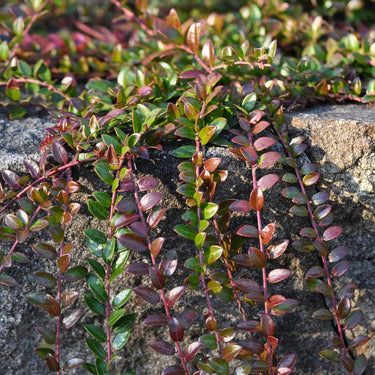
Creeping blueberry runs flat. Vaccinium crassifolium ‘Bloodstone’ makes a dense evergreen mat five to eight inches deep, the trailing stems rooting and swelling into small woody burls wherever they touch ground, so a single plant knits outward year on year into a carpet. The leaves are thick and leathery and hold a semi-gloss, broader and rounder than the species runs, closer in texture to periwinkle than to anything most people picture when they hear the word blueberry. In winter the late-maturing foliage takes on a reddish cast and the stems darken to a distinct red, which is where the name comes from. This is a winter plant, not a spring one, and the color is the whole argument.
This evergreen creeping blueberry is a North Carolina State University selection. Benson Kirkman and Jim Ballington found the clone in a wild stand in 1979 and described the pair formally in HortScience in 1985 alongside ‘Well’s Delight’, which Ballington had taken from Moore County, North Carolina in the same year. Those two were the first creeping blueberry cultivars ever named, and J. C. Raulston later put both on his list of fifty great uncommon plants, predicting they could become major landscape plants across much of the country. Four decades on that prediction remains mostly unfulfilled, which is a fair summary of how American gardening treats its own groundcovers. The plants offered here are our own propagation, grown on at the nursery in Aiken.
There is a taxonomic knot worth untying, because two plants in this catalog are involved. The population ‘Bloodstone’ came from is the one Rayner and Henderson described in 1980 as Vaccinium sempervirens, and Kirkman and Ballington filed the cultivar under V. crassifolium subspecies sempervirens. Kew and the Flora of North America now sink that name into V. crassifolium outright; the Flora of the Southeastern United States keeps V. sempervirens at species rank. The plants have not moved, only the labels. Small urn-shaped flowers, red in bud and opening pink and white, hang in short clusters in April and May, and the Xerces Society lists creeping blueberry as being of special value to native bees, with seven specialist species recorded. Purple-black berries follow in June and July. They are edible and they are dull, and anyone growing this plant for fruit has chosen the wrong blueberry.
Plant ‘Bloodstone’ where the ground is acid, sandy and sharply drained, through a pine bark mulch, in the longleaf pine palette of a Carolina sandhill: full sun for the best winter color, part shade accepted. Space two feet apart for a closed carpet in a few seasons, on a slope, a bank, a raised bed or the front of a border where the mat can be seen. Three cautions, all of them from the people who selected the plant. Drainage is not negotiable, and this cultivar in particular is prone to Phytophthora and to leaf and stem anthracnose in ground that stays too wet. Over-fertilization is the single commonest cause of failure. And the roots resent disturbance, so plant from a container and then leave the plant alone. Never lime the bed.
- Hardiness
- USDA Zones 6–9
- Sun
- Full Sun, Part Shade
- Soil
- Well-drained, Sandy, Acid
- Mature size
- Height 5–8 Inches · Spread 2–3 Feet
- Growth rate
- Medium
- Seasonality
- Evergreen
- Provenance
- Selected by Benson Kirkman and Jim Ballington from a wild Carolina stand in 1979 and released by North Carolina State University, described in HortScience in 1985. The plants offered are our own propagation.
Small urn-shaped bells, red in bud opening pink and white, April into May
From rooting to shipping, our top priority is ensuring you receive healthy, thriving plants for your garden’s success.
Because most of our plants are grown from rooted cuttings — alongside seed, air layering, and grafting chosen for each variety — you receive a stronger, true-to-type plant that establishes quickly in your garden.
Raised on organic soil blends and eco-friendly pest management — never harsh chemicals — your plant arrives healthy for your garden, your family, and the pollinators they feed.
Every purchase gives back. We donate to the Aiken Arboretum and support local wildlife conservation, so growing your garden helps protect the wider ecosystem too.

All our plant material is carefully propagated, grown, and nurtured at our humble nursery in Aiken, South Carolina.

Your plant arrives carefully packed and ready to settle in. Unpack them promptly, give them a day or two to acclimate, then plant following the notes we include — that’s all it takes. Clear care guidance comes with every order, so success is the easy part.
What to expect upon delivery
All our plants are sold in 1-gallon sizes, though the height of each plant can vary depending on its growth rate and seasonality, typically ranging from 1/2 to 2.5 feet.
Each plant is carefully packaged with its roots enclosed in a secure plastic bag containing moist soil, forming a compact root ball. To ensure safe transport, the box is padded with recycled newspaper, providing both stability and eco-friendly protection from weather during shipping.
What is your return policy?
Review our full return policy information on our SHIPPING AND RETURNS POLICY page.
What payment methods can I use?
We offer 35 different payment methods including major providers like Mastercard, Visa, PayPal, American Express and Diners as well as many different local payment methods including Klarna, iDEAL, AliPay, Sofort, giropay, and many more.
Can I make changes to my order after it’s been placed?
At Woodlanders, we strive to fulfill orders as quickly as possible. Therefore, we can only accommodate changes to your order within the first 24 hours after it has been placed. These changes include adding or removing products and modifying the delivery address. If you need to make any changes or if there has been a mistake with your order information, please reach out to us promptly via our CONTACT page with your order number for the quickest resolution.
Your satisfaction is our priority, and we appreciate your understanding and cooperation.