


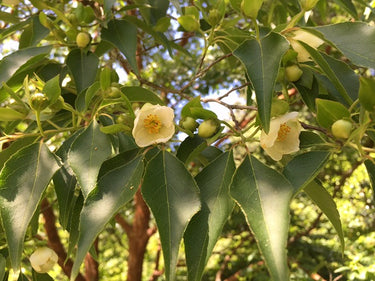


Tall Stewartia
Stewartia monadelpha
In propagation
Currently rooting cuttings. Expected Winter 2028.
Add your name with the notify button below, and we will email you the moment this plant is ready to bring home.
Learn how we grow on The Prop House.
Pickup currently unavailable at Aiken Nursery
Tall stewartia is an upright deciduous tree of medium size, and for most of the year the reason to grow one is the trunk. The bark sheds in thin flakes to leave a smooth surface of cinnamon and orange-brown, warm enough to pull the eye across a winter garden from some distance, and the effect only improves as the tree ages. Abundant small white flowers follow in summer and the leaves turn red and purple in fall, but the bark is the long argument. Reckon on twenty to twenty-five feet in a garden, though in the forests of Japan the species has been recorded at eighty.
Two name stories meet in this tree. The genus honors John Stuart, third Earl of Bute, an eighteenth-century patron of botany whose name Linnaeus wrote down as Stewart, an error the rules of nomenclature have since made permanent. The epithet monadelpha means one brotherhood, and describes the stamens, which are fused at the base into a single tube rather than standing free. In Japan, where the tree is native to Honshu, Shikoku and Kyushu, the name is himeshara, princess shara, a diminutive of the shara given to the larger-leaved Stewartia pseudocamellia. That shara comes in turn from the sal tree of Buddhist tradition, under which the Buddha is said to have died; Japanese gardeners long ago transferred the association to a hardy local stand-in, and the stewartias have carried the borrowed name ever since.
The flowers open through early and midsummer, white, cupped and camellia-like, an inch or so across with a boss of orange anthers at the center, and they are borne in real quantity rather than as an occasional event. Stewartia belongs to Theaceae, the tea family, alongside Camellia and the vanished Franklinia alatamaha, and the flower is where that kinship is most obvious. Among gardeners this species has a reputation as the most forgiving stewartia, more tolerant of ordinary garden conditions than a genus famous for sulking usually manages, which makes tall stewartia the sensible place to start for anyone who has killed one before.
Site the tree where the winter trunk will be lit and looked at, near a path, a drive, or a window, in moist, acid, well-drained soil with plenty of leaf mold, in morning sun with afternoon shade in the South. Stewartias resent root disturbance, so plant once and mulch well rather than shifting the tree around later. Underplant with ferns, epimedium and spring ephemerals that will not fight at the root, and leave the lower limbs high enough that the bark stays visible. Hardy through USDA zones 6 to 8. There is no ethnobotanical tradition here beyond the borrowed Buddhist name and a little use of the timber in Japan, which is fair enough for a tree grown honestly for beauty.
- Hardiness
- USDA Zones 6–8
- Sun
- Full Sun, Part Shade
- Soil
- Well-drained, Moist, Acid
- Mature size
- Height 20–25 Feet · Spread 15–20 Feet
- Growth rate
- Medium
- Seasonality
- Deciduous
Abundant small white cupped flowers with orange anthers through early and midsummer
From rooting to shipping, our top priority is ensuring you receive healthy, thriving plants for your garden’s success.
Because most of our plants are grown from rooted cuttings — alongside seed, air layering, and grafting chosen for each variety — you receive a stronger, true-to-type plant that establishes quickly in your garden.
Raised on organic soil blends and eco-friendly pest management — never harsh chemicals — your plant arrives healthy for your garden, your family, and the pollinators they feed.
Every purchase gives back. We donate to the Aiken Arboretum and support local wildlife conservation, so growing your garden helps protect the wider ecosystem too.

All our plant material is carefully propagated, grown, and nurtured at our humble nursery in Aiken, South Carolina.

Your plant arrives carefully packed and ready to settle in. Unpack them promptly, give them a day or two to acclimate, then plant following the notes we include — that’s all it takes. Clear care guidance comes with every order, so success is the easy part.
What to expect upon delivery
All our plants are sold in 1-gallon sizes, though the height of each plant can vary depending on its growth rate and seasonality, typically ranging from 1/2 to 2.5 feet.
Each plant is carefully packaged with its roots enclosed in a secure plastic bag containing moist soil, forming a compact root ball. To ensure safe transport, the box is padded with recycled newspaper, providing both stability and eco-friendly protection from weather during shipping.
What is your return policy?
Review our full return policy information on our SHIPPING AND RETURNS POLICY page.
What payment methods can I use?
We offer 35 different payment methods including major providers like Mastercard, Visa, PayPal, American Express and Diners as well as many different local payment methods including Klarna, iDEAL, AliPay, Sofort, giropay, and many more.
Can I make changes to my order after it’s been placed?
At Woodlanders, we strive to fulfill orders as quickly as possible. Therefore, we can only accommodate changes to your order within the first 24 hours after it has been placed. These changes include adding or removing products and modifying the delivery address. If you need to make any changes or if there has been a mistake with your order information, please reach out to us promptly via our CONTACT page with your order number for the quickest resolution.
Your satisfaction is our priority, and we appreciate your understanding and cooperation.