


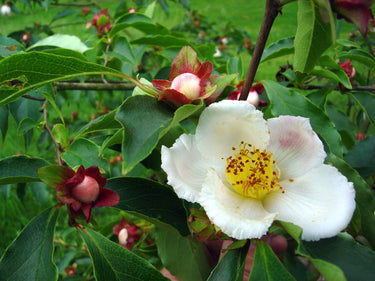

Beaked Stewartia
Stewartia rostrata
In propagation
Currently rooting cuttings. Expected Winter 2028.
Add your name with the notify button below, and we will email you the moment this plant is ready to bring home.
Learn how we grow on The Prop House.
Pickup currently unavailable at Aiken Nursery
Beaked stewartia is one of the rarest plants in a genus that has no common members, and we are indebted to Roger Gossler of Oregon for our stock. He calls the species one of the rarest Stewartias, grown above all for the large maroon calyx that closes around the seed pods once the flowers have fallen. "Very beautiful," he says, and Gossler has grown more stewartias than most gardeners will ever see. In the garden the plant makes a deciduous, multi-stemmed shrub or small tree, pyramidal while young and rounding into an oval with age, reaching anywhere from thirteen to thirty-odd feet depending on how patient the gardener turns out to be.
The genus commemorates John Stuart, third Earl of Bute, an eighteenth-century patron of botany whose surname Linnaeus set down as Stewart when he coined the name. The misspelling is now permanent, fixed in place by the rules of botanical nomenclature, which is a small comedy the plant carries without complaint. The epithet rostrata means beaked, for the drawn-out point on the seed capsule. Stewartia sits in Theaceae, the tea family, in the company of Camellia and the lost Franklinia, and the family resemblance shows plainly the moment the flowers open.
This species spent decades in cultivation with no name of its own. Two different plants were growing at the Arnold Arboretum under the single label Stewartia sinensis, and in the early 1970s Stephen Spongberg worked out that one of them was a distinct species from southeastern China, describing the plant as Stewartia rostrata. The flowers open white and cupped in May and June, five petals around a boss of stamens, and the calyx behind them flushes deep beet red and holds that color long after the petals drop, staining the developing capsules through summer. Autumn brings red and orange to the leaves. There is no ethnobotany to speak of here, no old medicine or dye or timber tradition; this is a plant grown for looking at, and honest enough to admit as much.
Site the beaked stewartia as a specimen where the calyx and the smooth young trunk can be read at close range, in dappled shade or morning sun with shelter from hard afternoon light, in moist, acid, well-drained ground enriched with leaf mold. Stewartias resent root disturbance and hate hot dry soil, so plant once, mulch generously, and water through the first summers rather than moving the plant about looking for a better spot. Hardy through USDA zones 5 to 8, a good deal colder than the Southern reputation of the genus suggests. Growing a nursery-propagated plant of a species this scarce is a quiet way of keeping the species in cultivation, which for the rarer stewartias is not a small thing.
Image courtesy of Philip de Spoelberch
- Hardiness
- USDA Zones 5–8
- Sun
- Full Sun, Part Shade
- Soil
- Well-drained, Moist, Acid
- Mature size
- Height 13–30 Feet · Spread 8–13 Feet
- Growth rate
- Slow
- Seasonality
- Deciduous
- Provenance
- Our stock came from Roger Gossler of Gossler Farms, Oregon. NOTE: the Odoo Source field records Hopelands for this SKU, which conflicts with the Gossler credit in the legacy catalog copy and needs Fiona to confirm.
Cupped white flowers in May and June, set in a deep maroon calyx that holds through fruiting
From rooting to shipping, our top priority is ensuring you receive healthy, thriving plants for your garden’s success.
Because most of our plants are grown from rooted cuttings — alongside seed, air layering, and grafting chosen for each variety — you receive a stronger, true-to-type plant that establishes quickly in your garden.
Raised on organic soil blends and eco-friendly pest management — never harsh chemicals — your plant arrives healthy for your garden, your family, and the pollinators they feed.
Every purchase gives back. We donate to the Aiken Arboretum and support local wildlife conservation, so growing your garden helps protect the wider ecosystem too.

All our plant material is carefully propagated, grown, and nurtured at our humble nursery in Aiken, South Carolina.

Your plant arrives carefully packed and ready to settle in. Unpack them promptly, give them a day or two to acclimate, then plant following the notes we include — that’s all it takes. Clear care guidance comes with every order, so success is the easy part.
What to expect upon delivery
All our plants are sold in 1-gallon sizes, though the height of each plant can vary depending on its growth rate and seasonality, typically ranging from 1/2 to 2.5 feet.
Each plant is carefully packaged with its roots enclosed in a secure plastic bag containing moist soil, forming a compact root ball. To ensure safe transport, the box is padded with recycled newspaper, providing both stability and eco-friendly protection from weather during shipping.
What is your return policy?
Review our full return policy information on our SHIPPING AND RETURNS POLICY page.
What payment methods can I use?
We offer 35 different payment methods including major providers like Mastercard, Visa, PayPal, American Express and Diners as well as many different local payment methods including Klarna, iDEAL, AliPay, Sofort, giropay, and many more.
Can I make changes to my order after it’s been placed?
At Woodlanders, we strive to fulfill orders as quickly as possible. Therefore, we can only accommodate changes to your order within the first 24 hours after it has been placed. These changes include adding or removing products and modifying the delivery address. If you need to make any changes or if there has been a mistake with your order information, please reach out to us promptly via our CONTACT page with your order number for the quickest resolution.
Your satisfaction is our priority, and we appreciate your understanding and cooperation.