



Chinese Stewartia
Stewartia sinensis
In propagation
Currently rooting cuttings. Expected Winter 2028.
Add your name with the notify button below, and we will email you the moment this plant is ready to bring home.
Learn how we grow on The Prop House.
Pickup currently unavailable at Aiken Nursery
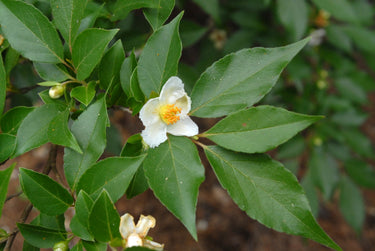
This small tree of Chinese origin has showy white flowers and fall foliage that is red or reddish, and the smooth whitish trunks with exfoliating bark are an important ornamental feature. In truth the bark is the reason most people plant one. Old stems shed in thin plates to leave a polished, mottled surface in cream, buff, and cinnamon that looks best in winter when nothing distracts from it, and improves every year for decades. The flowers arrive in early summer, white and cupped, about two inches across with a central boss of yellow stamens, unmistakably the work of a relative of Camellia. Then autumn brings a clean red. Very few small trees do three distinct things this well.
The tea family connection is not incidental. Stewartia sits in Theaceae alongside Camellia and Franklinia, and the family resemblance runs right through the flower. The genus name honors John Stuart, third Earl of Bute, a patron of botany whose name Linnaeus rendered with a w, and nomenclatural rules have preserved that spelling ever since. Sinensis places this species in China, where it grows in mountain forests, and it is one of a group of Asian stewartias that have proven considerably easier in cultivation than the two American species.
Our propagation stock comes from cuttings taken at Hopelands Gardens, a few minutes from the nursery here in Aiken. Local provenance of that kind is worth more than it sounds: these are cuttings off a tree that has already proven it will grow in this soil and this heat, rather than material shipped in from a cooler climate and hoped for.
Dirr, in his Manual of Woody Landscape Plants, says: "....a delightful small landscape plant that should be more widely used." and: "Hardy to Boston and should be pursued by discriminating gardeners." That second remark is worth attending to, because the cold hardiness surprises people. This is a tree that will grow well north of where the American silky camellia gives up, and it asks less of a gardener in every respect.
A plant for moist but well-drained acidic soil in sun or half shade, reaching fifteen to twenty-five feet. Like the whole genus, this species dislikes root disturbance, so plant young into a permanent position and mulch rather than cultivate around the base. Steady moisture matters, particularly while establishing; a droughty site produces a stunted tree that never develops the bark. Site where the winter trunk will actually be seen, near a path, a drive, or a window, since bark this good is wasted at the back of a border. Underplant with hellebores, epimedium, ferns, or low evergreens that will not compete hard at the surface, and resist the urge to limb up too early. Growth is unhurried and the tree rewards patience.
- Hardiness
- USDA Zones 5–8
- Sun
- Full Sun, Part Shade
- Soil
- Moist, Well-drained
- Mature size
- Height 15–25 Feet · Spread 10–15 Feet
- Growth rate
- Slow
- Seasonality
- Deciduous
white cupped camellia-like flowers about two inches across with yellow stamens, early summer
From rooting to shipping, our top priority is ensuring you receive healthy, thriving plants for your garden’s success.
Because most of our plants are grown from rooted cuttings — alongside seed, air layering, and grafting chosen for each variety — you receive a stronger, true-to-type plant that establishes quickly in your garden.
Raised on organic soil blends and eco-friendly pest management — never harsh chemicals — your plant arrives healthy for your garden, your family, and the pollinators they feed.
Every purchase gives back. We donate to the Aiken Arboretum and support local wildlife conservation, so growing your garden helps protect the wider ecosystem too.

All our plant material is carefully propagated, grown, and nurtured at our humble nursery in Aiken, South Carolina.

Your plant arrives carefully packed and ready to settle in. Unpack them promptly, give them a day or two to acclimate, then plant following the notes we include — that’s all it takes. Clear care guidance comes with every order, so success is the easy part.
What to expect upon delivery
All our plants are sold in 1-gallon sizes, though the height of each plant can vary depending on its growth rate and seasonality, typically ranging from 1/2 to 2.5 feet.
Each plant is carefully packaged with its roots enclosed in a secure plastic bag containing moist soil, forming a compact root ball. To ensure safe transport, the box is padded with recycled newspaper, providing both stability and eco-friendly protection from weather during shipping.
What is your return policy?
Review our full return policy information on our SHIPPING AND RETURNS POLICY page.
What payment methods can I use?
We offer 35 different payment methods including major providers like Mastercard, Visa, PayPal, American Express and Diners as well as many different local payment methods including Klarna, iDEAL, AliPay, Sofort, giropay, and many more.
Can I make changes to my order after it’s been placed?
At Woodlanders, we strive to fulfill orders as quickly as possible. Therefore, we can only accommodate changes to your order within the first 24 hours after it has been placed. These changes include adding or removing products and modifying the delivery address. If you need to make any changes or if there has been a mistake with your order information, please reach out to us promptly via our CONTACT page with your order number for the quickest resolution.
Your satisfaction is our priority, and we appreciate your understanding and cooperation.