


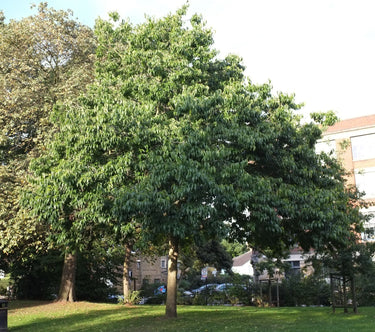


Hardy Rubber Tree, Du Zhong
Eucommia ulmoides
Pickup currently unavailable at Aiken Nursery
Eucommia ulmoides is a medium to large deciduous tree of forty to sixty feet, upright when young and broadening into a rounded crown with age. The leaves are elm-like, as the epithet says, dark glossy green, deeply veined and pointed, held on a clean straight trunk with grayish furrowed bark. There is no autumn color worth the name and the flowers are green, apetalous, and easy to miss, with male and female on separate trees. What this tree offers instead is a rare combination of qualities: dense shade, genuine toughness, freedom from pests and disease, tolerance of city air and poor ground, and a frame that holds up in storms.
Tear a leaf slowly and you will see the reason for the common name. Fine white threads of latex bridge the two halves and hold, elastic, before they part. Eucommia is the only latex-bearing tree native to the temperate world, and the gutta-percha it produces runs through leaves, bark, and fruit alike. The species is also the last of its line, the sole living member of the genus and the sole genus in the family Eucommiaceae, an entire branch of the flowering plants reduced to one survivor. Fossil Eucommia is scattered across Europe, Asia, and North America. What remains today is a tree of central China, so long and so thoroughly cultivated that whether any truly wild population still exists is an open question.
The reason for that cultivation is the bark. Du zhong is one of the senior tonics of the Chinese materia medica, in continuous use for more than two thousand years, classified among the herbs that nourish the kidney and liver, strengthen sinew and bone, and steady the lower back and knees. Bark is stripped, dried, and often prepared with salt; the same latex threads that appear in a torn leaf appear in a snapped piece of dried bark, and their presence is the traditional test of quality. Contemporary research has looked at du zhong extracts in relation to blood pressure, inflammation, and metabolic function, and lignans and iridoids have been isolated as likely actives. Bark can be harvested without felling the tree, which is part of why the species survived at all.
In the garden this is a superb and badly underused street and shade tree. Full sun, any reasonably drained soil, and no particular attention; Eucommia tolerates drought, compaction, and urban conditions that flatten more fashionable choices, and nothing much eats it. Growth is moderate and the habit clean enough for a lawn specimen, a parking strip, or a courtyard. Hardy well north of where most people expect, through zone 4. Worth noting that trees are dioecious, so a single specimen sets no fruit; and worth knowing that plants have escaped cultivation in a few places in the eastern United States, though nowhere at a scale that has caused concern. For anyone growing a medicinal collection, this is the plant that anchors it.
- Hardiness
- USDA Zones 4–7
- Sun
- Full Sun, Part Shade
- Soil
- Well-drained, Moist
- Mature size
- Height 40–60 Feet · Spread 30–45 Feet
- Growth rate
- Moderate
- Seasonality
- Deciduous
small green apetalous flowers before the leaves in spring, male and female on separate trees
References & research
These statements have not been evaluated by the Food and Drug Administration. This information is shared for traditional and educational interest only and is not intended to diagnose, treat, cure, or prevent any disease. Please consult a qualified healthcare professional before any medicinal use.
- May lower blood pressure and could interact with antihypertensive medication
- Not evaluated for safety in pregnancy or while breastfeeding
- Consult a qualified practitioner before use
From rooting to shipping, our top priority is ensuring you receive healthy, thriving plants for your garden’s success.
Because most of our plants are grown from rooted cuttings — alongside seed, air layering, and grafting chosen for each variety — you receive a stronger, true-to-type plant that establishes quickly in your garden.
Raised on organic soil blends and eco-friendly pest management — never harsh chemicals — your plant arrives healthy for your garden, your family, and the pollinators they feed.
Every purchase gives back. We donate to the Aiken Arboretum and support local wildlife conservation, so growing your garden helps protect the wider ecosystem too.

All our plant material is carefully propagated, grown, and nurtured at our humble nursery in Aiken, South Carolina.

Your plant arrives carefully packed and ready to settle in. Unpack them promptly, give them a day or two to acclimate, then plant following the notes we include — that’s all it takes. Clear care guidance comes with every order, so success is the easy part.
What to expect upon delivery
All our plants are sold in 1-gallon sizes, though the height of each plant can vary depending on its growth rate and seasonality, typically ranging from 1/2 to 2.5 feet.
Each plant is carefully packaged with its roots enclosed in a secure plastic bag containing moist soil, forming a compact root ball. To ensure safe transport, the box is padded with recycled newspaper, providing both stability and eco-friendly protection from weather during shipping.
What is your return policy?
Review our full return policy information on our SHIPPING AND RETURNS POLICY page.
What payment methods can I use?
We offer 35 different payment methods including major providers like Mastercard, Visa, PayPal, American Express and Diners as well as many different local payment methods including Klarna, iDEAL, AliPay, Sofort, giropay, and many more.
Can I make changes to my order after it’s been placed?
At Woodlanders, we strive to fulfill orders as quickly as possible. Therefore, we can only accommodate changes to your order within the first 24 hours after it has been placed. These changes include adding or removing products and modifying the delivery address. If you need to make any changes or if there has been a mistake with your order information, please reach out to us promptly via our CONTACT page with your order number for the quickest resolution.
Your satisfaction is our priority, and we appreciate your understanding and cooperation.