


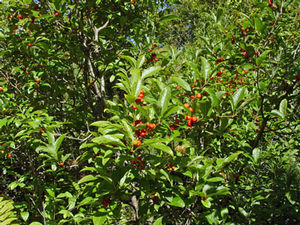

Smooth Winterberry Holly
Ilex laevigata
Pickup currently unavailable at Aiken Nursery
Smooth winterberry is similar to the common winterberry, Ilex verticillata, but is much less common in cultivation, and the differences reward a close look. The finely toothed deciduous leaves are glossy above rather than dull, which gives the whole shrub a cleaner and lighter quality through the growing season. Female plants produce attractive red berries, larger and slightly more orange than those of common winterberry, ripening in autumn and eaten by birds. The habit is upright and open, ten to twelve feet in time on a narrow four to six foot frame, with smooth gray bark and a fine twiggy silhouette once the leaves drop.
Laevigata means smooth or polished, for those glossy leaves, and Ilex is borrowed from the classical Latin name of the Mediterranean holm oak, whose foliage the European holly happens to resemble. The species occurs in the Atlantic Coast states from southern Maine to South Carolina, possibly reaching Georgia, and is uncommon in the southern portion of the range. In the wild you find smooth winterberry in acid swamps and seepage areas, very often growing with Atlantic white cedar, Chamaecyparis thyoides, in a habitat that has itself been reduced to fragments across most of the coastal plain.
The plants we offer are unsexed seedlings of South Carolina provenance, shared with us by Mike Creel. That matters in two ways. Local provenance means stock adapted to southern heat rather than to a New England swamp, which is not a given with a species whose center of abundance lies well north of here. And unsexed means exactly what it says: hollies carry male and female flowers on separate plants, and there is no way to tell which you have until a seedling flowers, usually in its third or fourth year. Buy three or five if fruit is the goal, and you will very likely end up with both sexes and a good crop.
In cultivation, plant in acid sandy soil with adequate moisture. This is a wetland plant, entirely happy in ground that stays saturated, and it belongs at a pond edge, in a bog garden, along a ditch, or in the low wet corner where nothing else has thrived. Full sun to part shade; fruit set is heavier in sun. Alkaline soil brings on chlorosis quickly. Pair with Chamaecyparis thyoides if you want to reconstruct the wild association, or with Clethra alnifolia, Itea virginica, Cyrilla racemiflora, and Magnolia virginiana for a southern wet planting. This is a collector's and restorationist's holly rather than a landscape staple, and that is rather the point.
- Hardiness
- USDA Zones 5–8
- Sun
- Full Sun, Part Shade
- Soil
- Moist
- Mature size
- Height 10–12 Feet · Spread 4–6 Feet
- Growth rate
- Moderate
- Seasonality
- Deciduous
small greenish white flowers in the leaf axils in late spring, male and female on separate plants
From rooting to shipping, our top priority is ensuring you receive healthy, thriving plants for your garden’s success.
Because most of our plants are grown from rooted cuttings — alongside seed, air layering, and grafting chosen for each variety — you receive a stronger, true-to-type plant that establishes quickly in your garden.
Raised on organic soil blends and eco-friendly pest management — never harsh chemicals — your plant arrives healthy for your garden, your family, and the pollinators they feed.
Every purchase gives back. We donate to the Aiken Arboretum and support local wildlife conservation, so growing your garden helps protect the wider ecosystem too.

All our plant material is carefully propagated, grown, and nurtured at our humble nursery in Aiken, South Carolina.

Your plant arrives carefully packed and ready to settle in. Unpack them promptly, give them a day or two to acclimate, then plant following the notes we include — that’s all it takes. Clear care guidance comes with every order, so success is the easy part.
What to expect upon delivery
All our plants are sold in 1-gallon sizes, though the height of each plant can vary depending on its growth rate and seasonality, typically ranging from 1/2 to 2.5 feet.
Each plant is carefully packaged with its roots enclosed in a secure plastic bag containing moist soil, forming a compact root ball. To ensure safe transport, the box is padded with recycled newspaper, providing both stability and eco-friendly protection from weather during shipping.
What is your return policy?
Review our full return policy information on our SHIPPING AND RETURNS POLICY page.
What payment methods can I use?
We offer 35 different payment methods including major providers like Mastercard, Visa, PayPal, American Express and Diners as well as many different local payment methods including Klarna, iDEAL, AliPay, Sofort, giropay, and many more.
Can I make changes to my order after it’s been placed?
At Woodlanders, we strive to fulfill orders as quickly as possible. Therefore, we can only accommodate changes to your order within the first 24 hours after it has been placed. These changes include adding or removing products and modifying the delivery address. If you need to make any changes or if there has been a mistake with your order information, please reach out to us promptly via our CONTACT page with your order number for the quickest resolution.
Your satisfaction is our priority, and we appreciate your understanding and cooperation.