


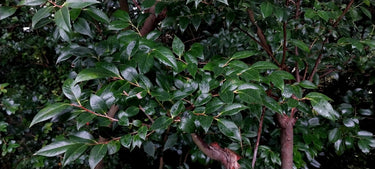


Sea Bilberry, Evergreen Blueberry
Vaccinium bracteatum
In propagation
Currently rooting cuttings. Expected Summer 2027.
Add your name with the notify button below, and we will email you the moment this plant is ready to bring home.
Learn how we grow on The Prop House.
Pickup currently unavailable at Aiken Nursery
A large evergreen shrub with glossy leaves, reaching six to twelve feet in time and occasionally more, with the leathery, polished foliage that sets the evergreen blueberries apart from their deciduous relatives. New growth flushes bronze to red before hardening to dark green. White urn-shaped flowers hang in short racemes in early summer, each cluster subtended by the leafy bracts that give the species its name, and are followed by small dark berries, edible and mildly sweet. The habit is dense and rounded, useful year-round in a way that a highbush blueberry never manages. Our plants were struck from cuttings taken at the old Woodlanders site, off stock that has been growing here in Aiken for many years.
What makes this plant genuinely remarkable is not in the garden at all. In China, Vaccinium bracteatum is wu fan shu, the black rice tree, and the leaves have been used for at least a thousand years to dye glutinous rice a deep blue-black. The dish is wu mi, black rice, and it is prepared for the Qingming festival and for Buddhist observances, particularly among the Dong people of Guizhou and across the provinces of the southeast. Leaf juice is pounded and steeped, the rice soaked in it, and the resulting grain takes on a color and a faint fragrance that no other plant produces. The chemistry has since become a research subject in its own right, with food scientists studying the pigment as a natural blue colorant and finding, along the way, that rice starch dyed this way digests more slowly than plain rice.
Alongside the food tradition sits a medicinal one. Wu fan shu appears in Chinese pharmacopeias for inflammation, diarrhea, and skin eruptions, and the leaves were regarded as strengthening and anti-fatiguing, which is part of why the black rice was eaten at festivals in the first place. Modern laboratory work on leaf extracts has reported antioxidant, antimicrobial, and hypoglycemic activity, and has isolated a range of flavonoids and iridoids. The research is active and preliminary rather than settled.
In the garden, treat this as you would any evergreen blueberry: acid soil, humus-rich and well-drained but never dry, in sun to part shade. The whole genus is fussy about pH and this species is no exception, so alkaline ground will bring on chlorosis quickly. Growth is unhurried. The glossy evergreen foliage and neat habit make a good informal hedge, a woodland-edge shrub, or a container specimen, and the plant pairs naturally with camellias, Illicium, and evergreen azaleas that want the same acid conditions. Anyone growing an ethnobotanical or dye collection should want this one on the strength of the rice alone.
- Hardiness
- USDA Zones 7–9
- Sun
- Full Sun, Part Shade
- Soil
- Well-drained, Moist
- Mature size
- Height 6–12 Feet · Spread 5–8 Feet
- Growth rate
- Slow
- Seasonality
- Evergreen
white urn-shaped flowers in short leafy-bracted racemes, early summer, followed by small dark edible berries
These statements have not been evaluated by the Food and Drug Administration. This information is shared for traditional and educational interest only and is not intended to diagnose, treat, cure, or prevent any disease. Please consult a qualified healthcare professional before any medicinal use.
- Not evaluated for safety in pregnancy or while breastfeeding
- May affect blood sugar; caution alongside diabetic medication
- Consult a qualified practitioner before use
From rooting to shipping, our top priority is ensuring you receive healthy, thriving plants for your garden’s success.
Because most of our plants are grown from rooted cuttings — alongside seed, air layering, and grafting chosen for each variety — you receive a stronger, true-to-type plant that establishes quickly in your garden.
Raised on organic soil blends and eco-friendly pest management — never harsh chemicals — your plant arrives healthy for your garden, your family, and the pollinators they feed.
Every purchase gives back. We donate to the Aiken Arboretum and support local wildlife conservation, so growing your garden helps protect the wider ecosystem too.

All our plant material is carefully propagated, grown, and nurtured at our humble nursery in Aiken, South Carolina.

Your plant arrives carefully packed and ready to settle in. Unpack them promptly, give them a day or two to acclimate, then plant following the notes we include — that’s all it takes. Clear care guidance comes with every order, so success is the easy part.
What to expect upon delivery
All our plants are sold in 1-gallon sizes, though the height of each plant can vary depending on its growth rate and seasonality, typically ranging from 1/2 to 2.5 feet.
Each plant is carefully packaged with its roots enclosed in a secure plastic bag containing moist soil, forming a compact root ball. To ensure safe transport, the box is padded with recycled newspaper, providing both stability and eco-friendly protection from weather during shipping.
What is your return policy?
Review our full return policy information on our SHIPPING AND RETURNS POLICY page.
What payment methods can I use?
We offer 35 different payment methods including major providers like Mastercard, Visa, PayPal, American Express and Diners as well as many different local payment methods including Klarna, iDEAL, AliPay, Sofort, giropay, and many more.
Can I make changes to my order after it’s been placed?
At Woodlanders, we strive to fulfill orders as quickly as possible. Therefore, we can only accommodate changes to your order within the first 24 hours after it has been placed. These changes include adding or removing products and modifying the delivery address. If you need to make any changes or if there has been a mistake with your order information, please reach out to us promptly via our CONTACT page with your order number for the quickest resolution.
Your satisfaction is our priority, and we appreciate your understanding and cooperation.