



Shaga Iris
Iris japonica
Pickup currently unavailable at Aiken Nursery
A small crested iris with the carriage of an orchid and a quietly extraordinary biography. Iris japonica was named by Carl Peter Thunberg in 1794. Thunberg was a protege of Linnaeus and one of the only Western botanists allowed into Japan during the country's closed period, from 1775 to 1778, so much of what he brought back is, in a real sense, the first documented record of Japanese flora in Western science. The species had already reached Europe two years earlier, carried out of China by Thomas Evans of the East India Company in 1792. By the 1820s Pierre-Joseph Redoute, the same artist whose rose paintings turn up on every aunt's tea tray, was painting the plant under the older name Iris fimbriata in his Choix des plus belles Fleurs. A treasure of cultivated gardens for more than two centuries.
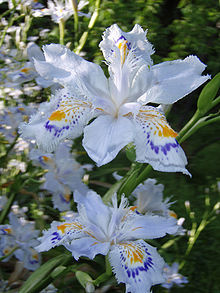
The flower is the surprise. Held flat against a slender branched stem, the bloom opens in pale lavender-blue with a yellow-orange crest down the center of each fall and a fringed, almost lacy margin along every petal, the source of both the Latin epithet fimbriata, fringed, and one of the English common names. In bloom the plant reads less like a typical iris and more like a small pale orchid hovering above the foliage. The Chinese call the flower Hudie Hua, butterfly flower, which is the right word.
What also sets the species apart is the way of spreading. Rather than clumping, Iris japonica sends out long thin stolons that root at intervals, building a slow, loose carpet of evergreen sword-shaped fans. Most of the populations in cultivation in Japan and beyond are triploid and seed-sterile, meaning every garden plant of the species today is a clone of clones, propagated vegetatively for centuries and passed along human routes, no exaggeration to say the plant has traveled with people from monastery gardens to imperial courts to East India Company holds to Aiken, South Carolina.
Excellent in dappled shade under a high deciduous canopy, along woodland edges, or as a refined groundcover in a shaded courtyard. Pair the shaga iris with hostas, ferns, Ophiopogon, and the smaller hellebores for a layered late-winter and early-spring scene. Drought tolerant once established, and deer and rabbits leave the fans alone. For the gardener who finds the standard purple bearded iris a touch too midcentury-suburb, here is something with the nuance of a botanical illustration.
- Hardiness
- USDA Zones 7–10
- Sun
- Part Shade, Full Shade
- Soil
- Well-drained, Moist, Fertile
- Mature size
- Height 12–18 Inches · Spread 18–24 Inches
- Growth rate
- Moderate
- Seasonality
- Evergreen
From rooting to shipping, our top priority is ensuring you receive healthy, thriving plants for your garden’s success.
Because most of our plants are grown from rooted cuttings — alongside seed, air layering, and grafting chosen for each variety — you receive a stronger, true-to-type plant that establishes quickly in your garden.
Raised on organic soil blends and eco-friendly pest management — never harsh chemicals — your plant arrives healthy for your garden, your family, and the pollinators they feed.
Every purchase gives back. We donate to the Aiken Arboretum and support local wildlife conservation, so growing your garden helps protect the wider ecosystem too.

All our plant material is carefully propagated, grown, and nurtured at our humble nursery in Aiken, South Carolina.

Your plant arrives carefully packed and ready to settle in. Unpack them promptly, give them a day or two to acclimate, then plant following the notes we include — that’s all it takes. Clear care guidance comes with every order, so success is the easy part.
What to expect upon delivery
All our plants are sold in 1-gallon sizes, though the height of each plant can vary depending on its growth rate and seasonality, typically ranging from 1/2 to 2.5 feet.
Each plant is carefully packaged with its roots enclosed in a secure plastic bag containing moist soil, forming a compact root ball. To ensure safe transport, the box is padded with recycled newspaper, providing both stability and eco-friendly protection from weather during shipping.
What is your return policy?
Review our full return policy information on our SHIPPING AND RETURNS POLICY page.
What payment methods can I use?
We offer 35 different payment methods including major providers like Mastercard, Visa, PayPal, American Express and Diners as well as many different local payment methods including Klarna, iDEAL, AliPay, Sofort, giropay, and many more.
Can I make changes to my order after it’s been placed?
At Woodlanders, we strive to fulfill orders as quickly as possible. Therefore, we can only accommodate changes to your order within the first 24 hours after it has been placed. These changes include adding or removing products and modifying the delivery address. If you need to make any changes or if there has been a mistake with your order information, please reach out to us promptly via our CONTACT page with your order number for the quickest resolution.
Your satisfaction is our priority, and we appreciate your understanding and cooperation.