


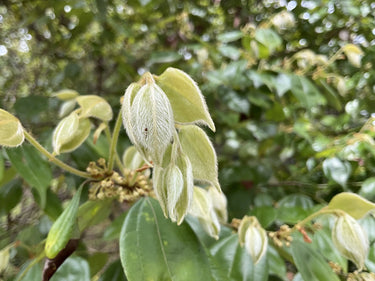


Japanese Evergreen Spicebush
Lindera strychnifolia
Pickup available at Aiken Nursery
Usually ready in 2-4 days
This quietly handsome evergreen has grown well for years in the Woodlanders garden here in Aiken, South Carolina, holding a place in semi-shade where many broadleaf evergreens sulk. The spicebush earns a spot on foliage alone: glossy, leathery leaves, roughly heart-shaped and about three inches across, each marked by three bold veins, with new growth flushing a soft bronze before deepening to green.
Lindera strychnifolia belongs to Lauraceae, the aromatic laurel family, in the company of cinnamon, sassafras, bay laurel, and the American spicebush, and every part of the plant carries that family's spicy scent. Botanists now file the species as Lindera aggregata, keeping strychnifolia as a synonym; the old epithet means simply Strychnos-leaved, a nod to the shape of the foliage and not, despite the sound of the word, any hint of strychnine. Small greenish-yellow flowers gather in early-spring umbels along the branches, modest rather than showy, and where male and female plants grow together the females ripen small drupes that darken from red to black.
In China the plant answers to another name entirely, wu yao, and there the real fame lies underground. The tuberous root has been a staple of traditional Chinese medicine since the Song dynasty, with the finest material long associated with the Tiantai hills of Zhejiang, so prized that the best grade still travels under the name Tiantai wu yao. Classed among the herbs that regulate qi, the root was used to warm the body's core and ease cold-natured pains of the belly and lower abdomen.
For all that medicinal weight, in an American garden Lindera strychnifolia is simply an excellent, uncommon broadleaf evergreen, still rare in the trade and passed mostly through arboreta and specialist growers. Set the shrub in part shade to shade, in moist, lime-free soil enriched with leaf mold, and site the plant so low light can catch the pale undersides of the leaves. Reaching six to ten feet, the spicebush makes a glossy anchor for a woodland edge or a shaded border, aromatic in the hand and evergreen through the Southern winter.
- Hardiness
- USDA Zones 8–9
- Sun
- Full Sun, Part Shade, Full Shade
- Soil
- Moist, Well-drained
- Mature size
- Height 6–10 Feet · Spread 4–6 Feet
- Growth rate
- Medium
- Seasonality
- Evergreen
- Provenance
- Grown and proven for years in the Woodlanders garden, Aiken, South Carolina.
Small greenish-yellow spring umbels; black drupes on female plants
These statements have not been evaluated by the Food and Drug Administration. This information is shared for traditional and educational interest only and is not intended to diagnose, treat, cure, or prevent any disease. Please consult a qualified healthcare professional before any medicinal use.
- In traditional practice, used with caution where there is qi or yin deficiency without stagnation.
- Not a substitute for professional medical care; consult a qualified practitioner before use, especially if pregnant, nursing, or taking medication.
From rooting to shipping, our top priority is ensuring you receive healthy, thriving plants for your garden’s success.
Because most of our plants are grown from rooted cuttings — alongside seed, air layering, and grafting chosen for each variety — you receive a stronger, true-to-type plant that establishes quickly in your garden.
Raised on organic soil blends and eco-friendly pest management — never harsh chemicals — your plant arrives healthy for your garden, your family, and the pollinators they feed.
Every purchase gives back. We donate to the Aiken Arboretum and support local wildlife conservation, so growing your garden helps protect the wider ecosystem too.

All our plant material is carefully propagated, grown, and nurtured at our humble nursery in Aiken, South Carolina.

Your plant arrives carefully packed and ready to settle in. Unpack them promptly, give them a day or two to acclimate, then plant following the notes we include — that’s all it takes. Clear care guidance comes with every order, so success is the easy part.
What to expect upon delivery
All our plants are sold in 1-gallon sizes, though the height of each plant can vary depending on its growth rate and seasonality, typically ranging from 1/2 to 2.5 feet.
Each plant is carefully packaged with its roots enclosed in a secure plastic bag containing moist soil, forming a compact root ball. To ensure safe transport, the box is padded with recycled newspaper, providing both stability and eco-friendly protection from weather during shipping.
What is your return policy?
Review our full return policy information on our SHIPPING AND RETURNS POLICY page.
What payment methods can I use?
We offer 35 different payment methods including major providers like Mastercard, Visa, PayPal, American Express and Diners as well as many different local payment methods including Klarna, iDEAL, AliPay, Sofort, giropay, and many more.
Can I make changes to my order after it’s been placed?
At Woodlanders, we strive to fulfill orders as quickly as possible. Therefore, we can only accommodate changes to your order within the first 24 hours after it has been placed. These changes include adding or removing products and modifying the delivery address. If you need to make any changes or if there has been a mistake with your order information, please reach out to us promptly via our CONTACT page with your order number for the quickest resolution.
Your satisfaction is our priority, and we appreciate your understanding and cooperation.