


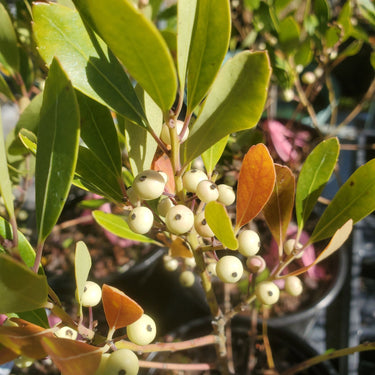


White-fruited Inkberry
Ilex glabra f. leucocarpa
Pickup available at Aiken Nursery
Usually ready in 2-4 days
Ilex glabra f. leucocarpa is the white-berried surprise among the inkberries, a native evergreen holly that trades the usual near-black fruit for berries of clean ivory white. On the ordinary inkberry the dark berries all but vanish against the deep green leaves, but here the pale fruit stands out cleanly and holds on the branches from fall right through to spring, a quiet, unexpected show in the winter garden.
The name is worth getting right, because the trade almost never does. This is a botanical form, published by F. W. Woods in Rhodora in 1956, not a cultivar, so the correct styling is f. leucocarpa in lower-case italics rather than a name in single quotes. Kew now treats the form as a synonym of the species outright, on the reasonable ground that a white-fruited plant is still an inkberry. We keep the name because the fruit color is the entire reason anyone seeks the plant out. Glabra means smooth, for the neat, spineless, glossy leaves that set inkberry apart from the prickly hollies, and leucocarpa means white-fruited.
Behind the novelty stands one of the finest native broadleaf evergreens of eastern North America, ranging along the coastal plain from Nova Scotia to Florida and west to the Gulf, growing in sandy, acid, often boggy ground. The small greenish-white flowers open in May and June and matter most to the bees: inkberry nectar yields the celebrated gallberry honey, a mild, light honey long tied to the pinewoods and bogs of the South. As with any holly, the white berries appear only on pollinated female plants, so a male inkberry set nearby is needed to insure the crop.
Neat, rounded, and evergreen, inkberry works as a low informal hedge, a foundation planting, a massing in a rain garden, or a companion to azaleas, camellias, and other acid-loving plants. Give the roots moist, acidic soil in sun to part shade and keep the ground from drying out. Two honest cautions come with the species. Inkberry suckers steadily from the roots and will drift into a colony, which is a virtue in a mass planting and a nuisance beside a path. And every inkberry goes bare-legged with age, dropping the lower leaves and losing the billowy look of a young plant; the answer is selective renewal pruning in early spring, cutting old stems to the base, rather than shearing the outside and hoping.
- Hardiness
- USDA Zones 5–9
- Sun
- Full Sun, Part Shade
- Soil
- Moist, Acid
- Mature size
- Height 4–5 Feet · Spread 3–4 Feet
- Growth rate
- Moderate
- Seasonality
- Evergreen
White, May; white berries fall to spring
From rooting to shipping, our top priority is ensuring you receive healthy, thriving plants for your garden’s success.
Because most of our plants are grown from rooted cuttings — alongside seed, air layering, and grafting chosen for each variety — you receive a stronger, true-to-type plant that establishes quickly in your garden.
Raised on organic soil blends and eco-friendly pest management — never harsh chemicals — your plant arrives healthy for your garden, your family, and the pollinators they feed.
Every purchase gives back. We donate to the Aiken Arboretum and support local wildlife conservation, so growing your garden helps protect the wider ecosystem too.

All our plant material is carefully propagated, grown, and nurtured at our humble nursery in Aiken, South Carolina.

Your plant arrives carefully packed and ready to settle in. Unpack them promptly, give them a day or two to acclimate, then plant following the notes we include — that’s all it takes. Clear care guidance comes with every order, so success is the easy part.
What to expect upon delivery
All our plants are sold in 1-gallon sizes, though the height of each plant can vary depending on its growth rate and seasonality, typically ranging from 1/2 to 2.5 feet.
Each plant is carefully packaged with its roots enclosed in a secure plastic bag containing moist soil, forming a compact root ball. To ensure safe transport, the box is padded with recycled newspaper, providing both stability and eco-friendly protection from weather during shipping.
What is your return policy?
Review our full return policy information on our SHIPPING AND RETURNS POLICY page.
What payment methods can I use?
We offer 35 different payment methods including major providers like Mastercard, Visa, PayPal, American Express and Diners as well as many different local payment methods including Klarna, iDEAL, AliPay, Sofort, giropay, and many more.
Can I make changes to my order after it’s been placed?
At Woodlanders, we strive to fulfill orders as quickly as possible. Therefore, we can only accommodate changes to your order within the first 24 hours after it has been placed. These changes include adding or removing products and modifying the delivery address. If you need to make any changes or if there has been a mistake with your order information, please reach out to us promptly via our CONTACT page with your order number for the quickest resolution.
Your satisfaction is our priority, and we appreciate your understanding and cooperation.