


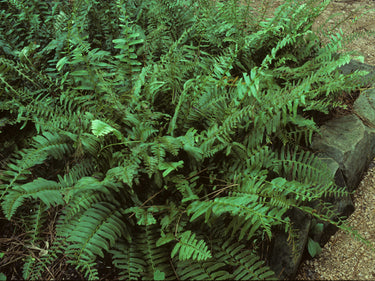


Christmas Fern
Polystichum acrostichoides
Pickup available at Aiken Nursery
Usually ready in 2-4 days
For a plant this common, the Christmas fern carries an oddly specific origin for the name. The fern was christened, the story goes, by one John Robinson, a botany professor at the Peabody Academy in Salem, Massachusetts, sometime in the late 1800s, and set down for posterity in a 1923 volume with the irreproachable title The Fern-Lover's Companion. Robinson's reasoning was seasonal. When the other ferns of the eastern woods go brown and crisp at the first hard frost, Polystichum acrostichoides holds green straight through December, which made the plant the fern people cut for wreaths and mantels at Christmas. There is a second theory, quieter and harder to settle, that the name comes from the leaflets themselves: look closely and each pinna carries a small lobe at its base, an ear or a thumb, that gives the leaflet the outline of a Christmas stocking. Both camps are probably right.
The Latin, for once, is plain description rather than flourish. Polystichum means many rows, for the ranks of spore cases lined up beneath the fertile fronds; acrostichoides means resembling Acrostichum, a leather fern whose spores cover the leaf almost completely. The botanists named the fern twice for the same modest feature and left the poetry to the common name. The plants grow in a tidy fountaining clump, eighteen inches to two and a half feet, the fronds leathery and dark and lance-shaped, rising from a central crown rather than running off across the bed. In spring the new growth uncurls as silvery, scaly fiddleheads, the most ornamental moment in an otherwise composed year. The fronds that come up first are usually the fertile ones, held stiffly upright with their upper third contracted and browned beneath with sori. The sterile fronds follow, lower and looser, and those are the ones that stay green.
What the fern does in winter is the whole reason for the name, and one of the more endearing habits in the genus. As the cold sets in, the evergreen fronds give up their upright posture and lie flat to the ground, pressed low under the leaf litter and the snow. It reads as collapse and is in fact strategy: flattened against the earth, the fronds ride out a freeze that would shred them standing, and rise again when the ground warms. Give the plants organically rich, acidic, well-drained soil in part to full shade, hardy across a remarkable run from Nova Scotia to the Florida panhandle, zones 3 through 9. They want moisture while establishing and turn surprisingly drought-tolerant once settled, holding their ground in the dry rooty shade beneath big trees where most things sulk. The one thing they will not forgive is wet feet in winter, which rots the crown. Deer and rabbits walk past them. Massed on a shaded slope, they knit the soil and hold it.
A fern that decked the halls before anyone thought to plant the species on purpose: green at the solstice, flat under the snow, and standing again before you have quite registered that winter is over. The quiet backbone of the eastern woods, and one of the few green things left when the rest of the garden has gone to sticks.
- Hardiness
- USDA Zones 4–9
- Sun
- Part Shade, Full Shade
- Soil
- Moist, Rich
- Mature size
- Height 1–2 Feet · Spread 1–2 Feet
- Growth rate
- Fast
- Seasonality
- Evergreen
These statements have not been evaluated by the Food and Drug Administration. This information is shared for traditional and educational interest only and is not intended to diagnose, treat, cure, or prevent any disease. Please consult a qualified healthcare professional before any medicinal use.
- Traditional use only, not clinically evaluated
- Ferns may contain compounds of concern; not recommended for internal use
- Consult a professional before use
From rooting to shipping, our top priority is ensuring you receive healthy, thriving plants for your garden’s success.
Because most of our plants are grown from rooted cuttings — alongside seed, air layering, and grafting chosen for each variety — you receive a stronger, true-to-type plant that establishes quickly in your garden.
Raised on organic soil blends and eco-friendly pest management — never harsh chemicals — your plant arrives healthy for your garden, your family, and the pollinators they feed.
Every purchase gives back. We donate to the Aiken Arboretum and support local wildlife conservation, so growing your garden helps protect the wider ecosystem too.

All our plant material is carefully propagated, grown, and nurtured at our humble nursery in Aiken, South Carolina.

Your plant arrives carefully packed and ready to settle in. Unpack them promptly, give them a day or two to acclimate, then plant following the notes we include — that’s all it takes. Clear care guidance comes with every order, so success is the easy part.
What to expect upon delivery
All our plants are sold in 1-gallon sizes, though the height of each plant can vary depending on its growth rate and seasonality, typically ranging from 1/2 to 2.5 feet.
Each plant is carefully packaged with its roots enclosed in a secure plastic bag containing moist soil, forming a compact root ball. To ensure safe transport, the box is padded with recycled newspaper, providing both stability and eco-friendly protection from weather during shipping.
What is your return policy?
Review our full return policy information on our SHIPPING AND RETURNS POLICY page.
What payment methods can I use?
We offer 35 different payment methods including major providers like Mastercard, Visa, PayPal, American Express and Diners as well as many different local payment methods including Klarna, iDEAL, AliPay, Sofort, giropay, and many more.
Can I make changes to my order after it’s been placed?
At Woodlanders, we strive to fulfill orders as quickly as possible. Therefore, we can only accommodate changes to your order within the first 24 hours after it has been placed. These changes include adding or removing products and modifying the delivery address. If you need to make any changes or if there has been a mistake with your order information, please reach out to us promptly via our CONTACT page with your order number for the quickest resolution.
Your satisfaction is our priority, and we appreciate your understanding and cooperation.