


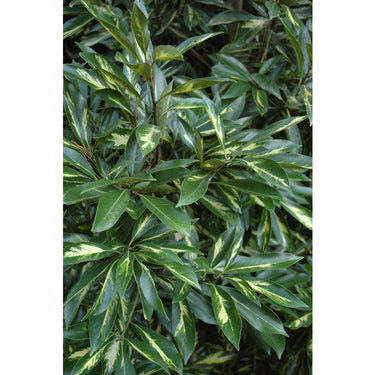


Variegated Japanese Tanbark Oak
Lithocarpus edulis 'Variegata'
Pickup currently unavailable at Aiken Nursery
A broadleaf evergreen with a story, this variegated tanbark oak came into the country from Japan through the late Dr. Fred Meyer of the United States National Arboretum, a botanist and tireless plant explorer, and was almost certainly first offered to American gardeners by Woodlanders. The draw is the foliage: dense, leathery, glossy leaves, each dark green blade split by an irregular central streak of gold and cream, so that a whole tree seems lit from within. Plant Delights later distributed the same selection under the name 'Starburst,' and both names point to this one bright-leaved plant.
Lithocarpus is the genus of stone oaks, or tanbark oaks, close kin to the true oaks in Fagaceae but set apart by stiff, upright flower spikes rather than the dangling catkins of Quercus, and by acorns so hard-shelled they gave the genus its name, from the Greek for stone fruit. The species epithet, edulis, means edible, and records a genuine use: in Japan the acorns of this tree, mateba-shii, have long been gathered for food, roasted and ground after leaching away the tannins that make so many acorns bitter. The bark, like that of the other tanbark oaks, once fed the leather-tanning trade with its tannins.
Left to grow, Lithocarpus edulis makes a rounded evergreen tree of twenty-five to thirty-five feet, slow and deliberate in youth and dense with age, bearing creamy upright flower spikes in early summer and, in autumn, the hard little acorns. The variegated form is grown for leaf rather than crop, but a mature specimen still flowers and fruits. Hardy through USDA zones 7 to 9 and tolerant of coastal wind and city air, the tree serves as a luminous evergreen screen, a specimen to light a shaded corner, or a slow-building anchor where a gardener wants substance that holds all winter.
There is an old-fashioned generosity to a tree like this, an evergreen that feeds wildlife, once fed people, and carries a variegation striking enough to stop a visitor mid-path. Give the tanbark oak deep, well-drained soil and an open spot with room to spread, full sun to part shade, and a little shelter while young. Growers report that deer leave the foliage alone, one more argument for a plant that asks little and offers a great deal, including a direct link to the exploring botanists who once carried such things home.
- Hardiness
- USDA Zones 7–9
- Sun
- Full Sun, Part Shade
- Soil
- Well-drained
- Mature size
- Height 25–35 Feet · Spread 25–35 Feet
- Growth rate
- Slow
- Seasonality
- Evergreen
Creamy, upright flower spikes in early summer; hard edible acorns in fall
From rooting to shipping, our top priority is ensuring you receive healthy, thriving plants for your garden’s success.
Because most of our plants are grown from rooted cuttings — alongside seed, air layering, and grafting chosen for each variety — you receive a stronger, true-to-type plant that establishes quickly in your garden.
Raised on organic soil blends and eco-friendly pest management — never harsh chemicals — your plant arrives healthy for your garden, your family, and the pollinators they feed.
Every purchase gives back. We donate to the Aiken Arboretum and support local wildlife conservation, so growing your garden helps protect the wider ecosystem too.

All our plant material is carefully propagated, grown, and nurtured at our humble nursery in Aiken, South Carolina.

Your plant arrives carefully packed and ready to settle in. Unpack them promptly, give them a day or two to acclimate, then plant following the notes we include — that’s all it takes. Clear care guidance comes with every order, so success is the easy part.
What to expect upon delivery
All our plants are sold in 1-gallon sizes, though the height of each plant can vary depending on its growth rate and seasonality, typically ranging from 1/2 to 2.5 feet.
Each plant is carefully packaged with its roots enclosed in a secure plastic bag containing moist soil, forming a compact root ball. To ensure safe transport, the box is padded with recycled newspaper, providing both stability and eco-friendly protection from weather during shipping.
What is your return policy?
Review our full return policy information on our SHIPPING AND RETURNS POLICY page.
What payment methods can I use?
We offer 35 different payment methods including major providers like Mastercard, Visa, PayPal, American Express and Diners as well as many different local payment methods including Klarna, iDEAL, AliPay, Sofort, giropay, and many more.
Can I make changes to my order after it’s been placed?
At Woodlanders, we strive to fulfill orders as quickly as possible. Therefore, we can only accommodate changes to your order within the first 24 hours after it has been placed. These changes include adding or removing products and modifying the delivery address. If you need to make any changes or if there has been a mistake with your order information, please reach out to us promptly via our CONTACT page with your order number for the quickest resolution.
Your satisfaction is our priority, and we appreciate your understanding and cooperation.