


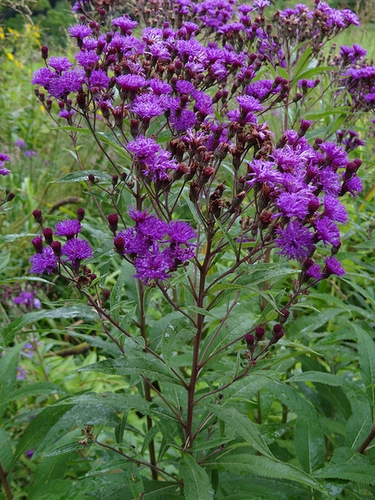


New York Ironweed
Vernonia noveboracensis
Pickup available at Aiken Nursery
Usually ready in 2-4 days
Ironweed earns the name twice over. The stems are stiff enough to stand through a hurricane season without staking, and the seedheads that follow the flowers rust to the exact color of weathered iron. But the reason to grow Vernonia noveboracensis is the purple: not the tidy lavender of garden asters but a saturated, almost fluorescent violet that arrives in late July and holds into October, riding five to eight feet up on strong green stems above a mass of long, finely toothed leaves. Few native perennials carry a color this pure so late in the year.
The genus honors William Vernon, an English botanist who collected in Maryland in 1698 and carried the seeds home to Cambridge; Schreber formally established Vernonia in 1791, long after Vernon had died. The epithet noveboracensis is botanical Latin for "of New York," a common enough tag on species first described from the northeastern colonies, though this ironweed is far more abundant southward, running through the Carolinas and Georgia into Alabama and Florida. In the wild, look for the plant in wet meadows, ditches, streambanks, and low pasture, often alongside Joe-pye weed, for which ironweed is regularly mistaken at a distance.
Ecologically this is a heavyweight. The flowers are a late-season nectar station for monarchs and swallowtails staging for migration, and the genus supports a pollen specialist, the denticulate longhorn bee (Melissodes denticulatus), that visits little else. Songbirds take the seed through fall. The hollow dead stems become winter nesting sites for small native bees, which is a good argument for cutting old growth back to a foot or two rather than to the ground and letting the stubs stand until they collapse on their own. North Carolina named the species Wildflower of the Year in 2004, and deer, notably, leave the bitter foliage alone.
That bitterness is the ethnobotanical thread. Cherokee practice used root infusions for pain after childbirth, for stomach ulcers, and for loosening teeth, while leaf teas served as a blood tonic and for women's complaints. The whole genus runs bitter with sesquiterpene lactones, the same class of compounds that makes the African ironweeds a staple of traditional medicine and a continuing subject of pharmacological research.
In the garden, give ironweed sun and moisture and then step back. Rain gardens, pond margins, stormwater basins, wet meadows, and the back of a deep border all suit, and the classic companions share the same wet feet: swamp sunflower, swamp milkweed, swamp rose mallow, and a matrix of switchgrass or big bluestem. Gardeners who find eight feet excessive can cut the stems back by half in early July for a shorter, bushier plant, and cutting a group to varying heights gives a longer, layered bloom. Ordinary garden soil that stays reasonably moist is enough, and established clumps handle dry spells better than the swampy provenance would suggest.
- Hardiness
- USDA Zones 5–9
- Sun
- Full Sun, Part Shade
- Soil
- Moist, Well-drained
- Mature size
- Height 5–8 Feet · Spread 3–4 Feet
- Growth rate
- Medium
- Seasonality
- Deciduous
Deep purple fluffy disc florets in loose terminal clusters, late July to October
These statements have not been evaluated by the Food and Drug Administration. This information is shared for traditional and educational interest only and is not intended to diagnose, treat, cure, or prevent any disease. Please consult a qualified healthcare professional before any medicinal use.
- Not a substitute for professional medical care; consult a qualified practitioner before using any plant medicinally.
- Traditional uses relate to childbirth and menstruation; avoid during pregnancy.
- The genus is rich in bitter sesquiterpene lactones, a compound class associated with contact dermatitis in the aster family.
- Nearly all published chemistry concerns other Vernonia species, so nothing is established for this plant specifically.
- Identify the plant positively before any use, since ironweeds hybridize freely and resemble Joe-pye weed at a distance.
From rooting to shipping, our top priority is ensuring you receive healthy, thriving plants for your garden’s success.
Because most of our plants are grown from rooted cuttings — alongside seed, air layering, and grafting chosen for each variety — you receive a stronger, true-to-type plant that establishes quickly in your garden.
Raised on organic soil blends and eco-friendly pest management — never harsh chemicals — your plant arrives healthy for your garden, your family, and the pollinators they feed.
Every purchase gives back. We donate to the Aiken Arboretum and support local wildlife conservation, so growing your garden helps protect the wider ecosystem too.

All our plant material is carefully propagated, grown, and nurtured at our humble nursery in Aiken, South Carolina.

Your plant arrives carefully packed and ready to settle in. Unpack them promptly, give them a day or two to acclimate, then plant following the notes we include — that’s all it takes. Clear care guidance comes with every order, so success is the easy part.
What to expect upon delivery
All our plants are sold in 1-gallon sizes, though the height of each plant can vary depending on its growth rate and seasonality, typically ranging from 1/2 to 2.5 feet.
Each plant is carefully packaged with its roots enclosed in a secure plastic bag containing moist soil, forming a compact root ball. To ensure safe transport, the box is padded with recycled newspaper, providing both stability and eco-friendly protection from weather during shipping.
What is your return policy?
Review our full return policy information on our SHIPPING AND RETURNS POLICY page.
What payment methods can I use?
We offer 35 different payment methods including major providers like Mastercard, Visa, PayPal, American Express and Diners as well as many different local payment methods including Klarna, iDEAL, AliPay, Sofort, giropay, and many more.
Can I make changes to my order after it’s been placed?
At Woodlanders, we strive to fulfill orders as quickly as possible. Therefore, we can only accommodate changes to your order within the first 24 hours after it has been placed. These changes include adding or removing products and modifying the delivery address. If you need to make any changes or if there has been a mistake with your order information, please reach out to us promptly via our CONTACT page with your order number for the quickest resolution.
Your satisfaction is our priority, and we appreciate your understanding and cooperation.