


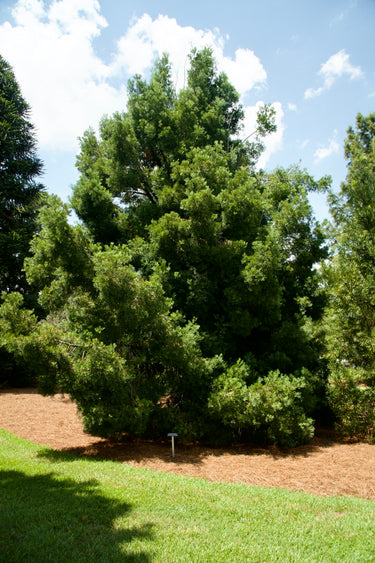


Outeniqua Yellowwood
Afrocarpus falcatus
In propagation
Currently rooting cuttings. Expected Winter 2028.
Add your name with the notify button below, and we will email you the moment this plant is ready to bring home.
Learn how we grow on The Prop House.
Pickup currently unavailable at Aiken Nursery
The yellowwoods are to South Africa roughly what the live oaks are to the Lowcountry: the tree everyone knows, the tree in the old photographs, the tree the furniture was made from. Afrocarpus falcatus, the Outeniqua yellowwood, is the tallest of them, a conifer of coastal and montane forest from the Eastern Cape north through Mozambique and Malawi, reaching thirty to sixty feet in cultivation and a great deal more in the deep forest at Tsitsikamma. The famous specimens live for centuries and carry trunks two or three feet through. Yellowwoods collectively are treated as South Africa's national tree, and cutting one is regulated by law.
Nothing about the plant looks like a conifer to an eye trained on pines. There are no needles and no woody cones; instead the branches carry sprays of narrow, flat, slightly sickle-shaped leaves about two inches long, blue-green and soft in outline, and the seed is a fleshy yellow drupe that birds eat and distribute. This is the Podocarpaceae, an old southern-hemisphere family that split from the northern conifers a very long time ago and never adopted any of the northern habits. Falcatus means sickle-shaped, for the curve of the leaf, and the genus name is simply the African branch of the group, separated from Podocarpus proper in the twentieth century.
In cultivation the tree is well known in coastal California and in the mildest parts of the Southeast, where the qualities that recommend the plant are the ones a slow conifer offers: dense evergreen structure, a clean pyramidal habit when young broadening with age, no litter to speak of, and a tolerance of heat that many conifers lack. The wood behind the reputation is pale, fine-grained, and worked for centuries into furniture, floorboards, roof beams, and boats; a good deal of the yellowwood antique trade in South Africa came off this one species.
Give the tree deep, fertile, well-drained soil and full sun to light shade, and give real room to a plant that intends to become large. Water through establishment; established specimens are notably tough. One honest caution about hardiness: this is a zone 9 tree that succeeds in the milder parts of zone 8, and a hard Piedmont winter will find the limit. Plant in a sheltered position with good drainage, accept that a severe freeze may burn the foliage, and understand that patience is the whole proposition with a conifer that measures growth in decades. Cuttings of this plant came off the Armstrong Campus in Savannah in August 2026, which is a fair test of the mild coastal end of the range.
- Hardiness
- USDA Zones 8–11
- Sun
- Full Sun, Part Shade
- Soil
- Well-drained, Moist
- Mature size
- Height 30–60 Feet · Spread 20–30 Feet
- Growth rate
- Slow
- Seasonality
- Evergreen
- Provenance
- Cuttings taken on the Armstrong Campus, Savannah, Georgia, August 2026.
From rooting to shipping, our top priority is ensuring you receive healthy, thriving plants for your garden’s success.
Because most of our plants are grown from rooted cuttings — alongside seed, air layering, and grafting chosen for each variety — you receive a stronger, true-to-type plant that establishes quickly in your garden.
Raised on organic soil blends and eco-friendly pest management — never harsh chemicals — your plant arrives healthy for your garden, your family, and the pollinators they feed.
Every purchase gives back. We donate to the Aiken Arboretum and support local wildlife conservation, so growing your garden helps protect the wider ecosystem too.

All our plant material is carefully propagated, grown, and nurtured at our humble nursery in Aiken, South Carolina.

Your plant arrives carefully packed and ready to settle in. Unpack them promptly, give them a day or two to acclimate, then plant following the notes we include — that’s all it takes. Clear care guidance comes with every order, so success is the easy part.
What to expect upon delivery
All our plants are sold in 1-gallon sizes, though the height of each plant can vary depending on its growth rate and seasonality, typically ranging from 1/2 to 2.5 feet.
Each plant is carefully packaged with its roots enclosed in a secure plastic bag containing moist soil, forming a compact root ball. To ensure safe transport, the box is padded with recycled newspaper, providing both stability and eco-friendly protection from weather during shipping.
What is your return policy?
Review our full return policy information on our SHIPPING AND RETURNS POLICY page.
What payment methods can I use?
We offer 35 different payment methods including major providers like Mastercard, Visa, PayPal, American Express and Diners as well as many different local payment methods including Klarna, iDEAL, AliPay, Sofort, giropay, and many more.
Can I make changes to my order after it’s been placed?
At Woodlanders, we strive to fulfill orders as quickly as possible. Therefore, we can only accommodate changes to your order within the first 24 hours after it has been placed. These changes include adding or removing products and modifying the delivery address. If you need to make any changes or if there has been a mistake with your order information, please reach out to us promptly via our CONTACT page with your order number for the quickest resolution.
Your satisfaction is our priority, and we appreciate your understanding and cooperation.