


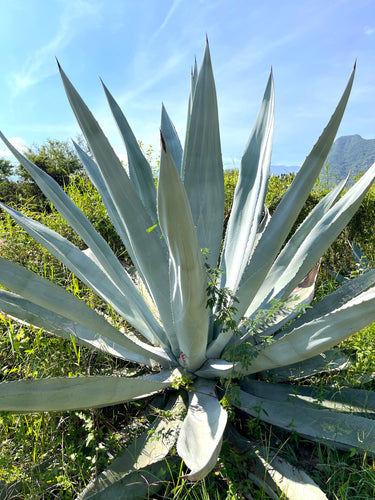

Century Plant
Agave americana
Pickup currently unavailable at Aiken Nursery
The century plant is the great architectural agave, a broad rosette of thick, gray green, spine-tipped leaves that can spread six to eight feet across, each leaf edged with hooked teeth and ending in a hard dark spine. The form is bold and symmetrical, a piece of living sculpture for a hot, dry corner, and the silver cast of the foliage carries the planting through every season.
Few plants have served people longer. Native to Mexico and the warm reaches of Texas, Agave americana is the maguey of Mesoamerica, the source of pulque, the milky fermented sap once drunk as a sacred and medicinal beverage, and of pita, the strong leaf fiber twisted into rope, net, and cloth across the pre-Columbian world. The flowers were eaten, and folk medicine turned the sap to use as a poultice and a digestive remedy. The common name century plant nods to the long wait for bloom: after years, often a decade or two, a single rosette throws up a flower stalk twenty feet or more, opens yellow flowers, sets seed, and then dies, leaving offsets to carry on.
Give the century plant full sun and sharp drainage, a gravel garden, a hot bank, a raised bed, or a large container, and let the rosette stand as a focal point among other sun-and-drought lovers. Site away from paths and play areas, since the spines are formidable, and enjoy a planting that asks for almost nothing once established. Hardy in zones 8 to 10, evergreen, and as tough as any plant in the dry garden.
- Hardiness
- USDA Zones 8–10
- Sun
- Full Sun
- Soil
- Well-drained
- Mature size
- Height 6–8 Feet · Spread 6–8 Feet
- Growth rate
- Slow
- Seasonality
- Evergreen
Tall stalk of yellow flowers once at maturity, then the rosette dies (monocarpic)
References & research
These statements have not been evaluated by the Food and Drug Administration. This information is shared for traditional and educational interest only and is not intended to diagnose, treat, cure, or prevent any disease. Please consult a qualified healthcare professional before any medicinal use.
- Fresh sap can irritate skin and mucous membranes
- Traditional use only; not evaluated as a modern medicine
- Sharp spines; handle with care
From rooting to shipping, our top priority is ensuring you receive healthy, thriving plants for your garden’s success.
Because most of our plants are grown from rooted cuttings — alongside seed, air layering, and grafting chosen for each variety — you receive a stronger, true-to-type plant that establishes quickly in your garden.
Raised on organic soil blends and eco-friendly pest management — never harsh chemicals — your plant arrives healthy for your garden, your family, and the pollinators they feed.
Every purchase gives back. We donate to the Aiken Arboretum and support local wildlife conservation, so growing your garden helps protect the wider ecosystem too.

All our plant material is carefully propagated, grown, and nurtured at our humble nursery in Aiken, South Carolina.

Your plant arrives carefully packed and ready to settle in. Unpack them promptly, give them a day or two to acclimate, then plant following the notes we include — that’s all it takes. Clear care guidance comes with every order, so success is the easy part.
What to expect upon delivery
All our plants are sold in 1-gallon sizes, though the height of each plant can vary depending on its growth rate and seasonality, typically ranging from 1/2 to 2.5 feet.
Each plant is carefully packaged with its roots enclosed in a secure plastic bag containing moist soil, forming a compact root ball. To ensure safe transport, the box is padded with recycled newspaper, providing both stability and eco-friendly protection from weather during shipping.
What is your return policy?
Review our full return policy information on our SHIPPING AND RETURNS POLICY page.
What payment methods can I use?
We offer 35 different payment methods including major providers like Mastercard, Visa, PayPal, American Express and Diners as well as many different local payment methods including Klarna, iDEAL, AliPay, Sofort, giropay, and many more.
Can I make changes to my order after it’s been placed?
At Woodlanders, we strive to fulfill orders as quickly as possible. Therefore, we can only accommodate changes to your order within the first 24 hours after it has been placed. These changes include adding or removing products and modifying the delivery address. If you need to make any changes or if there has been a mistake with your order information, please reach out to us promptly via our CONTACT page with your order number for the quickest resolution.
Your satisfaction is our priority, and we appreciate your understanding and cooperation.