



Shadblow Serviceberry
Amelanchier canadensis
Pickup currently unavailable at Aiken Nursery
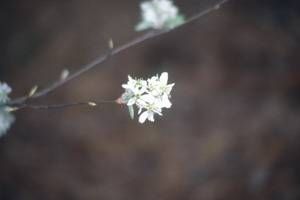
Amelanchier canadensis is the coastal-plain member of a confusing and much-loved genus, a suckering multi-stemmed shrub or small tree of fifteen to twenty-five feet that reads as a thicket in the wild and as an airy vase in the garden. The show begins absurdly early: white flowers in short upright racemes open on bare gray wood while the woods are still brown, hold for a week or so, and then go. Fruit follows in June, raisin-sized, ripening green to red to a deep purple-black, sweet with a faint almond note. Autumn runs from yellow through orange to russet-red, and the bark, smooth and silver-gray with darker striping, carries the winter.
The common names outnumber the species. Shadbush and shadblow both keep a piece of coastal calendar: the flowers open exactly as the shad run up the Atlantic rivers to spawn, and generations of fishermen read one from the other. Juneberry names the fruit and the month. Sarvis, and the tidier serviceberry that grew out of it, is older and murkier, most plausibly a worn-down descendant of Sorbus. The genus name is borrowed straight from amelanchier, a French provincial name for the European Amelanchier ovalis, and canadensis marks the northern end of a range that runs from Newfoundland down the coastal plain to Georgia.
The fruit mattered. Across the Northeast, Algonquian and Iroquoian peoples, among them the Wampanoag, Ojibwe, Potawatomi, and Haudenosaunee, gathered serviceberries fresh, dried them in cakes for winter, and pounded them into pemmican with fat and dried meat. Straight young stems went into arrow shafts. Bark and root preparations appear in the ethnobotanical record for digestive complaints, for fevers and colds, and for use after childbirth. Rosaceae runs through the whole story: the family that gave us apples, pears, and hawthorns also gave the eastern woodlands one of the first reliable fruits of the year.
Plant serviceberry where the early bloom will register against something dark, an evergreen hedge or a stand of pine, because the flowering is brief and easily lost against a gray March sky. Full sun to light shade suits the plants well. Unlike most of the genus, this species is a creature of swamps, bogs, and coastal lowlands, and tolerates ground that stays wet far better than the usual nursery advice suggests. Suckers build a clump over time, which you can thin to three or five trunks for a small specimen tree or leave alone for the thicket habit birds prefer. Expect competition for the crop: cedar waxwings, catbirds, and robins tend to strip the fruit before you have finished deciding whether to make jelly.
- Hardiness
- USDA Zones 4–8
- Sun
- Full Sun, Part Shade
- Soil
- Moist, Well-drained
- Mature size
- Height 15–25 Feet · Spread 15–20 Feet
- Growth rate
- Moderate
- Seasonality
- Deciduous
white flowers in short upright racemes on bare wood, very early spring
These statements have not been evaluated by the Food and Drug Administration. This information is shared for traditional and educational interest only and is not intended to diagnose, treat, cure, or prevent any disease. Please consult a qualified healthcare professional before any medicinal use.
- Seeds and foliage of Rosaceae members can contain cyanogenic compounds and should not be consumed in quantity
- Not evaluated for safety in pregnancy or while breastfeeding
- Consult a qualified practitioner before use
From rooting to shipping, our top priority is ensuring you receive healthy, thriving plants for your garden’s success.
Because most of our plants are grown from rooted cuttings — alongside seed, air layering, and grafting chosen for each variety — you receive a stronger, true-to-type plant that establishes quickly in your garden.
Raised on organic soil blends and eco-friendly pest management — never harsh chemicals — your plant arrives healthy for your garden, your family, and the pollinators they feed.
Every purchase gives back. We donate to the Aiken Arboretum and support local wildlife conservation, so growing your garden helps protect the wider ecosystem too.

All our plant material is carefully propagated, grown, and nurtured at our humble nursery in Aiken, South Carolina.

Your plant arrives carefully packed and ready to settle in. Unpack them promptly, give them a day or two to acclimate, then plant following the notes we include — that’s all it takes. Clear care guidance comes with every order, so success is the easy part.
What to expect upon delivery
All our plants are sold in 1-gallon sizes, though the height of each plant can vary depending on its growth rate and seasonality, typically ranging from 1/2 to 2.5 feet.
Each plant is carefully packaged with its roots enclosed in a secure plastic bag containing moist soil, forming a compact root ball. To ensure safe transport, the box is padded with recycled newspaper, providing both stability and eco-friendly protection from weather during shipping.
What is your return policy?
Review our full return policy information on our SHIPPING AND RETURNS POLICY page.
What payment methods can I use?
We offer 35 different payment methods including major providers like Mastercard, Visa, PayPal, American Express and Diners as well as many different local payment methods including Klarna, iDEAL, AliPay, Sofort, giropay, and many more.
Can I make changes to my order after it’s been placed?
At Woodlanders, we strive to fulfill orders as quickly as possible. Therefore, we can only accommodate changes to your order within the first 24 hours after it has been placed. These changes include adding or removing products and modifying the delivery address. If you need to make any changes or if there has been a mistake with your order information, please reach out to us promptly via our CONTACT page with your order number for the quickest resolution.
Your satisfaction is our priority, and we appreciate your understanding and cooperation.