




False Indigo Bush
Amorpha fruticosa
Pickup available at Aiken Nursery
Usually ready in 2-4 days
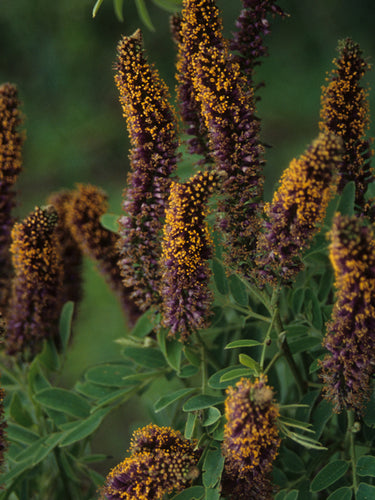
Amorpha fruticosa, the false indigo bush, is the largest and most widespread of the native false indigos, a fast, open, deciduous shrub that carries long spires of tiny deep blue-purple flowers, each lit with a single vivid orange anther, at the branch tips in late spring and early summer. From a suckering base rise arching stems six to twelve feet tall, clothed in soft, ferny, pinnate leaves that give off a clean, resinous scent when crushed. In full bloom the whole shrub seems to smoke with color, and the flower spikes hum with bees.
A plant of floodplains, streambanks, gravel bars, and swamp margins across most of the United States and into Canada and Mexico, the false indigo bush is one of the toughest and most adaptable of native shrubs, at home in wet ground and dry alike. The name Amorpha, from the Greek word for shapeless, marks the odd single-petaled flower, so unlike the usual winged pea blossom of the bean family to which the plant belongs. As a legume, false indigo fixes nitrogen at the roots and builds the poorest soils, and the foliage feeds the caterpillars of the silver-spotted skipper and several other native butterflies and moths.
In the garden, Amorpha fruticosa suits a wild or naturalistic planting, a streambank, a rain garden, a pond edge, or a tough sunny bank where the fast growth and suckering roots help bind the soil. The summer flower spikes feed bees and butterflies, and the shrub makes a fine screen or backdrop where room allows. Vigorous and free-seeding, false indigo can spread beyond bounds in the wrong place, and sale is restricted in a few states, so site the plant with that enthusiasm in mind and cut back the seed spikes where self-sowing is unwelcome.
Give the plant full sun to part shade and almost any soil, wet or dry, lean or rich, and false indigo asks for nothing more. Prune hard in late winter to keep the open habit in check and to draw out strong new flowering wood, and pull suckers or spent seed spikes to curb the spread. A tough, fast, pollinator-rich native shrub for the difficult, damp, or neglected corners of a large garden.
- Hardiness
- USDA Zones 4–9
- Sun
- Full Sun, Part Shade
- Soil
- Moist, Average, Well-drained
- Mature size
- Height 6–12 Feet · Spread 6–12 Feet
- Growth rate
- Fast
- Seasonality
- Deciduous
Deep blue-purple flower spikes with orange anthers, late spring to early summer
These statements have not been evaluated by the Food and Drug Administration. This information is shared for traditional and educational interest only and is not intended to diagnose, treat, cure, or prevent any disease. Please consult a qualified healthcare professional before any medicinal use.
- Historical and traditional use only
- Not evaluated for internal human use
- Seeds and foliage contain bioactive compounds that may be toxic if ingested
- Contains rotenoids noted for insecticidal activity
From rooting to shipping, our top priority is ensuring you receive healthy, thriving plants for your garden’s success.
Because most of our plants are grown from rooted cuttings — alongside seed, air layering, and grafting chosen for each variety — you receive a stronger, true-to-type plant that establishes quickly in your garden.
Raised on organic soil blends and eco-friendly pest management — never harsh chemicals — your plant arrives healthy for your garden, your family, and the pollinators they feed.
Every purchase gives back. We donate to the Aiken Arboretum and support local wildlife conservation, so growing your garden helps protect the wider ecosystem too.

All our plant material is carefully propagated, grown, and nurtured at our humble nursery in Aiken, South Carolina.

Your plant arrives carefully packed and ready to settle in. Unpack them promptly, give them a day or two to acclimate, then plant following the notes we include — that’s all it takes. Clear care guidance comes with every order, so success is the easy part.
What to expect upon delivery
All our plants are sold in 1-gallon sizes, though the height of each plant can vary depending on its growth rate and seasonality, typically ranging from 1/2 to 2.5 feet.
Each plant is carefully packaged with its roots enclosed in a secure plastic bag containing moist soil, forming a compact root ball. To ensure safe transport, the box is padded with recycled newspaper, providing both stability and eco-friendly protection from weather during shipping.
What is your return policy?
Review our full return policy information on our SHIPPING AND RETURNS POLICY page.
What payment methods can I use?
We offer 35 different payment methods including major providers like Mastercard, Visa, PayPal, American Express and Diners as well as many different local payment methods including Klarna, iDEAL, AliPay, Sofort, giropay, and many more.
Can I make changes to my order after it’s been placed?
At Woodlanders, we strive to fulfill orders as quickly as possible. Therefore, we can only accommodate changes to your order within the first 24 hours after it has been placed. These changes include adding or removing products and modifying the delivery address. If you need to make any changes or if there has been a mistake with your order information, please reach out to us promptly via our CONTACT page with your order number for the quickest resolution.
Your satisfaction is our priority, and we appreciate your understanding and cooperation.