


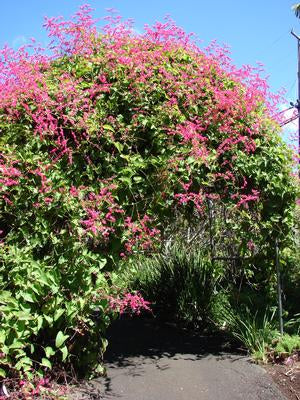

Coral Vine
Antigonon leptopus
In propagation
Currently rooting cuttings. Expected Winter 2028.
Add your name with the notify button below, and we will email you the moment this plant is ready to bring home.
Learn how we grow on The Prop House.
Pickup currently unavailable at Aiken Nursery
Few vines work as hard for as little as the coral vine. Antigonon leptopus comes out of Mexico with heart-shaped leaves, tendrils that grab any small object within reach, and long sprays of small papery flowers in a hot, slightly unreasonable pink from midsummer until frost stops the show. The flowers are borne in such quantity that the whole plant seems to fizz, and the common names have piled up accordingly: coral vine, queen's wreath, Mexican creeper, chain of love, and, in the Gulf South, confederate vine. Bees find the plant before you do.
Speed is the practical argument. In the Deep South this vine freezes to the ground most winters, returns from a tuberous root once the soil warms, and covers a trellis or a good stretch of fence in a single season, which makes the plant genuinely useful for anyone who needs a screen this year rather than in five. Only in frost-free gardens does the growth stay evergreen and woody. That tuber is worth knowing about for two reasons: the swollen root is what carries the vine through a Southern winter under mulch in a protected spot, and in Mexico the tubers are dug and eaten, growing surprisingly large with age.
The name is a small puzzle. Antigonon is usually read as Greek for against-angled or with-angles, apparently for the zigzag of the flowering stems, though botanists have never entirely agreed; leptopus is more straightforward, meaning slender-stalked, for the thin wiry stems that carry those heavy sprays of bloom. The family is Polygonaceae, which puts this vine in company with buckwheat, rhubarb, and the smartweeds, and once you know that, the papery flower parts stop looking like petals and start looking like the family trait they actually are.
Site the vine in full sun against a fence, an arbor, or an ugly chain-link run that needs disappearing, in ordinary well-drained soil, and give something thin for the tendrils to grip; the plant climbs by twining tendrils rather than clinging, so a smooth post is useless. Water through establishment and then very little. One honest caution comes with the vigor: in genuinely frost-free, humid climates, Florida and Hawaii among them, coral vine has escaped and is listed as an invasive, spreading by seed, tuber, root sucker, and stem fragment. Where winter cuts the plant to the ground each year, that risk largely disappears, but gardeners in zone 9b and warmer should site the vine where the tubers can be dug and the seedlings pulled, and should not plant near wild land.
- Hardiness
- USDA Zones 8–11
- Sun
- Full Sun
- Soil
- Well-drained
- Mature size
- Height 15–30 Feet · Spread 6–10 Feet
- Growth rate
- Fast
- Seasonality
- Dies back, depends on zone
- Provenance
- Cuttings taken on the Armstrong Campus, Savannah, Georgia, August 2026.
Long sprays of small papery hot-pink flowers, midsummer until frost
From rooting to shipping, our top priority is ensuring you receive healthy, thriving plants for your garden’s success.
Because most of our plants are grown from rooted cuttings — alongside seed, air layering, and grafting chosen for each variety — you receive a stronger, true-to-type plant that establishes quickly in your garden.
Raised on organic soil blends and eco-friendly pest management — never harsh chemicals — your plant arrives healthy for your garden, your family, and the pollinators they feed.
Every purchase gives back. We donate to the Aiken Arboretum and support local wildlife conservation, so growing your garden helps protect the wider ecosystem too.

All our plant material is carefully propagated, grown, and nurtured at our humble nursery in Aiken, South Carolina.

Your plant arrives carefully packed and ready to settle in. Unpack them promptly, give them a day or two to acclimate, then plant following the notes we include — that’s all it takes. Clear care guidance comes with every order, so success is the easy part.
What to expect upon delivery
All our plants are sold in 1-gallon sizes, though the height of each plant can vary depending on its growth rate and seasonality, typically ranging from 1/2 to 2.5 feet.
Each plant is carefully packaged with its roots enclosed in a secure plastic bag containing moist soil, forming a compact root ball. To ensure safe transport, the box is padded with recycled newspaper, providing both stability and eco-friendly protection from weather during shipping.
What is your return policy?
Review our full return policy information on our SHIPPING AND RETURNS POLICY page.
What payment methods can I use?
We offer 35 different payment methods including major providers like Mastercard, Visa, PayPal, American Express and Diners as well as many different local payment methods including Klarna, iDEAL, AliPay, Sofort, giropay, and many more.
Can I make changes to my order after it’s been placed?
At Woodlanders, we strive to fulfill orders as quickly as possible. Therefore, we can only accommodate changes to your order within the first 24 hours after it has been placed. These changes include adding or removing products and modifying the delivery address. If you need to make any changes or if there has been a mistake with your order information, please reach out to us promptly via our CONTACT page with your order number for the quickest resolution.
Your satisfaction is our priority, and we appreciate your understanding and cooperation.