


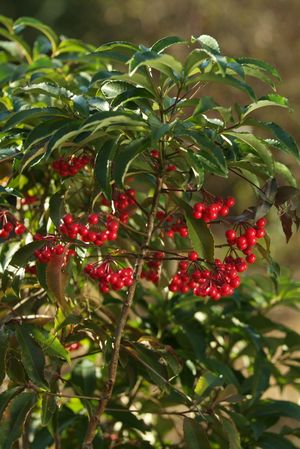

Coral Ardisia
Ardisia crenata
Pickup currently unavailable at Aiken Nursery
A small shrub built like a miniature tree, Ardisia crenata rises on one clean stem to two or four feet, occasionally six, and carries a single tier of glossy dark green leaves at the top like a parasol. The leaf margins are thick and scalloped, waved just enough to catch the light along the edge. Small white to pale pink stars hang in nodding clusters in late spring, lightly scented, and are followed by the reason anyone actually grows the shrub: tight bunches of round, lacquer-red berries that hold from autumn straight through to the next flowering.
Crenata means scalloped, for those wavy leaf edges, and the edges reward a close look for a second reason. A line of small swellings runs along every margin, and inside those nodules lives a bacterium, Candidatus Burkholderia crenata, which the shrub cannot live without and which lives nowhere else. The bacterium manufactures FR900359, a cyclic depsipeptide first isolated from this species in the 1980s and now one of the most valued tools in pharmacology, a selective inhibitor of Gq proteins used in laboratories worldwide. Very few garden plants arrive with a resident chemist.
In Chinese medicine the dried root is zhu sha gen, cinnabar root, named for the color of the fruit. The tradition uses the root to clear heat and to break blood stasis, to dispel wind and damp, and above all for the throat; among the Miao people of southwestern China the root is regarded first as a throat remedy, and Zhuang practitioners work with several relatives in the genus for related complaints. The chemistry underneath includes triterpenoid saponins alongside the celebrated depsipeptide, and those same compounds make the plant genuinely toxic to grazing livestock.
In the garden this is an outstanding container subject and a striking evergreen for shaded southern beds, where the berries carry December and the habit stays architectural without any pruning at all. Give part to full shade, moist well-drained soil with plenty of organic matter, and shelter from hard freeze. Now the necessary caution, which is not a small one: coral ardisia has naturalized aggressively across the Gulf South, was declared invasive in Florida in 1995, and was elevated to noxious weed status there in 2014. Birds carry the seed into hardwood hammocks, where dense stands crowd out the native understory. Grow this one in a pot, or in a garden well outside the Gulf Coastal Plain, and check your state regulations before ordering.
- Hardiness
- USDA Zones 8–10
- Sun
- Part Shade, Full Shade
- Soil
- Well-drained, Moist
- Mature size
- Height 2–4 Feet · Spread 2–3 Feet
- Growth rate
- Moderate
- Seasonality
- Evergreen
small white to pale pink star-shaped flowers in nodding clusters, late spring to early summer
These statements have not been evaluated by the Food and Drug Administration. This information is shared for traditional and educational interest only and is not intended to diagnose, treat, cure, or prevent any disease. Please consult a qualified healthcare professional before any medicinal use.
- All parts are toxic if eaten and have poisoned grazing livestock
- Keep fruit away from children and pets
- Saponin content makes this plant unsuitable for self-medication
- Not evaluated for safety in pregnancy or while breastfeeding
From rooting to shipping, our top priority is ensuring you receive healthy, thriving plants for your garden’s success.
Because most of our plants are grown from rooted cuttings — alongside seed, air layering, and grafting chosen for each variety — you receive a stronger, true-to-type plant that establishes quickly in your garden.
Raised on organic soil blends and eco-friendly pest management — never harsh chemicals — your plant arrives healthy for your garden, your family, and the pollinators they feed.
Every purchase gives back. We donate to the Aiken Arboretum and support local wildlife conservation, so growing your garden helps protect the wider ecosystem too.

All our plant material is carefully propagated, grown, and nurtured at our humble nursery in Aiken, South Carolina.

Your plant arrives carefully packed and ready to settle in. Unpack them promptly, give them a day or two to acclimate, then plant following the notes we include — that’s all it takes. Clear care guidance comes with every order, so success is the easy part.
What to expect upon delivery
All our plants are sold in 1-gallon sizes, though the height of each plant can vary depending on its growth rate and seasonality, typically ranging from 1/2 to 2.5 feet.
Each plant is carefully packaged with its roots enclosed in a secure plastic bag containing moist soil, forming a compact root ball. To ensure safe transport, the box is padded with recycled newspaper, providing both stability and eco-friendly protection from weather during shipping.
What is your return policy?
Review our full return policy information on our SHIPPING AND RETURNS POLICY page.
What payment methods can I use?
We offer 35 different payment methods including major providers like Mastercard, Visa, PayPal, American Express and Diners as well as many different local payment methods including Klarna, iDEAL, AliPay, Sofort, giropay, and many more.
Can I make changes to my order after it’s been placed?
At Woodlanders, we strive to fulfill orders as quickly as possible. Therefore, we can only accommodate changes to your order within the first 24 hours after it has been placed. These changes include adding or removing products and modifying the delivery address. If you need to make any changes or if there has been a mistake with your order information, please reach out to us promptly via our CONTACT page with your order number for the quickest resolution.
Your satisfaction is our priority, and we appreciate your understanding and cooperation.