


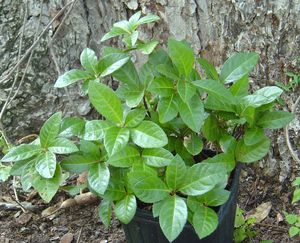

Marlberry
Ardisia japonica
Pickup currently unavailable at Aiken Nursery
Low, shining, and quietly territorial, Ardisia japonica travels on slender underground stems and knits a dense evergreen carpet eight to twelve inches high across ground that most groundcovers refuse. The leaves are gathered in loose whorls near the tips of the stems, glossy and finely toothed, dark enough to read as almost black in deep shade. Small white to pale pink stars nod beneath the foliage in midsummer, easy to miss unless you kneel, and the berries that follow ripen coral red and hang on through winter, often still bright when the next year's flowers open.
The genus name comes from the Greek ardis, the point of an arrow, for the sharply tapered anthers that give each little flower a dart at the center. Japonica is straightforward enough, though the true range runs wider than the name suggests, from Japan through Korea and into eastern and central China. Western gardeners have grown marlberry since the nineteenth century. Japanese growers have been at the work far longer, selecting a remarkable run of variegated and crested forms with names like 'Hakuokan' and 'Chirimen' that circulate among collectors as objects closer in spirit to bonsai than to bedding.
In Chinese medicine the dried whole plant is zi jin niu, and in the folk tradition of southern China the same herb answers to ai di cha, roughly "short ground tea," a name that catches both the low habit and the way the leaves were brewed. Practitioners have long turned to the herb for stubborn coughs and chronic bronchitis, to move phlegm and to break up what the tradition calls blood stasis. Modern chemistry has found bergenin, gallic acid, and a run of quercetin glycosides in the leaves, and laboratory work on the respiratory claims is ongoing rather than settled.
Marlberry belongs in the difficult places: the dry shade under a live oak, the strip beside a north foundation wall, the slope where liriope has started to look tired. Give the plants shade or high filtered light, soil with enough body to hold moisture, and steady water through the first two summers while the rhizomes find their bearings. Growth is slow at the start and then relentless, roughly six inches of spread a year, which makes marlberry a poor choice for anyone in a hurry and an excellent one for anyone building something permanent. Pair with hellebores, autumn fern, and Danae racemosa for a shade planting that never goes bare. One honest caution: Japanese ardisia has escaped cultivation in north Florida and carries a Category II listing from the Florida Invasive Species Council, so gardeners in that corner of the state are better served by partridgeberry or shiny blueberry.
- Hardiness
- USDA Zones 7–9
- Sun
- Part Shade, Full Shade
- Soil
- Well-drained, Moist
- Mature size
- Height 8–12 Inches · Spread 2–3 Feet
- Growth rate
- Slow
- Seasonality
- Evergreen
small white to pale pink star-shaped flowers nodding under the foliage, July to August
These statements have not been evaluated by the Food and Drug Administration. This information is shared for traditional and educational interest only and is not intended to diagnose, treat, cure, or prevent any disease. Please consult a qualified healthcare professional before any medicinal use.
- Not evaluated for safety in pregnancy or while breastfeeding
- Berries are ornamental and are not a food
- May interact with prescribed respiratory or anticoagulant medication
- Consult a qualified practitioner before use
From rooting to shipping, our top priority is ensuring you receive healthy, thriving plants for your garden’s success.
Because most of our plants are grown from rooted cuttings — alongside seed, air layering, and grafting chosen for each variety — you receive a stronger, true-to-type plant that establishes quickly in your garden.
Raised on organic soil blends and eco-friendly pest management — never harsh chemicals — your plant arrives healthy for your garden, your family, and the pollinators they feed.
Every purchase gives back. We donate to the Aiken Arboretum and support local wildlife conservation, so growing your garden helps protect the wider ecosystem too.

All our plant material is carefully propagated, grown, and nurtured at our humble nursery in Aiken, South Carolina.

Your plant arrives carefully packed and ready to settle in. Unpack them promptly, give them a day or two to acclimate, then plant following the notes we include — that’s all it takes. Clear care guidance comes with every order, so success is the easy part.
What to expect upon delivery
All our plants are sold in 1-gallon sizes, though the height of each plant can vary depending on its growth rate and seasonality, typically ranging from 1/2 to 2.5 feet.
Each plant is carefully packaged with its roots enclosed in a secure plastic bag containing moist soil, forming a compact root ball. To ensure safe transport, the box is padded with recycled newspaper, providing both stability and eco-friendly protection from weather during shipping.
What is your return policy?
Review our full return policy information on our SHIPPING AND RETURNS POLICY page.
What payment methods can I use?
We offer 35 different payment methods including major providers like Mastercard, Visa, PayPal, American Express and Diners as well as many different local payment methods including Klarna, iDEAL, AliPay, Sofort, giropay, and many more.
Can I make changes to my order after it’s been placed?
At Woodlanders, we strive to fulfill orders as quickly as possible. Therefore, we can only accommodate changes to your order within the first 24 hours after it has been placed. These changes include adding or removing products and modifying the delivery address. If you need to make any changes or if there has been a mistake with your order information, please reach out to us promptly via our CONTACT page with your order number for the quickest resolution.
Your satisfaction is our priority, and we appreciate your understanding and cooperation.