


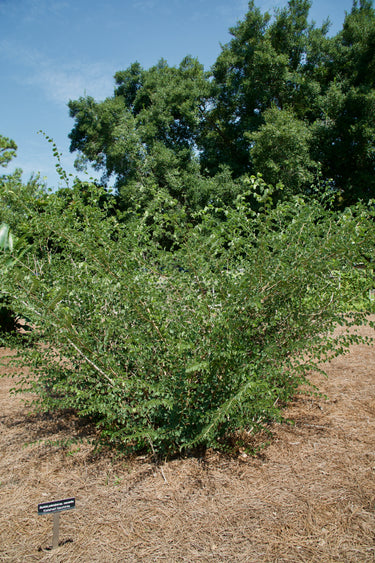


Kalahari Coffee Bauhinia
Bauhinia petersiana ssp. macrantha
In propagation
Currently rooting cuttings. Expected Winter 2028.
Add your name with the notify button below, and we will email you the moment this plant is ready to bring home.
Learn how we grow on The Prop House.
Pickup currently unavailable at Aiken Nursery
On the deep Kalahari sands, where a hard year brings barely fourteen inches of rain, this bauhinia grows as a spreading, half-scrambling shrub, now and then gathering enough height to pass for a small tree at twenty feet. The leaves give the genus away at a glance: two rounded lobes joined at the base, the shape everyone calls a camel's foot or a cow's hoof, blue-green and leathery enough to shrug off a dry season. Then, in summer, the shrub opens flowers that look too large and too fine for the country they came from, five crinkled white petals with a fringed, almost torn edge, carried in flushes that run on into autumn. In Botswana and Zimbabwe the grey louries and the parrots come to eat them.
The genus carries one of the better jokes in botanical naming. Bauhinia honors Jean and Gaspard Bauhin, sixteenth-century Swiss brothers and twin botanists, because the paired lobes of a single leaf sit together like two halves of one thing. Every bauhinia leaf you pick up is a small monument to a pair of siblings who catalogued plants in an age before anyone had agreed how that should be done. The species name remembers Wilhelm Peters, the German naturalist whose long expedition through Mozambique in the 1840s sent back a great deal of what Europe first knew of the region, and macrantha simply means large-flowered, which, set against the rest of the genus, is fair comment.
Coffee accounts for most of the common names. Roasted, ground, and brewed, the seeds make a drink close enough to the real thing that the plant travels as koffiebeesklou in Afrikaans, wild coffee bean in English, and Zambezi coffee in the seed trade. The rest of the shrub is nearly as useful: young pods are boiled and eaten as a green in the way of spinach, roots are baked, and the bark yields a serviceable rope. A therapeutic tradition sits alongside the kitchen one across Zimbabwe and Zambia, where the leaves are boiled for the steam and the cooled liquid taken for a cough, macerated roots are decocted for diarrhoea, and pounded leaves in salted water are sprinkled warm on wounds.
For American gardeners this is frankly a plant for zone 9 and warmer, and we would rather say so plainly than sell you a disappointment. Give the shrub the hottest, sharpest-drained ground you have, sand or a gravelly bank rather than anything that stays wet, and full sun; the plant asks for very little water once settled and flowers better lean than rich. One honest caution comes with the flowers, and that caution is cold. In 9a, site against a south-facing wall and keep frost cloth within reach. North of that, grow this bauhinia in a large container that can spend the winter under glass, which is no hardship for a shrub this drought-tolerant and this happy in a pot. Very few American nurseries have ever offered the plant at all, so growing one is also a quiet way of keeping an uncommon African shrub in cultivation on this side of the ocean.
- Hardiness
- USDA Zones 9–11
- Sun
- Full Sun, Part Shade
- Soil
- Well-drained
- Mature size
- Height 8–20 Feet · Spread 6–12 Feet
- Growth rate
- Medium
- Seasonality
- Semi-Evergreen
- Provenance
- Cuttings taken on the Armstrong Campus, Savannah, Georgia, August 2026.
Large crinkled white flowers with fringed petals, summer into autumn
From rooting to shipping, our top priority is ensuring you receive healthy, thriving plants for your garden’s success.
Because most of our plants are grown from rooted cuttings — alongside seed, air layering, and grafting chosen for each variety — you receive a stronger, true-to-type plant that establishes quickly in your garden.
Raised on organic soil blends and eco-friendly pest management — never harsh chemicals — your plant arrives healthy for your garden, your family, and the pollinators they feed.
Every purchase gives back. We donate to the Aiken Arboretum and support local wildlife conservation, so growing your garden helps protect the wider ecosystem too.

All our plant material is carefully propagated, grown, and nurtured at our humble nursery in Aiken, South Carolina.

Your plant arrives carefully packed and ready to settle in. Unpack them promptly, give them a day or two to acclimate, then plant following the notes we include — that’s all it takes. Clear care guidance comes with every order, so success is the easy part.
What to expect upon delivery
All our plants are sold in 1-gallon sizes, though the height of each plant can vary depending on its growth rate and seasonality, typically ranging from 1/2 to 2.5 feet.
Each plant is carefully packaged with its roots enclosed in a secure plastic bag containing moist soil, forming a compact root ball. To ensure safe transport, the box is padded with recycled newspaper, providing both stability and eco-friendly protection from weather during shipping.
What is your return policy?
Review our full return policy information on our SHIPPING AND RETURNS POLICY page.
What payment methods can I use?
We offer 35 different payment methods including major providers like Mastercard, Visa, PayPal, American Express and Diners as well as many different local payment methods including Klarna, iDEAL, AliPay, Sofort, giropay, and many more.
Can I make changes to my order after it’s been placed?
At Woodlanders, we strive to fulfill orders as quickly as possible. Therefore, we can only accommodate changes to your order within the first 24 hours after it has been placed. These changes include adding or removing products and modifying the delivery address. If you need to make any changes or if there has been a mistake with your order information, please reach out to us promptly via our CONTACT page with your order number for the quickest resolution.
Your satisfaction is our priority, and we appreciate your understanding and cooperation.